Offshore Virtual Assistants for Insurance Agencies:
What to Delegate and What to Keep In-House
An offshore insurance virtual assistant is a remote professional based outside the United States who handles the non-licensed, process-driven work of an insurance agency: policy servicing support, certificate requests, renewal preparation, data entry in your agency management system, billing follow-up and claims status tracking. They support your licensed team. They do not replace it, because advising, recommending coverage, negotiating and binding are licensed activities that stay with licensed staff.
That licensing line is the most important idea in this guide. Agencies that draw it clearly, write it into their procedures and protect client data properly can hand off a large share of their service workload. Agencies that skip it take on real regulatory and errors-and-omissions risk.
This guide covers what to delegate, what to keep, how to stay on the right side of licensing and data-security expectations, how to run workflows across time zones, what it costs, how to choose a provider and how to onboard in your first 30 days.
For the general picture of costs, pros and cons, and hiring models, read our complete guide to offshore virtual assistants. This article focuses on what is specific to insurance agencies.
Explore detailed breakdown of Savvital Offshore Virtual Assistant services
Why do insurance agencies consider offshore support?
Most agencies reach the same point. Service work grows with the book of business: certificates, endorsements, renewals, billing questions and claim status requests. Licensed producers and account managers end up spending time on tasks that don't need a license, and finding and keeping local entry-level staff is hard.
Offshore support addresses that in three ways:
• Capacity: The routine service queue gets a dedicated owner, so licensed staff can focus on advising, selling and relationships.
• Predictable cost: A flat monthly arrangement is easier to budget than adding payroll, taxes, benefits and equipment for a local hire.
• Continuity: One person who learns your procedures and systems reduces the repeated errors and dropped tasks that come with constant turnover.
None of this is automatic. Results depend on how clearly the work is defined, how well the person is trained on your systems and how well you supervise. Our guide to hiring an insurance virtual professional covers the general process. This article adds the offshore-specific questions.
If you're still deciding whether virtual support fits an agency at all, start with how virtual assistants help insurance agencies. It covers the case for delegation before location comes into it.
What is an offshore insurance virtual assistant?
An offshore insurance virtual assistant works remotely from another country on behalf of your agency. You may also see the role called an offshore customer service representative (CSR) for an insurance agency, an offshore account manager's assistant or an offshore insurance back-office assistant. The labels differ, but the core idea is the same: a trained person who handles agency service tasks in your systems under the supervision of your licensed team.
How this differs from a general virtual assistant:
• Industry vocabulary. They know terms such as endorsement, renewal, certificate holder, loss run and non-pay cancellation, or are trained on them.
• Systems. They work inside agency management and rating tools, not just email and calendars.
• Boundaries. They understand what unlicensed staff may and may not do.
For the full day-to-day picture of the role, see Insurance Virtual Assistance for Agencies.
For what the role looks like at Savvital, see its page for insurance agency virtual assistants and the Insurance Associate role. For a general overview of tasks, see What Does an Insurance Virtual Assistant Do?
The licensing line: what to delegate and what to keep
In general, selling, soliciting and negotiating insurance require a state license, while clerical and administrative work does not. Unlicensed staff generally work under the supervision of a licensed person. The exact boundary varies by state, so treat the table below as a starting point, not a legal answer.
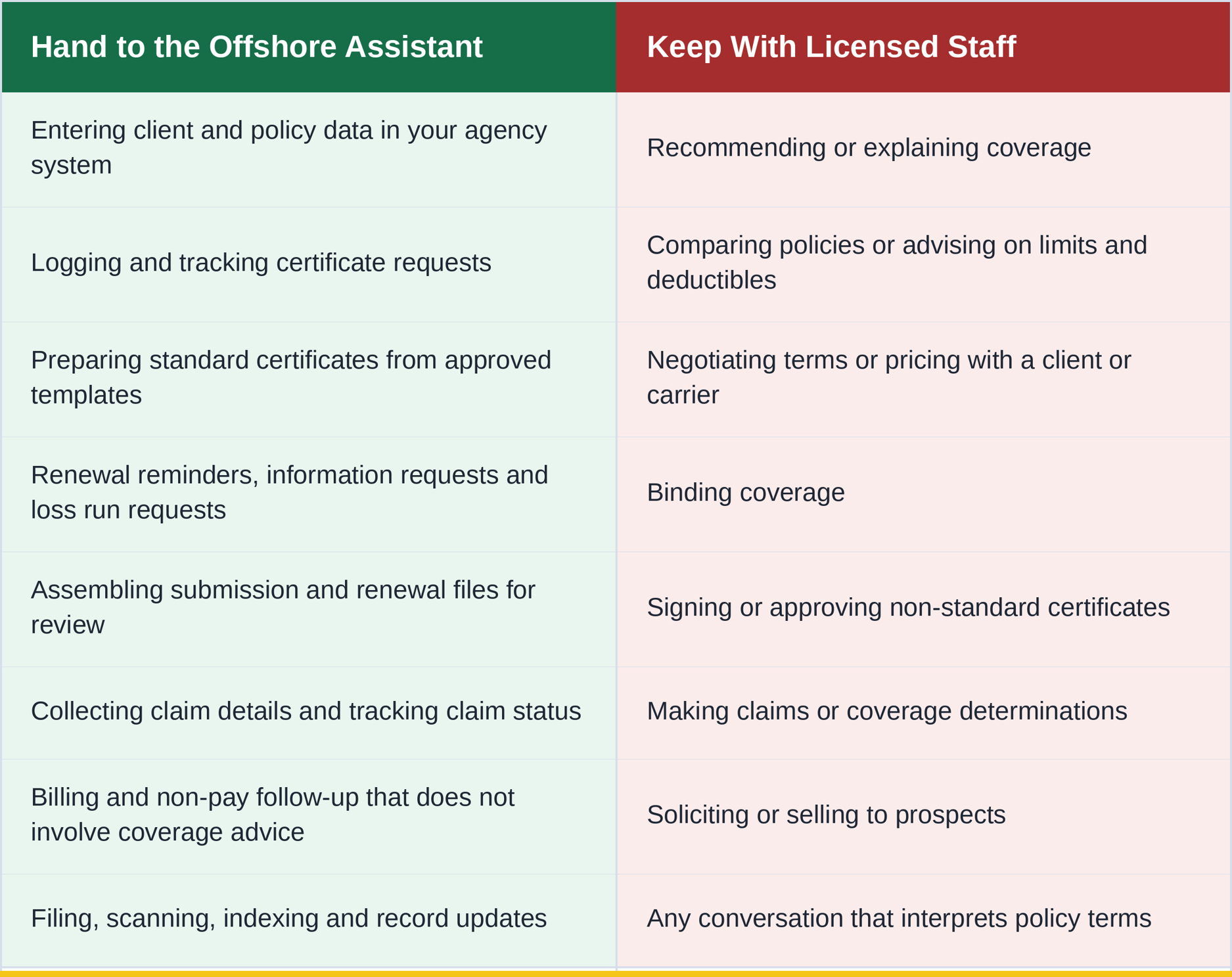
An offshore assistant can enter client and policy data in your agency system, log and track certificate requests, prepare standard certificates from approved templates, send renewal reminders and loss run requests, assemble submission and renewal files for review, collect claim details and track claim status, follow up on billing and non-pay notices that don't involve coverage advice, and handle filing and record updates.
Licensed staff keep recommending or explaining coverage, comparing policies and advising on limits and deductibles, negotiating terms or pricing, binding coverage, signing or approving non-standard certificates, making claims or coverage determinations, soliciting or selling, and any conversation that interprets policy terms.
Two practical rules help:
• If it involves advice, recommendation, interpretation of terms, negotiation or binding, it stays with licensed staff.
• If the assistant prepares and a licensed person reviews and decides, it is usually on the right side of the line. Still, check your state's rules.
Savvital's insurance page states that its assistants handle non-licensed work only, with binding, coverage advice and final placement decisions staying with the agency's licensed agents. Any provider you consider should be able to say the same, and show it in their procedures.
Gray areas and how to handle them
The line between clerical and licensed work is not always obvious, and there is no universal safe list. Train your assistant on the situations that most often cause trouble, and give them a simple rule: when in doubt, don't answer, hand it to a licensed person.
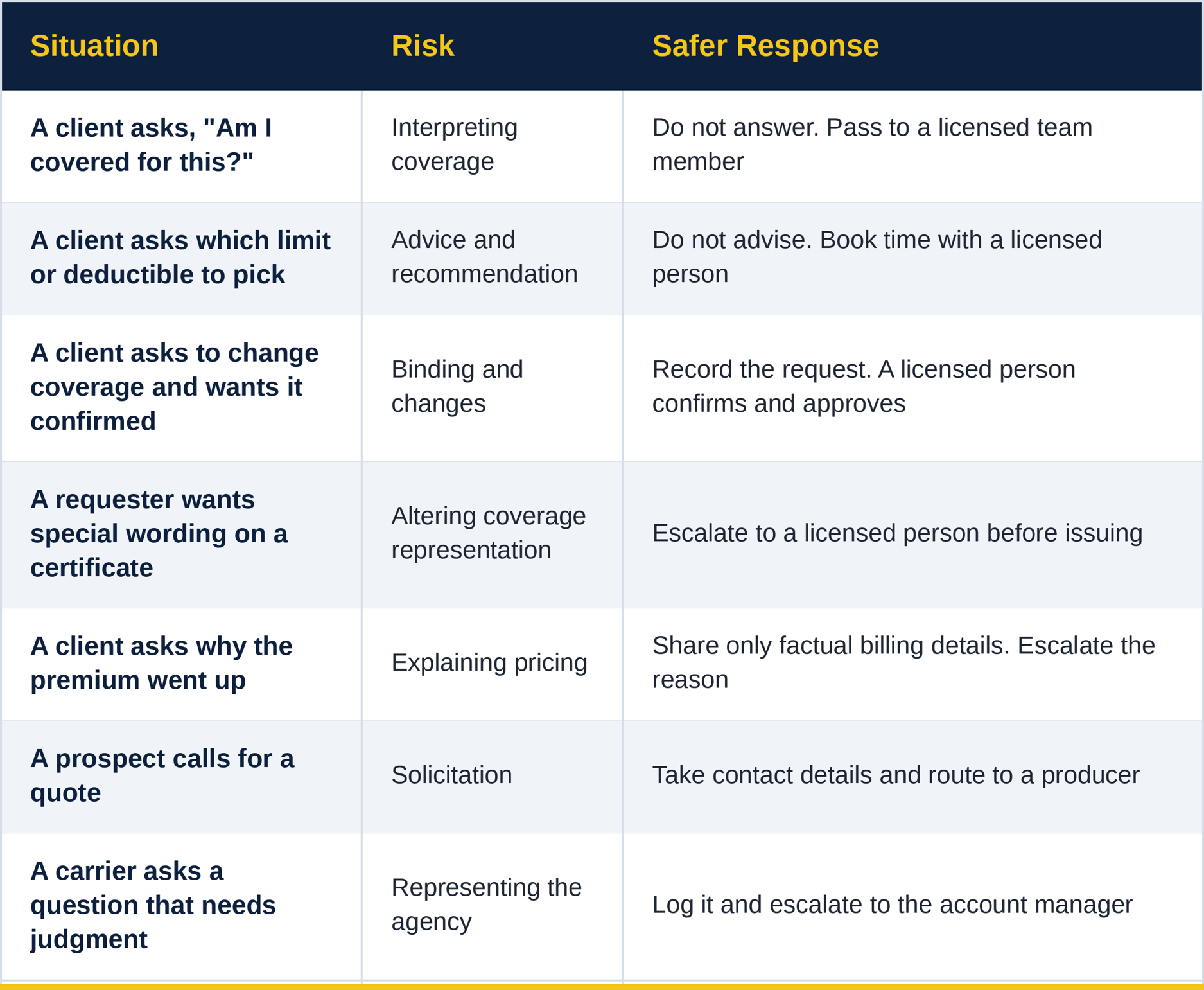
In short: if a client asks "Am I covered for this?", the assistant doesn't answer and passes it to a licensed team member. If a client asks which limit or deductible to choose, the assistant doesn't advise and books time with a licensed person. Coverage change requests are recorded, then confirmed and approved by a licensed person. Requests for special certificate wording are escalated before issuing. Questions about why a premium rose get only factual billing details, with the reason escalated. A prospect asking for a quote is routed to a producer, and a carrier question that needs judgment is logged and escalated to the account manager.
Write these into your procedures as scripts. For example, a standard line such as "I'll pass your question to a licensed team member who can help with that" lets the assistant respond helpfully without crossing the line.
Which insurance workflows can an offshore assistant support?
Think in workflows, not tasks. Each workflow below has a part an offshore assistant can prepare and a part your licensed team decides.
If you want a broader list to choose from, 10 tasks insurance agencies should outsource and insurance back-office tasks to outsource go through the options in more detail.
The assistant prepares and tracks; your licensed team decides anything involving coverage, terms or binding.
Certificates of insurance
Certificate requests are repetitive and time-sensitive. An assistant can log requests, prepare standard certificates from approved templates and send them to the requester. Who may issue or sign a certificate varies by state, and non-standard wording or additional insured terms should be approved by a licensed person. Confirm the rule with your licensed staff and regulator.
Policy servicing and endorsements
An assistant can collect change information from the client, enter it in your agency management system and prepare the request for carrier submission. A licensed person confirms that the change fits the client's exposure and approves anything non-routine.
Renewals
Renewals reward early, structured work. An assistant can monitor expirations, send reminders and information requests, request loss runs, chase signatures and assemble the renewal file. Remarketing decisions, quote comparisons and presenting terms stay with licensed staff.
New business and quote data entry
An assistant can enter client information into your rating tools and agency system and assemble supporting documents, so a producer reviews a complete submission instead of building it from scratch. Quoting, recommending coverage and binding stay with licensed staff.
Claims support
An assistant can collect claim information, record it, send it to the carrier, gather documents and track status so clients get updates. Claims decisions and coverage determinations belong to the carrier and your licensed team.
Billing and payment follow-up
Chasing premium payments, reconciling discrepancies and following up on non-pay notices are routine, checkable tasks. Handling payments on existing policies is generally clerical as long as coverage isn't discussed. Confirm your state's rule.
Forms and documentation
Preparing and filing standard forms, assembling audit documents, updating records and keeping files organised are strong fits for offshore support, with licensed review where the content has coverage implications. Back-office work like this is covered in more depth in insurance back-office tasks to outsource.
Calls and appointment setting
An assistant can answer routine calls, take messages and book appointments. They shouldn't discuss coverage, cost or terms while doing so. For more on phone coverage, see virtual receptionist services.
Agency systems and carrier portals
An offshore assistant is only as useful as the systems they can work in. Before you start, list:
• Your agency management system, such as Applied Epic, HawkSoft or AMS360.
• Rating and comparison tools, such as EZLynx or carrier rating portals.
• Carrier and MGA portals used for submissions, endorsements and downloads.
• Document, e-signature and communication tools.
Savvital's insurance page lists agency management and rating tools its assistants work in. Check that any provider has experience with yours, and test on your own system during the trial.
Carrier portal access needs care. Carrier and MGA agreements differ on who may have credentials, whether sub-user accounts are allowed and what supervision is required. Review each agreement before you grant access, and ask carriers if the terms are unclear. Don't share a producer's login.
Client data, privacy and security
Insurance agencies hold sensitive information: personal details, financial information, claims data and sometimes health information. Using an offshore team doesn't remove your obligations. It adds a vendor you are responsible for overseeing.
The rules that may apply
• Privacy and security rules for financial and insurance data. In the United States, the Gramm-Leach-Bliley Act's privacy requirements apply to insurance, and state insurance regulators enforce them. Many states have also adopted insurance data security laws based on the National Association of Insurance Commissioners (NAIC) model law. Under that model, licensees remain responsible for overseeing the third-party service providers that can access client information. The model includes exemptions for some small licensees, and state versions differ, so check yours.
• HIPAA, where health information is involved. If your agency handles protected health information, a virtual assistant who touches it is generally treated as a business associate, and a signed business associate agreement is expected before access. Savvital's insurance page states that a business associate agreement is signed for every client. For more, read HIPAA-Compliant Virtual Assistants for Insurance Agencies.
• Carrier, MGA and client contract requirements. Some agreements set their own security or location expectations.
Ask your advisor which of these apply to your agency and in which states.
Practical controls to put in place
Put these controls in place:
• Individual logins. Each person has their own account, so you can see who did what and nobody shares credentials.
• Role-based access. Limit access to the systems and data the role needs, which reduces exposure if something goes wrong.
• Multi-factor authentication. A second check at sign-in protects against stolen passwords.
• VPN or managed device. A secured connection to your systems helps keep data off unprotected networks.
• Audit logs. Records of access and changes support review and incident response.
• Confidentiality agreement. A written duty to protect client data sets clear expectations.
• Regular access reviews. Remove access that is no longer needed so permissions don't pile up.
Questions to ask any provider
• Where will my assistant work from, and can you confirm that in writing?
• Do you sign a business associate agreement and a written confidentiality agreement?
• What technical safeguards are in place (access controls, monitoring, VPN, endpoint protection)?
• How is access limited to the systems and data each role needs?
• What happens if there is a security incident, and who notifies whom?
• Can you support my carriers' and clients' security requirements?
Savvital states that its assistants work within HIPAA-compliant infrastructure with VPN and endpoint protection through a security partner. As with any provider, ask for the details in writing and check them against your own obligations.
Errors-and-omissions and carrier considerations
Delegating work doesn't delegate responsibility. If an assistant makes a mistake on a certificate, an endorsement or a renewal, the agency is still accountable. Reduce the risk with a few steps:
• Talk to your E&O carrier or broker about how outsourced or offshore support is treated under your policy, and whether anything needs to be disclosed. Don't assume.
• Document your procedures. Written standard operating procedures show what the assistant may do and what needs review.
• Build in supervisory review. Spot-check certificates, endorsement requests and renewal files, especially in the first weeks.
• Run accuracy checks. Stale or wrong policy records cause problems later.
• Keep an audit trail. Notes in your system show who did what and when.
Running agency workflows across time zones
Because an offshore assistant works in a different time zone, plan workflows around it. The point is to put the right work in the right hours.
• Overnight, process-driven work. Renewal preparation, data entry, document assembly, loss run requests and billing follow-up can be completed outside your hours and be ready for your licensed team in the morning.
• Live, same-hour work. Urgent client calls and anything needing an immediate licensed decision should have a clear owner in your hours.
• A written handoff. A short end-of-day note from the assistant ("done, in progress, blocked") and a start-of-day note from you keep the queue moving.
• A defined escalation route. Decide what counts as urgent, such as a certificate needed by a deadline or a lapse in coverage, and who the assistant contacts.
For practical ways to manage overlap, see Overseas Virtual Assistants.
Offshore, onshore or both for an insurance agency?
Many agencies end up with a mix: live, client-facing calls handled by local staff, and back-office service work handled offshore. If you're weighing this, our comparison of offshore vs onshore virtual assistants covers the trade-offs in detail. For administrative workloads specifically, see offshore administrative and executive assistants.
How much does an offshore insurance virtual executive cost?
Costs vary by provider, skill level and hiring model, and we don't quote a market range because published figures differ widely and are rarely independent. Instead, here is how to think about it.
• Compare with the full cost of a local hire: salary, payroll taxes, benefits, equipment, training and turnover.
• Count your licensed staff's time. The real cost of service work is the time producers and account managers spend on it instead of selling and advising.
• Use a break-even check: hours per week of delegable service work × the value of that time × about 4.3 weeks.
See pricing, the savings calculator and our guide to insurance virtual assistant cost in the USA.
7uhm
How to choose an offshore provider for insurance work
Beyond the general criteria in the pillar guide, look for:
• Insurance-trained assistants, not generalists you must teach from scratch.
• Experience in your agency management system and rating tools.
• A clear licensing boundary, written into their procedures and onboarding.
• A signed business associate agreement and confidentiality terms.
• Documented security controls, with details you can verify.
• A replacement and backup policy, so claims and renewals aren't stranded when someone is out.
• Published pricing, a trial or guarantee and flexible terms.
• Willingness to confirm where assistants work.
For the general hiring process, see How to Hire an Insurance Virtual Assistant.
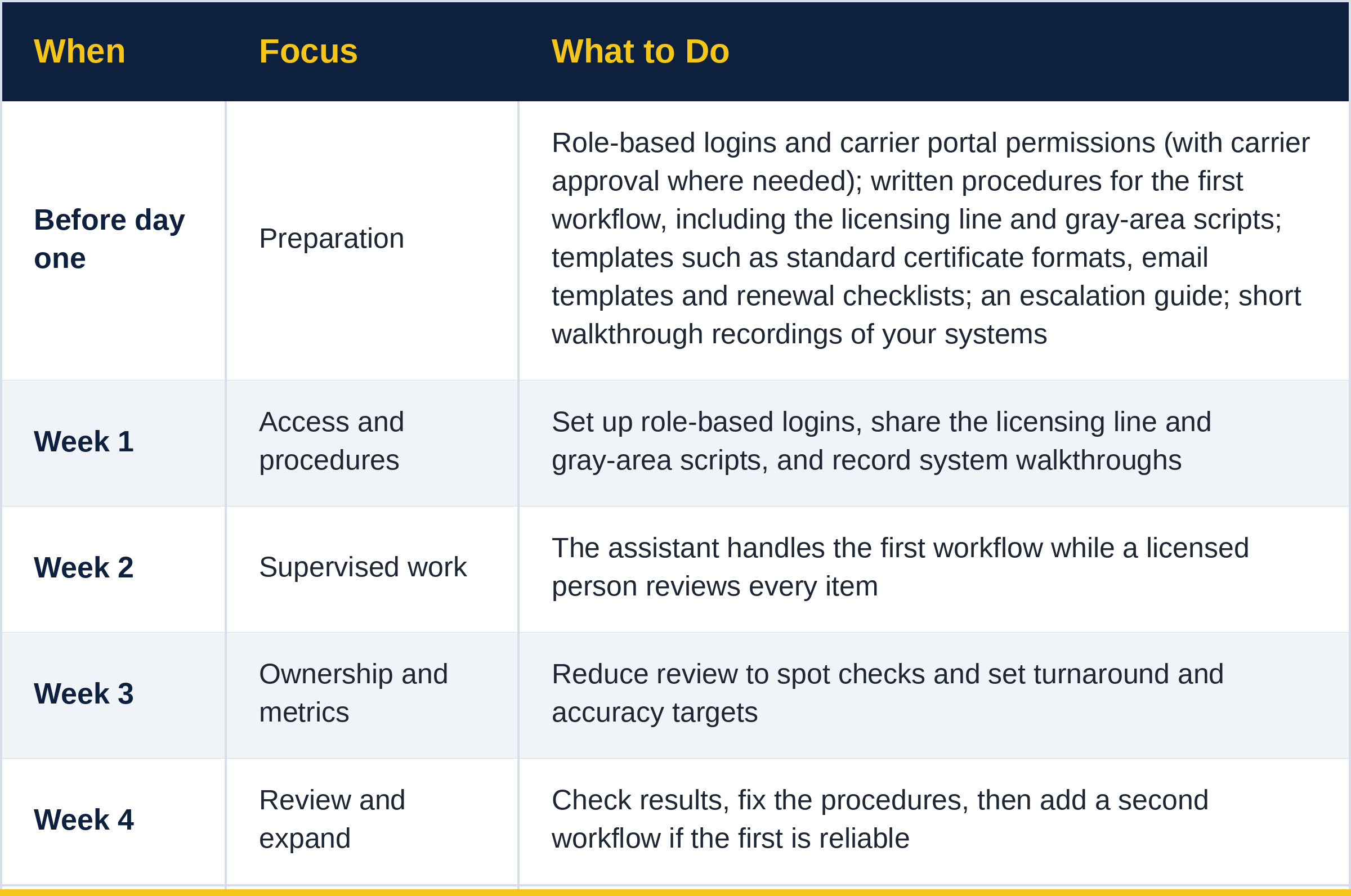
Your first 30 days
Start narrow and expand. A good first workflow is one that is high-volume, rule-based and easy to review, such as certificate requests or renewal preparation.
How to measure success
Choose a few measures at the start so the review is based on evidence.
• Certificate turnaround: time from request to certificate sent, within the agreed window.
• Renewal tasks on time: share of renewal steps finished by their due date.
• Data accuracy: spot-check entries in your agency system; corrections should be few and falling.
• Follow-up completion: billing and information requests closed out, with nothing left open without a reason.
• Escalation quality: gray-area items passed on correctly, with no coverage questions answered by the assistant.
• Licensed staff time recovered: hours your team spends on service work before and after, shifting toward advising and selling.
Review monthly. If errors persist or supervision time stays high, adjust the procedures, training or provider before adding more work.
Common mistakes
• Not defining the licensing boundary in writing.
• Letting the assistant answer coverage questions because it feels quicker.
• Sharing a producer's login instead of using proper access.
• Skipping the carrier agreements before giving portal access.
• No supervisory review, especially in the first weeks.
• Ignoring data obligations because "the vendor handles it".
• Handing over everything at once instead of starting with one workflow.
• Choosing on rate alone and ignoring insurance experience and replacement terms.
• Not talking to your E&O carrier about how outsourced support is treated.
Never Miss Another Business Call
If missed calls are costing you leads, a dedicated virtual assistant can answer, screen, and route them, without you needing to be at your desk.
See current Savvital pricing →
Offshore Virtual Assistant Services →
Explore the Insurance Virtual Assistant service →
More on insurance agency support
• How virtual assistants help insurance agencies
• Insurance Virtual Assistance for Agencies
• What Does an Insurance Virtual Assistant Do?
• 10 tasks insurance agencies should outsource
• Insurance back-office tasks to outsource
• Insurance virtual assistant cost in the USA
Keep reading in this series
- Offshore Virtual Assistants: What They Do, What They Cost, and How to Hire One
- Overseas Virtual Assistants: How to Choose, Vet and Work With One
- Offshore vs Onshore Virtual Assistant
- Offshore Virtual Assistants for Insurance Agencies
Frequently Asked Questions
What is an offshore insurance virtual assistant?
A remote professional based outside the U.S. who handles non-licensed agency work, such as policy servicing support, certificate requests, renewal preparation, data entry and billing follow-up, under the supervision of your licensed team.
What can an offshore insurance executive do?
They can prepare and process routine service work (see what an insurance virtual assistant does for the general task list): logging requests, entering data in your agency system, preparing standard documents, following up on renewals and payments and tracking claim status. Advising, recommending coverage, negotiating and binding stay with licensed staff.
Does an offshore insurance assistant need to be licensed?
Not for clerical and administrative work, which is generally the scope of an assistant. Selling, soliciting and negotiating generally require a license, so those tasks stay with licensed staff. Rules vary by state, so confirm with your state department of insurance.
Can an offshore assistant issue certificates of insurance?
They can usually log requests, prepare standard certificates from approved templates and send them. Who may sign or issue a certificate varies by state, and non-standard wording should be approved by a licensed person. Confirm the rule for your state.
Is it allowed to use offshore staff in an insurance agency?
Requirements vary by state, carrier and client contract, so confirm with your state insurance department, your carriers and an attorney before you start.
How do I keep client data secure with an offshore assistant?
Use individual logins, role-based access, multi-factor authentication, secure connections, audit logs and written confidentiality agreements, and review access regularly. Your obligations may include state insurance data security laws and, where health information is involved, HIPAA.
Do offshore assistants need a business associate agreement?
If the assistant can access protected health information, a business associate agreement is generally expected before access. Ask your provider and your advisor.
Should I use offshore support for client calls?
Many agencies keep live client calls with local staff and use offshore support for back-office work. If an assistant answers calls, they should not discuss coverage, cost or terms. See offshore vs onshore virtual assistants.
Published on 20 Oct 2026
Author: Noor Ul Ain Liaqat