Insurance Policy Renewal and Servicing
A missed renewal does not just cost an agency a client. It can mean a lapse in coverage, a frustrated call, and in the worst cases, real exposure if something happens during the gap. Policy renewal and servicing is high volume, deadline driven work, and it is exactly the kind of task a dedicated virtual assistant is built to keep organized. This guide covers what insurance policy servicing involves, how the renewal process works step by step, and what a policy renewal management virtual assistant does to keep it all on track.
What Is Insurance Policy Servicing?
Insurance policy servicing covers everything that happens to a policy after it is written: endorsements, mid term changes, renewals, cancellations, and the ongoing client communication that goes along with all of it. It is different from selling a new policy, since the work here is about maintaining an existing client relationship correctly rather than closing a deal. For agencies with a growing book of business, servicing is usually the larger share of day to day work, even though it gets far less attention than new sales.
The Insurance Policy Renewal Process, Step by Step
A well run renewal follows a consistent process, whether it happens automatically through a carrier or is actively managed by the agency:
1. Review the current policy and declarations page. Coverage limits, exclusions, and any endorsements added during the term all need to be confirmed before the renewal moves forward.
2. Evaluate changes since the last term. New equipment, staff, locations, or other business and life changes can affect what coverage is actually needed.
3. Review loss history and claims. Carriers reassess risk at renewal, and prior claims can affect pricing or terms, so this needs to be understood before the client is contacted.
4. Decide whether to remarket the policy. If the current carrier's renewal terms are not competitive, shopping the policy to other carriers may be worth the effort.
5. Confirm the client, finalize the renewal, and update records. Once terms are set, the renewal needs to be documented and the agency management system updated so nothing falls out of sync.
Each of these steps is straightforward on its own. What makes renewal work genuinely difficult at scale is doing all five, correctly, for every policy in the book, on time, every single cycle.
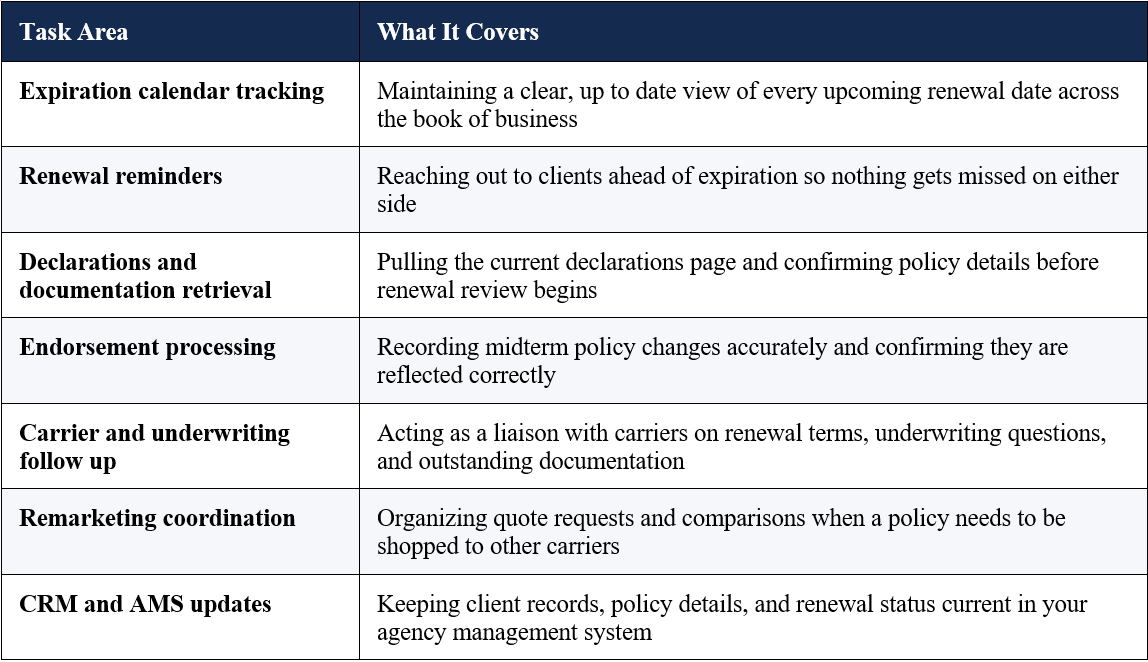
Tasks of Policy Renewal Management Virtual Assistant
Why Missed Renewals Are an E&O Risk, Not Just a Retention Problem
It is easy to think of a missed renewal purely as a lost client. The bigger risk is errors and omissions exposure, often shortened to E and O. If a policy lapses because a renewal was not processed in time, and a loss occurs during that gap, the agency can face real liability for the missed deadline, separate from whatever happened to the client. Renewal tracking is not just a client service nicety. It is risk management for the agency itself.

Renewal Workflow Coordination Across Your Book of Business
As a book of business grows, renewal dates stop being something a producer can track from memory or a sticky note. Renewal workflow coordination means keeping a single, reliable expiration calendar, standardizing how renewal reminders go out, and making sure carrier communications and documentation stay attached to the right policy. A policy renewal management virtual assistant owns this coordination directly, which is often the difference between a book of business that runs smoothly and one where renewals slip through during busy periods.
Policy Renewal VA vs. Automated Renewal Software
Some agencies try to solve renewal tracking with software alone: automated reminder emails, dashboard alerts, expiration tracking built into the agency management system. Automation helps, but it does not replace judgment. Software can flag that a renewal is coming up. It cannot review the declarations page for accuracy, decide whether a policy should be remarketed, or have the actual conversation with a client about a coverage change. The strongest setups use both: automated tracking to make sure nothing is missed, and a dedicated person who actually works the renewal once it is flagged.
Read our guide on INSURANCE CLAIMS PROCESSING VA
What to Look for When Hiring a Policy Renewal and Servicing VA
• Direct experience with renewal workflows, not just general administrative support
• Familiarity with your agency management system and carrier portals
• A clear process for flagging policies that need broker attention, such as a significant coverage gap or a remarketing decision
• HIPAA compliant infrastructure and a signed BAA if the book of business includes health or benefits policies
• A defined onboarding period, ideally 5 to 10 business days, to learn your specific renewal cadence and carriers
How Onboarding a Policy Renewal VA Works
Onboarding typically starts with access to your agency management system and carrier portals, followed by a walkthrough of your current renewal calendar and how far in advance your agency likes to start the process. Most agencies begin the insurance virtual assistant on a subset of upcoming renewals to confirm accuracy in tracking, documentation, and client communication before handing over the full expiration calendar. From there, the VA becomes the consistent point of ownership for renewal tracking across the book of business.
A Reliable Renewal Process Protects the Whole Agency
Renewal and servicing work will never be the most visible part of running an agency, but it is one of the most consequential. A client rarely notices a renewal that goes smoothly. They absolutely notice one that does not. Treating renewal tracking as a dedicated, owned function, rather than something producers handle in the gaps between other work, is what keeps a growing book of business organized instead of exposed.
Frequently Asked Questions
What does a policy renewal management virtual assistant do?
They track expiration dates, send renewal reminders, retrieve declarations pages, process endorsements, follow up with carriers on underwriting questions, and keep your agency management system updated. The goal is to make sure every renewal moves through the process on time and accurately
What is the difference between policy servicing and policy renewal?
Policy servicing is the broader category, covering endorsements, mid term changes, cancellations, and renewals together. Renewal specifically refers to extending a policy for a new coverage term. Renewal is one part of servicing, not the entire scope of it.
Why are missed renewals considered an E&O risk?
If a policy lapses because a renewal was not processed and a loss occurs during that gap, the agency can face errors and omissions liability for the missed deadline. This makes renewal tracking a risk management function for the agency, not just a client service task.
Can automated renewal software replace a renewal virtual assistant?
Not entirely. Automated reminders and dashboards help flag upcoming renewals, but they cannot review a declarations page for accuracy, decide whether to remarket a policy, or handle the client conversation. Most agencies get the best results combining automated tracking with a dedicated person managing the process.
How long does it take to onboard a policy renewal VA?
Most agencies see a working relationship established within 5 to 10 business days, covering system access and a walkthrough of the current renewal calendar. Many start the VA on a subset of renewals first to confirm accuracy before transferring the full expiration calendar.
Published on 17 Aug 2026
Author: Noor Ul Ain Liaqat