A missed call is rarely just a missed call. For a small business owner, it's a potential client who hangs up and calls the next name on the list, or an existing customer who assumes nobody's picking up anymore. Virtual receptionist services exist to close that gap, handling incoming calls so an owner isn't the one scrambling for the phone between meetings.
Troy Thompson, President & CEO of Savvital, has talked about this firsthand. On the Risk and Resilience Podcast, he described how his own calls get forwarded to his executive assistant, Diane, who answers by identifying herself clearly: "This is Troy Thompson's phone, I'm Diane, his executive assistant," then relays who called and why through Slack. It's a small routine, but it means Troy is never the bottleneck between a ringing phone and a client getting an answer.
Savvital also owns Pinnacle Insurance Agency of Minnesota in Coon Rapids, so Troy's perspective on this isn't theoretical, it's drawn from running both a virtual-assistant company and an insurance agency where missed calls carry a real cost.
What Is a Virtual Assistant Phone Answering Service?
A virtual assistant phone answering service is a remote professional who answers, screens, and routes a business's incoming calls, acting as the first point of contact instead of voicemail or an automated system. Calls are typically forwarded to the virtual assistant's line, who answers on the business's behalf, takes a message or resolves the request, and passes along anything that needs the owner's direct attention.
This is different from a traditional answering service in one key way: continuity. Rather than a rotating pool of unfamiliar agents reading from a script, a dedicated virtual assistant learns the business, the common questions, and how the owner wants things handled, the same way Diane has learned how Troy wants his calls managed.
How Does a Virtual Assistant Call Answering Service Work?
In practice, a virtual assistant call answering service runs on simple call forwarding. The business's main line, or a dedicated number, is routed to the assistant, who answers using the business's name and handles the call much like an in-house receptionist would. Troy described this exact setup on the podcast, noting that Diane uses RingCentral to manage his calls and coordinate follow-ups.
Most setups fall into one of three patterns:
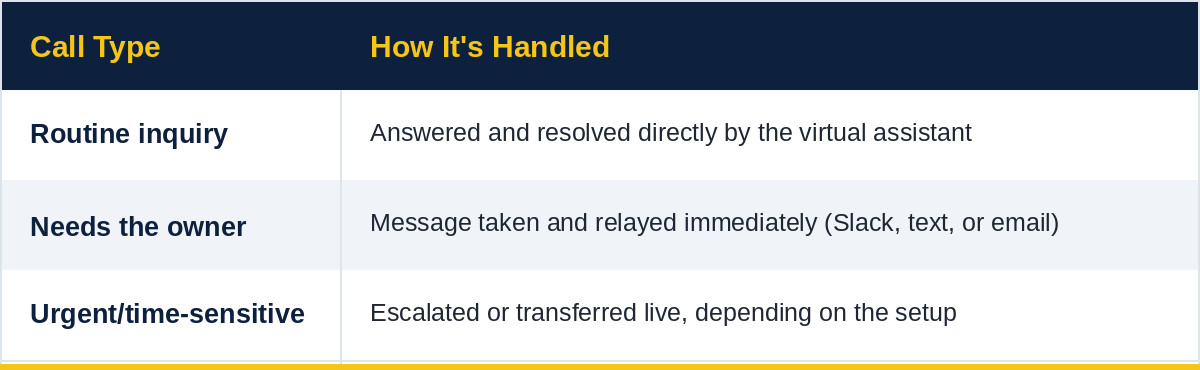
A virtual assistant answering service works best when there's a clear, agreed process for which calls get escalated and which get handled independently, the same ongoing-communication model Troy stressed applies to every task he hands off, not just phone calls.
Why Response Time on Missed Calls Matters
A virtual assistant telephone answering service solves a problem that's easy to underestimate: how quickly a business responds to a first call. Research on inbound sales calls has repeatedly shown that response speed correlates strongly with conversion, callers who reach someone immediately are far more likely to become customers than callers sent to voicemail. [I don't have a verified, specific source or percentage for this claim handy, so treat it as a general trend rather than a cited statistic, worth checking a primary study if you want a number for the post.]
For an insurance agency specifically, this matters even more. A prospect calling about a quote, or an existing client calling about a claim, is often comparing options in real time. If the call isn't answered, they move to the next name on their list. Savvital's insurance-specific virtual assistant service is built around exactly this kind of responsiveness, pairing call handling with the account-specific training an insurance office needs.
What to Look for in a Virtual Receptionist Company
Not every virtual receptionist company operates the same way, and the differences matter once you're relying on them for client-facing calls.
A few things worth checking before committing:
- Dedicated vs. shared staff. A dedicated assistant who learns your business, like Diane learning Troy's calendar and contacts, handles calls more naturally than a shared pool answering for dozens of different businesses.
- Training and oversight. Ask how the provider trains assistants on your specific business and who manages quality over time.
- Tools and integration. Confirm the service works with however you already take calls and track messages, whether that's RingCentral, a CRM, or something else.
- Security practices. For regulated industries like insurance, ask about data-handling and compliance, not just call-answering speed.
This is also where a managed service tends to differ from a freelance hire, a distinction covered in more depth in Savvital's freelance VA vs. managed service comparison.
Does This Work for Insurance Agencies Specifically?
Yes. An insurance agent answering service has to handle a mix of routine and sensitive calls, renewal questions, claims, new quotes, so consistency matters more than in most industries. Troy's own agency, Pinnacle Insurance, runs on the same virtual-assistant model Savvital sells, which is part of why the approach is built around insurance workflows specifically rather than adapted from a generic answering-service template. More on how the cost breaks down for agencies is covered in How Much Does a Virtual Assistant Cost for an Insurance Agency?
Diane's call-handling routine is one part of a broader role, she also manages Troy's calendar, email, and task list. The fuller picture of what that looks like is covered in What Does a Virtual Assistant Do?
Explore More From This Series: Troy Thompson has joined multiple podcasts to talk about how Savvital works, here's the full lineup, organized by topic and show.
- How Much Does a Virtual Assistant Cost for an Insurance Agency? — Bricks and Risk
- Freelance VA vs. Managed Service Provider — Bricks and Risk
- What Does a Virtual Assistant Do? — Risk and Resilience
Never Miss Another Business Call
If missed calls are costing you leads, a dedicated virtual assistant can answer, screen, and route them, without you needing to be at your desk.
Frequently Asked Questions
Is a virtual phone assistant the same as a virtual receptionist?
Largely, yes, both terms describe a remote professional who answers business calls on your behalf. "Virtual receptionist" tends to describe the role more broadly, while "virtual phone assistant" sometimes implies a narrower focus on call handling specifically, without the broader administrative tasks a fuller virtual assistant role would include.
How is this different from a regular answering service?
A traditional answering service usually routes calls to whichever agent is available, often reading from a general script. A dedicated virtual assistant, like the model Savvital uses, learns the specific business and handles calls with that context, closer to an in-house receptionist than a call center.
Can a virtual receptionist handle calls for a regulated industry like insurance?
Yes, with the right provider. Look for HIPAA-compliant infrastructure and signed data-handling agreements if you're in insurance, healthcare, or another regulated field, this is worth confirming directly with any provider rather than assuming it's included.
Published on 1 Oct 2026
Author: Noor Ul Ain Liaqat