Claims work is some of the most time consuming, detail heavy administrative work an insurance agency handles, and it rarely lets up. An insurance claims processing virtual assistant exists to take that workload off a broker's plate without the cost of a full time claims employee. This guide covers exactly what a claims processing VA does, how insurance claims outsourcing actually works from first notice of loss through resolution, and what to check before you hire one.
What Is an Insurance Claims Processing Virtual Assistant?
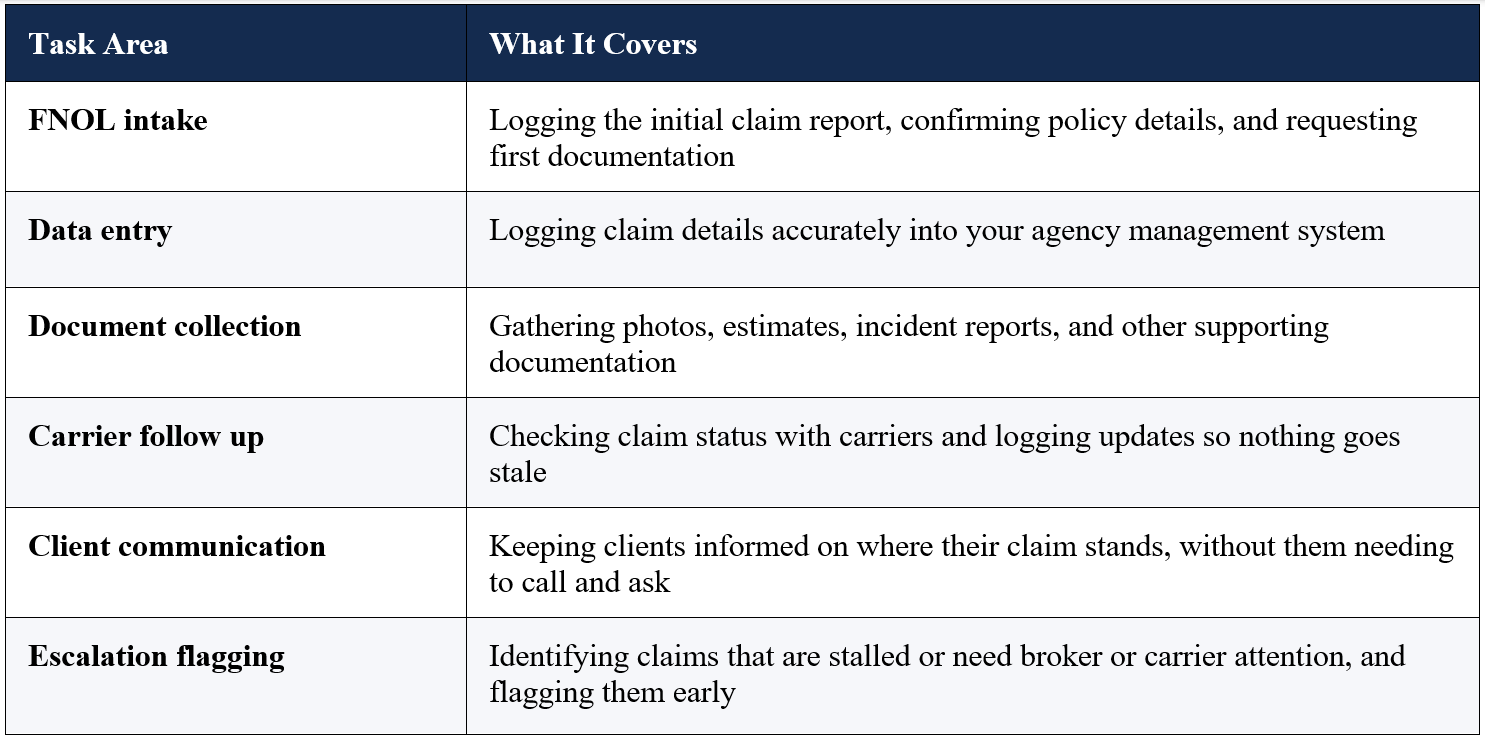
An insurance claims processing virtual assistant is a remote professional who handles the administrative side of a claim from intake through resolution: gathering documentation, entering claim details into your agency management system, following up with carriers on status, and keeping clients informed along the way. They do not adjust claims or make coverage decisions. That authority stays with the carrier and, where applicable, a licensed adjuster. What a claims processing VA removes is the manual coordination work that eats hours without requiring a license to complete.
What Is FNOL, and Why It Is Where Claims Processing Starts
First Notice of Loss, almost always shortened to FNOL, is the industry term for the moment a client first reports a claim. It is also the starting point for nearly everything a claims processing VA does. When a client calls or emails to report a loss, the VA opens the claim file, confirms policy details, requests the initial documentation such as photos or incident reports, and logs the FNOL into your agency management system so the clock starts on tracking it properly.
Getting FNOL intake right matters more than it might seem. A claim that is logged late, or logged with missing details, tends to stay slow for its entire lifecycle, since carriers and adjusters are working from whatever was captured at the start. A dedicated claims processing VA who handles FNOL intake consistently, the same way every time, is often the single biggest factor in whether a claim moves smoothly or stalls early.
What Does an Insurance Claims Processing VA Actually Do?
Insurance Claims Processing VA vs. Outsourcing to a BPO or TPA
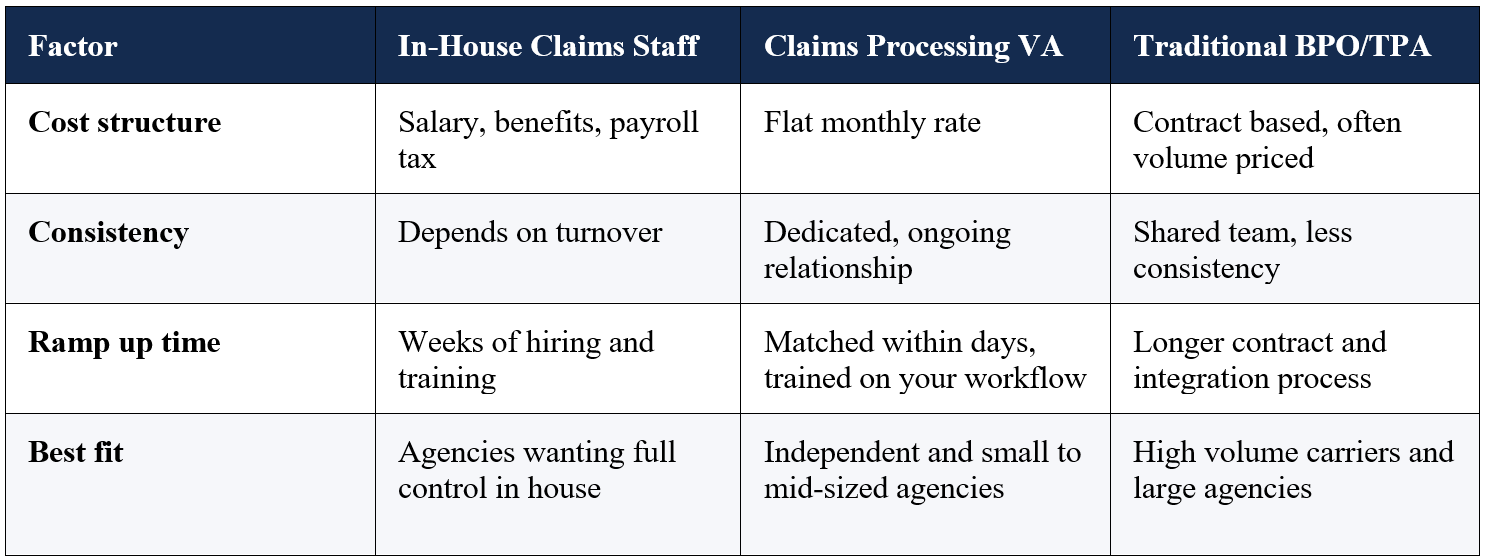
Claims processing outsourcing is not a new idea. Larger carriers and agencies have long used third party administrators, known as TPAs, and specialized claims BPO companies to handle claims volume at scale, sometimes with full adjusting authority written into the contract. A dedicated claims processing virtual assistant is a different model: instead of routing your claims through a large, shared operation, you get a specific person who learns your agency, your carriers, and your clients, and works inside the systems you already use rather than a system the outsourcing company owns.
For most independent and small to mid sized agencies, that distinction matters. A TPA relationship makes sense at high volume with dedicated contract terms. A claims processing VA fits the agency that wants the administrative relief without handing over the client relationship to a third party's branding or process.
Why Claims Processing Is One of the First Tasks Agencies Delegate
Claims work tends to be the first thing agencies hand off for a simple reason: it is high volume, repetitive, and time sensitive, but it does not require the broker's specific judgment to move forward. A claim that sits untouched for a few days because no one had time to follow up with the carrier creates real client frustration, and that frustration reflects on the broker even when the delay is the carrier's fault, not the agency's.
This is also a proven category. Several firms in the remote insurance staffing space, including direct competitors, already offer dedicated claims processing support, which signals real, established demand rather than an unproven idea.

In-House Claims Staff vs. Virtual Claims Processing Assistant vs. BPO
How to Hire an Insurance Claims Processing VA
Hiring for this role goes smoother when you treat it as a short process rather than a single decision. Here is what that process actually looks like:
- Define what you are delegating first. Most agencies start with FNOL intake and carrier follow up specifically, rather than handing over the entire claims workflow on day one. A narrower starting scope makes it easier to judge whether the fit is right.
- Shortlist providers against clear criteria. At minimum, confirm HIPAA compliant infrastructure with a signed BAA available on request, direct experience with insurance specific systems and carrier portals, and a track record supporting agencies similar in size to yours.
- Ask how escalation works before you sign anything. A good provider can explain exactly how a stalled or complicated claim gets flagged back to you, not just how routine claims get processed.
- Confirm the onboarding timeline. A realistic process runs 5 to 10 business days and includes system access, carrier portal logins, and a walkthrough of your current claims workflow, not a generic training course unrelated to your agency.
- Start with a smaller claims volume. Run the VA on a limited set of claims first to confirm accuracy and communication quality before transferring your full claims queue.
- Review after 30 days. Check claim turnaround time, client complaints related to claims status, and whether escalations were flagged appropriately, then decide whether to expand scope.
What to Look for When Hiring an Insurance Claims Processing VA
• HIPAA compliant infrastructure and a signed BAA available on request, since claims often involve protected health information
• Familiarity with agency management systems and carrier portals, so documentation stays organized in the systems you already use
• A clear escalation process, so claims that need broker attention get flagged rather than sitting quietly
• A defined onboarding period, ideally 5 to 10 business days, to learn your specific carriers and workflows
• Dedicated support rather than a rotating pool of contractors handling different claims each time
How a Claims Processing VA Fits Into Your Existing Systems
A claims processing VA should work inside the software and portals your agency already uses, not require you to adopt a new system just to delegate this task. That means logging into your existing agency management platform, using your established carrier portal logins, and following the documentation process your agency already has in place. The goal is fewer gaps in your workflow, not an additional layer to manage.
Read our full guide to What is Insurance Operations Support
Onboarding a Claims Processing VA: What to Expect
A realistic onboarding process starts with access: carrier portal logins, your agency management system, and a walkthrough of how your agency currently handles FNOL intake and follow up. From there, most agencies start the VA on a smaller volume of claims to confirm the workflow is accurate before handing over the full claims queue. Within the first two weeks, most agencies see a clear pattern emerge: claims move through the process faster simply because someone is following up on a consistent schedule instead of whenever a producer has a spare moment.
Frequently Asked Questions
What does an insurance claims processing virtual assistant do?
They handle the administrative side of a claim, from FNOL intake and data entry through carrier follow up and client updates. They do not adjust claims or make coverage decisions, which remain with the carrier and any licensed adjuster involved. Their role is coordination and communication, not claims authority.
What does FNOL mean in insurance claims processing?
FNOL stands for First Notice of Loss, the moment a client first reports a claim. It marks the starting point for claims processing, including confirming policy details and requesting initial documentation. Getting FNOL intake accurate and timely has a major impact on how smoothly the rest of the claim moves.
Is a claims processing VA the same as a claims adjuster?
No. A claims adjuster is licensed to evaluate a claim and determine coverage or payout. A claims processing virtual assistant handles the administrative coordination around a claim, such as documentation, data entry, and status follow up, and does not have adjusting authority.
How is a claims processing VA different from a TPA or claims BPO?
A TPA or claims BPO typically handles high claim volume through a shared operation, sometimes with adjusting authority written into the contract. A dedicated claims processing VA is a single person who learns your specific agency and works inside your existing systems, which tends to suit independent and small to mid sized agencies better.
How much does an insurance claims processing VA cost?
Savvital plans start at 1,300 dollars a month for part time support or 2,300 dollars a month for a full time virtual professional. Actual cost depends on claim volume and hours needed, and typically runs lower than a comparable in-house hire once payroll taxes and benefits are factored in.
How long does it take to onboard a claims processing VA?
Most agencies see a working relationship established within 5 to 10 business days, covering system access and a walkthrough of existing workflows. Many start the VA on a smaller claims volume first to confirm accuracy before transferring the full claims queue.
Published on 6 Aug 2026
Author: Noor Ul Ain Liaqat