Offshore Virtual Assistants: A Complete Guide
An offshore virtual assistant is a remote worker based outside the United States who handles administrative, customer-facing or back-office tasks for your business. This guide covers what offshore assistants do, what they cost, the honest pros and cons, and how to hire one. It also draws on what Savvital CEO Troy Thompson said about building a globally sourced team on the Risk and Resilience podcast.
A quick note on terms: this guide is about offshore staffing, meaning people who work for you from another country. It is not about offshore banking, tax jurisdictions or company registration.
What is an offshore virtual assistant?
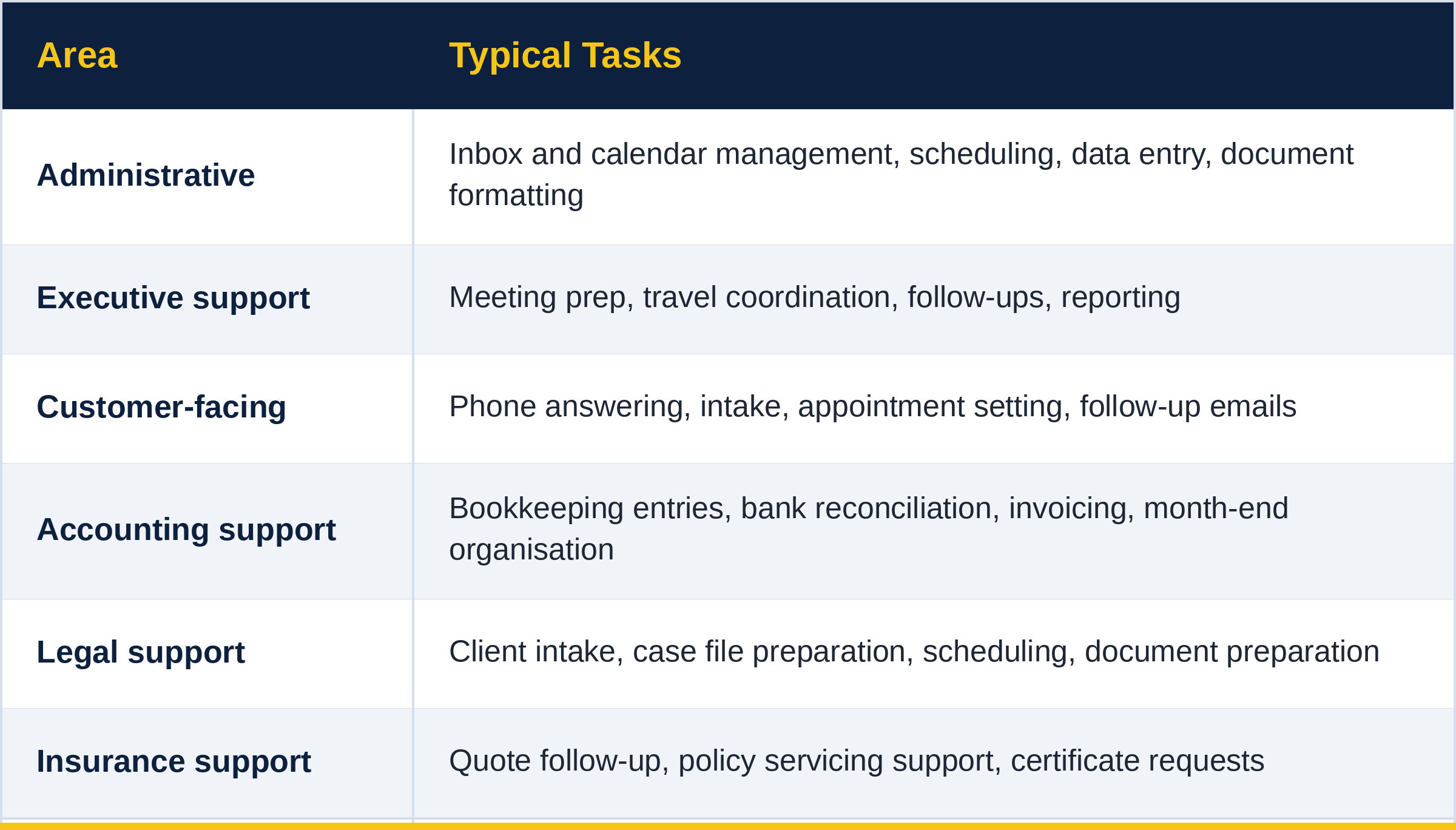
An offshore virtual assistant (VA) works remotely from another country and supports a U.S. business with tasks it would otherwise handle in-house. Typical work includes email, scheduling, data entry, phone answering, customer follow-up and bookkeeping support.
You will see several terms used for the same idea:
- Offshore virtual assistant: based in a distant country, often chosen for cost and talent depth.
- Overseas virtual assistant: the same thing in plainer language.
- Nearshore virtual assistant: based in a country near your own, usually with closer time zones.
- Onshore (U.S.-based) virtual assistant: based in the United States.
How you hire one matters as much as where they live. You can hire an individual directly, use a freelance marketplace, or work with a managed provider that recruits, trains, supervises and replaces the person for you. We cover that choice below.
What can an offshore virtual assistant do?
An offshore assistant can take on most work that is repeatable, process-driven and doesn't require being physically present.
Why do U.S. businesses hire offshore virtual assistants?
Three reasons come up repeatedly: cost, access to talent, and the difficulty of filling entry-level roles locally.
They complement your team; they don't replace it
On the Risk and Resilience podcast, Troy Thompson addressed the concern directly. He said Savvital did not set up its business to replace local American employees, and that the goal is to complement current staff. His example: instead of hiring another $60,000-a-year employee, a business could add a virtual assistant at a fraction of that cost and make the existing employee roughly twice as effective by taking low-value tasks off their plate.
He also pointed to the knock-on effect: when an assistant frees up your team and you bring in more revenue, you can afford to hire more local people.
Some roles are hard to keep filled locally
Troy and the host discussed how many owners struggle to find and keep people for entry-level work. A hire takes a role, then moves, or wants a promotion, and the owner is back to square one. Offshore assistants are one way to keep those tasks covered consistently.
Pay that makes the job attractive
Troy described the economics as a kind of currency arbitrage: assistants are paid well above the local average in their own country, while the cost to the U.S. client stays well below a U.S. salary. He added that some of Savvital's team members are doctors, lawyers and dentists who choose to work as virtual assistants for American clients because it is a better opportunity than working in their original field locally. That is his account of his own team, not a statistic about the industry.
Looking for a managed offshore team?
Savvital’s Offshore Virtual Assistant Services give U.S. businesses vetted assistants at a flat $2,300 a month, with month-to-month terms and a 30-day money-back guarantee.
How much does an offshore virtual assistant cost?
Pricing depends on the hiring model more than the country. There are three common structures:
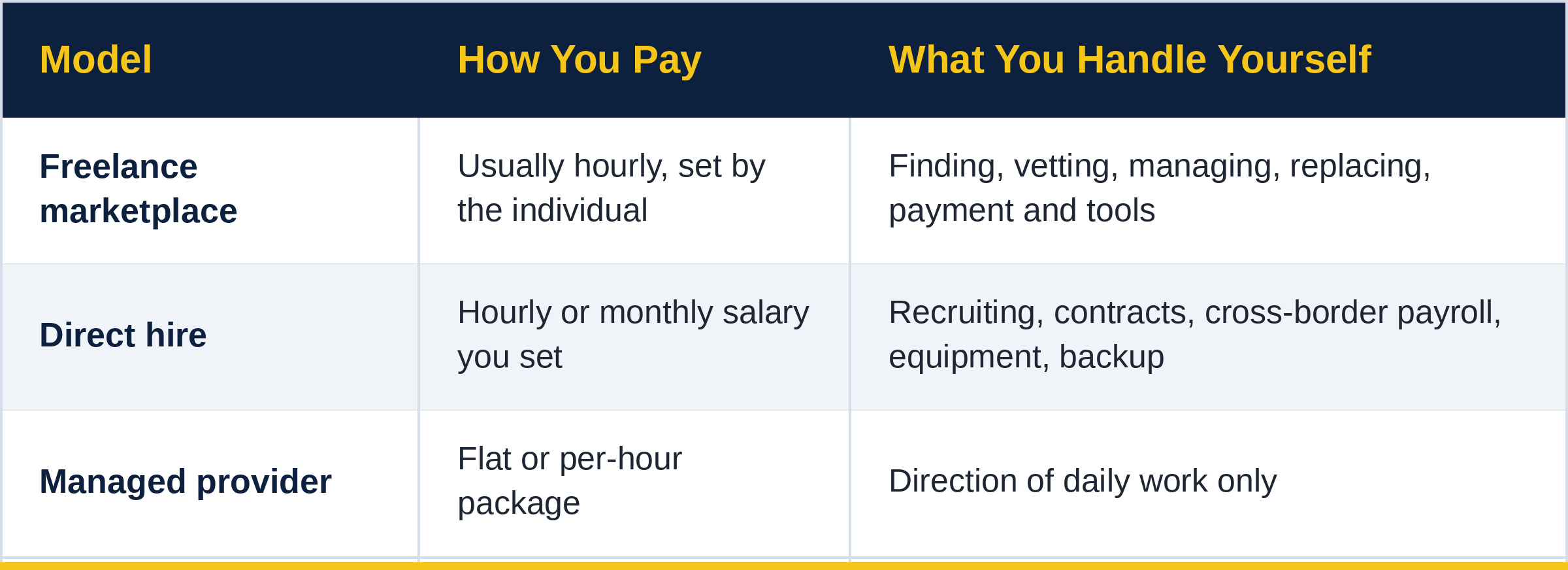
Savvital's pricing starts at $2,300 per month for 40 hours a week, month-to-month, with a 30-day money-back guarantee and free replacements. See full pricing and the savings calculator.
Compare that against the all-in cost of an in-house hire: salary, payroll taxes, benefits, equipment, training and turnover. For a structured comparison, read Virtual Assistant vs In-House Employee
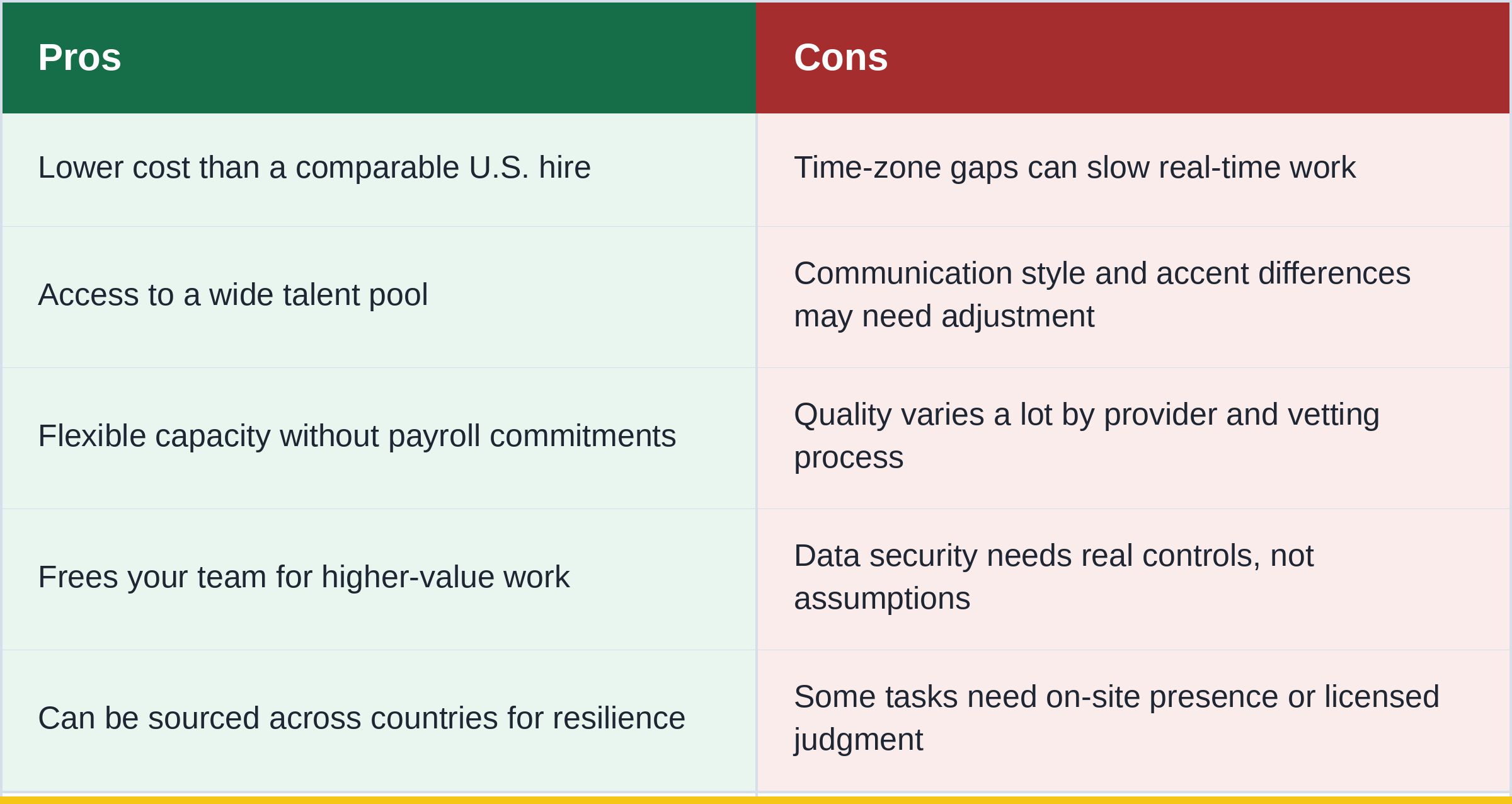
Are offshore virtual assistants worth it? Pros and cons
How to reduce the main risks
- Time zone: agree on overlap hours in writing before you start, and set up a daily check-in.
- Communication: test English fluency in a live call, not just in writing.
- Security: ask how data is protected, which tools are used, and whether the provider operates HIPAA-compliant infrastructure if you handle health information. Savvital states it runs HIPAA-compliant infrastructure with 24/7 monitoring, VPN and firewall protection. For more, read What Is a HIPAA-Compliant Virtual Assistant?
- Quality: start with a small, well-defined set of tasks and expand.
Why a multi-country team matters
Troy described a deliberate reason to spread a team across locations. Savvital's team started with partners in Islamabad, Pakistan, and has since expanded to the Philippines and Sri Lanka. In the episode he said it's good to have a variety of countries, using the example of Philippines-based team members affected by natural disasters including flooding and an earthquake, some of whom were offline for a time. Because the team was spread across countries, the business could keep running.
The practical lesson for any buyer: ask your provider where its people are, and what happens to your work if one location is disrupted. A provider with one location has one point of failure.
Direct hire or managed provider?
If you're weighing a direct hire (or a freelancer) against an agency, the real question is who carries the management burden.
- Direct hire: more control and possibly lower hourly cost, but you handle recruiting, contracts, payment across borders, equipment, training and backup when the person is sick or leaves.
- Managed provider: a higher per-hour figure on paper, but the provider handles vetting, replacement and infrastructure.
Our comparison, Freelance VA vs Managed Service Provider, walks through this in detail.
How to hire an offshore virtual assistant: step by step
Whether you want to hire an offshore virtual assistant directly or hire offshore assistant support through an agency, the process is the same.
- List the tasks. Write down what you want to hand off and how many hours per week it takes.
- Decide the model. Freelancer, direct hire or managed provider (above).
- Define working hours. Specify required overlap with your time zone.
- Vet carefully. Ask for a skills test, a live interview and references or a trial period.
- Check security. Confirm tools, access controls and compliance practices for your industry.
- Document your processes. Short checklists and screen recordings save weeks.
- Start small and review. Run a 30-day trial with a defined set of tasks, then expand.
For administrative hiring specifically, see offshore administrative and executive assistants.
What to look for when comparing offshore VA companies
Rather than a ranked list, use these criteria to compare any provider, Savvital included:
- Pricing transparency: published rates, minimum commitments, fees for replacement.
- Contract flexibility: month-to-month vs long-term.
- Replacement policy: how fast, and at what cost.
- Location and backup: where the team is based and what covers an outage.
- Security and compliance: documented controls.
- Role depth: whether they supply accounting, legal or insurance-trained assistants, not only generalists.
- Trial or guarantee: how you can exit if it's not working.
For a market-wide view, read our roundup of the best virtual assistant services.
Can an offshore assistant handle personal tasks too?
Yes, in many cases. Troy said his own executive assistant handles both business and personal work, from scheduling and calls to personal errands like coordinating family logistics. If you want to hire a remote personal assistant, define which personal tasks are in scope and which accounts or information you're comfortable sharing.
Ready to talk to an offshore virtual assistant provider?
Savvital offers managed offshore virtual assistants at a flat $2,300 per month, month-to-month, with a 30-day money-back guarantee and free replacements.
Read next in this series
Frequently Asked Questions
What is an offshore virtual assistant?
A remote worker based outside your country, who handles administrative, customer-facing or back-office work for a business.
How much does an offshore virtual assistant cost?
It depends on the hiring model, skill level and provider. Savvital's price is $2,300 per month for 40 hours a week, flat and month-to-month.
Is it better to hire an offshore virtual assistant or a onshore VA?
Offshore is usually lower in cost, while U.S.-based assistants (onshore, depending where you are from) offer closer time-zone and cultural alignment.
How do I hire remote virtual assistants?
List your tasks, choose a hiring model, define working hours, vet candidates, check security and start with a short trial. See the step-by-step section above.
What's the difference between a direct hire and a managed provider?
With a direct hire, you manage recruiting, payment and backup. With a managed provider, the company handles those and you direct the daily work.
Published on 9 Oct 2026
Author: Noor Ul Ain Liaqat