The choice between an offshore and an onshore virtual assistant comes down to what you need most. Offshore assistants generally cost less and offer a wider talent pool, but they work in a different time zone. An onshore virtual assistant, one based in the United States, shares your hours, your laws and your business culture, usually at a higher cost. Neither is better for everyone.
This guide compares the two in depth. It covers what each model means, how they differ on cost, time zone, communication, compliance, risk and management effort, which model suits which kind of business, how to combine them, and how to run a fair test before you commit. It also explains where Savvital fits, so you can judge our own model honestly.
For costs, pros and cons, and hiring models in depth, read our complete guide to offshore virtual assistants.
What do offshore and onshore virtual assistants mean?
The two terms describe where your assistant works from relative to where your business is based. They say nothing about quality, skill or professionalism. Those depend on the individual and the provider.
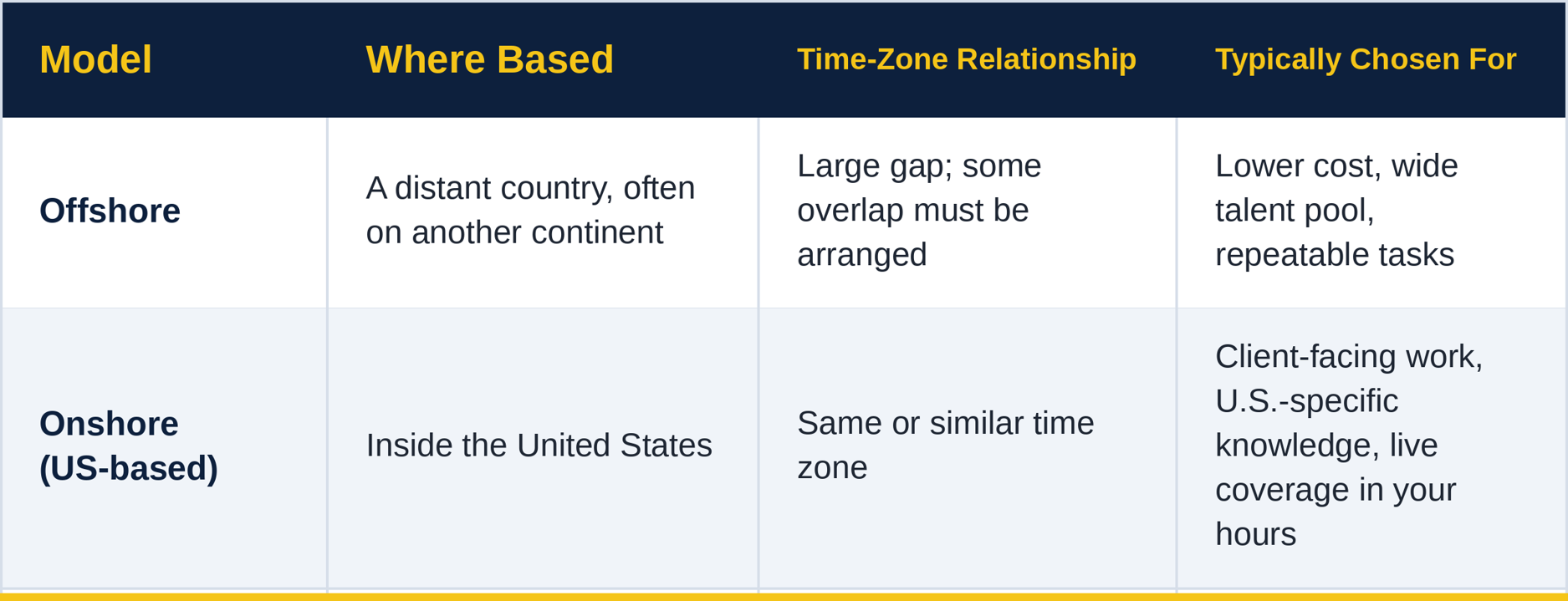
A few notes on terminology:
• "Onshore" and "US-based" mean the same thing for a U.S. business: the assistant works from within the United States.
• "Offshore" and "overseas" are used interchangeably in everyday speech. Our guide to the overseas virtual assistant covers vetting and onboarding.
• Offshore here means staffing. In some contexts "offshore" refers to offshore banking, tax or company registration. This guide is only about where your support staff work from.
What is an onshore (US-based) virtual assistant?
An onshore virtual assistant works remotely from within the United States. A US-based virtual assistant usually shares your working hours, your public holidays and your legal framework, and is more likely to understand U.S. business customs, state-specific rules and local terminology.
Three ways to hire onshore
"US-based" can describe quite different arrangements, and they behave differently:
1. An independent US-based freelancer. You deal with one person directly. You handle vetting, contracts, payment, tools and backup coverage.
2. A US-based agency. The agency supplies and manages assistants located in the U.S. You get a single point of contact and usually a replacement process, typically at a higher price than an offshore agency.
3. Your own remote employee. You hire a W-2 employee who works from home. This gives the most control but carries the full cost of employment. See Virtual Assistant vs In-House Employee for how that comparison works.
Where a US-based virtual assistant tends to fit best
• Real-time work. Live call handling, same-hour responses and meetings that must happen in your normal hours.
• Client-facing roles where customers expect a U.S. presence or where conversational familiarity matters.
• Work tied to U.S. regulation, state licensing or state-specific knowledge.
• Contracts or clients that require U.S.-only handling of data or personnel. Always confirm what a contract or regulation actually requires rather than assuming.
The trade-offs
Onshore support generally costs more, and the pool of candidates in a narrow skill can be smaller. Prices vary widely by provider and skill, so compare written quotes.
If you are searching for an American virtual assistant specifically, ask each provider to confirm in writing where its assistants are located, not just where the company is registered. A U.S. mailing address does not mean a U.S.-based team.
What is an offshore virtual assistant?
An offshore virtual assistant works remotely from a distant country, usually on another continent. Offshore assistants are typically the lowest-cost option and draw on the broadest pool of skilled workers, but the time-zone gap needs managing with agreed overlap hours and written handoffs.
Why businesses choose offshore
• Lower cost than a comparable U.S. hire, once salary, payroll taxes, benefits and equipment are counted.
• A wider talent pool, including trained support for accounting, legal and insurance work.
• Capacity for hard-to-fill roles. Entry-level administrative and support roles are often difficult to fill and keep locally.
• Work that continues outside your hours. Preparation and data tasks can be finished overnight and ready when you start.
The trade-offs
• Time-zone gaps can slow real-time work unless you plan overlap.
• More structure is needed up front, such as documented processes and written handoffs.
• Quality varies by provider. Screening, training and replacement policies matter a great deal.
• Communication style and accent differences may need adjustment, especially for client calls.
A third option sometimes sits between the two: a nearshore virtual assistant, based in a nearby country such as one in Latin America, usually with time zones closer to yours than an offshore assistant. It can balance cost and overlap, though the savings and talent pool vary by role.
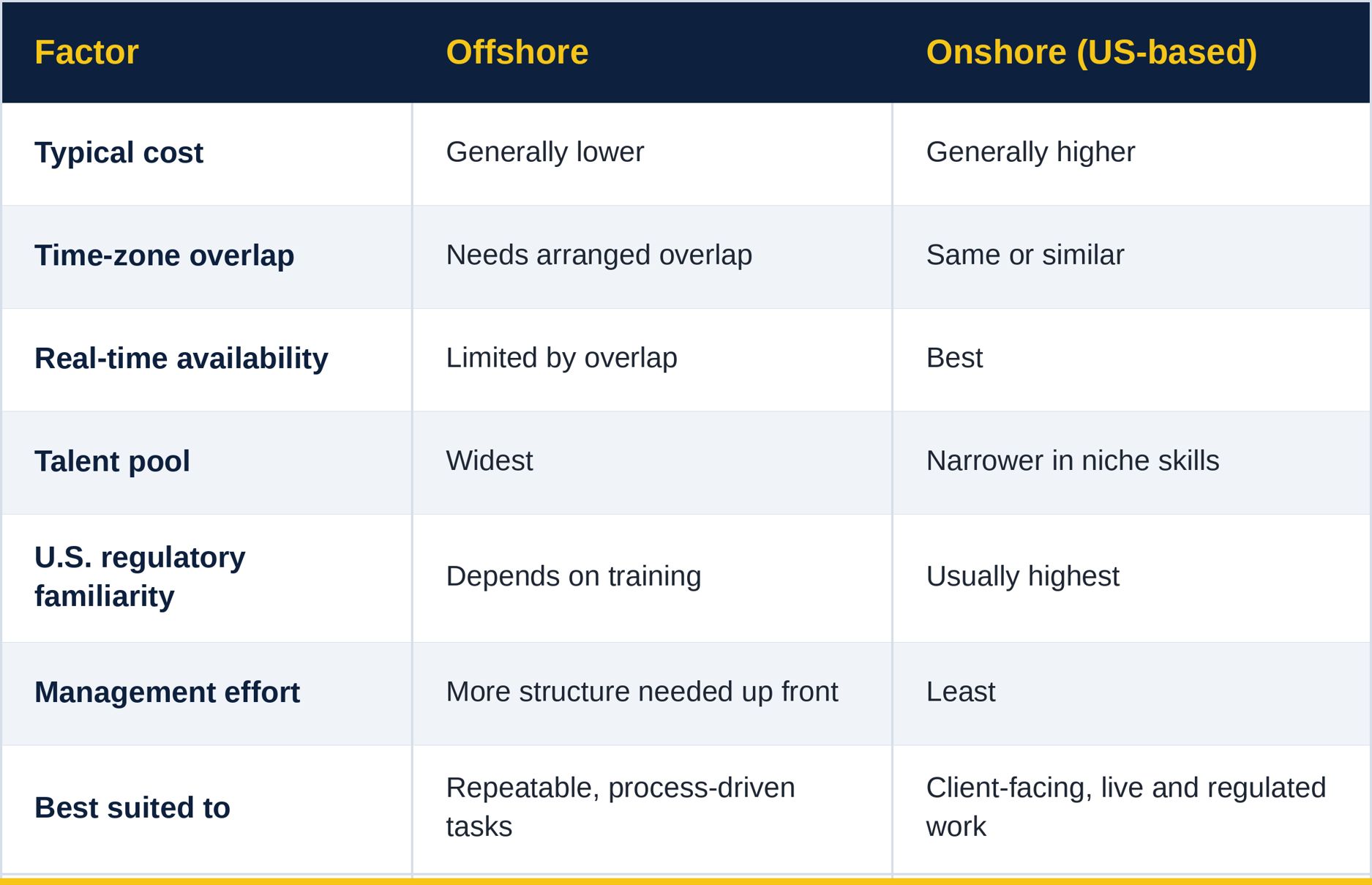
Offshore vs onshore virtual assistant: side-by-side comparison
Ratings below are general tendencies, not guarantees. Individual providers vary.
The factors that decide it
1. Cost: look at effective cost, not the hourly rate
The hourly rate is only part of the cost. Add the time you spend managing and correcting the work, and the cost of replacing someone who doesn’t work out.
In a hypothetical example, a $20-an-hour offshore assistant who needs 4 hours of your time a week costs $400 a week, against a $45-an-hour onshore assistant who needs 1 hour. Even after counting management time, the offshore option is far cheaper.
Ask how much management each option really needs. See Savvital’s pricing page.
2. Time zone and coverage
• Onshore: Same or similar time zone. Live coverage is simplest.
• Offshore: A large gap. Some overlap must be arranged, and some work can run while you're offline.
The gap is not only a drawback. For work that doesn't need an immediate reply, such as data entry, research or preparation, an offshore assistant can finish tasks outside your hours so they are ready when you start. For anything that needs a same-hour response, plan for overlap. Some businesses look at nearshore assistants for a closer time-zone match, but the same rule applies: agree the overlap in writing whichever you choose.
Practical rules for either model: agree overlap hours in writing, use a short written handoff at the end of each day, and decide in advance what counts as urgent and how to reach each other.
3. Communication and working style
Communication is the factor owners worry about most and the one that varies most by individual. Whatever the model:
• Test written communication with a short task and spoken communication with a live video call.
• Check whether the assistant asks clarifying questions or guesses.
• Agree a format for updates (daily note, weekly review, shared task board).
Accent and idiom can matter for client-facing calls. If your customers speak with your assistant, include a live call test and a few sample calls in your trial, whichever model you choose.
4. Talent pool and specialization
• Offshore typically offers the widest pool, including specialised skills in accounting support, legal support and insurance operations. Savvital's role pages show what a trained role looks like, for example the Accounting Associate and Legal Virtual Professionals.
• Onshore pools can be thin for niche skills and are more expensive to hire from.
Whichever model you choose, ask for experience with your specific tools (for example QuickBooks, your CRM or agency management system) and ask for a skills test.
5. Compliance, data and contracts
This is where assumptions cause the most trouble. A few points to check with a professional advisor before you hire:
• Contract or regulatory restrictions on where data is handled. Some client contracts, government work or industry rules limit where data can be accessed or stored. Check yours rather than guessing.
• Health information. If you handle protected health information, ask whether the provider supports HIPAA compliance and will sign the agreements your situation requires. See What Is a HIPAA-Compliant Virtual Assistant?
• Worker classification. Whether someone is an employee or a contractor is a legal question that depends on the arrangement. This is another reason some businesses prefer a managed provider, but it is not a substitute for advice from your attorney or accountant.
• Confidentiality. Use a written confidentiality agreement with any provider or individual, onshore or offshore.
Nothing in this guide is legal advice. Treat the points above as a checklist of questions for your advisor.
6. Risk and business continuity
Every model carries risk, and the risks differ:
• A single freelancer, anywhere, is a single point of failure. If they are sick or leave, work stops.
• An assistant based in one region can be affected by local power, internet or weather disruptions.
• A provider with a team spread across several locations and a replacement process can absorb these events better.
Ask any provider what happens if your assistant is unavailable for a week, and where their other team members are based.
7. Management effort and scalability
• Onshore: Usually the least coordination, especially with an agency.
• Offshore: More structure needed up front (documented processes, written handoffs), after which the arrangement can run smoothly.
If you expect to add more assistants later, favour a provider that can scale with you and a process you can repeat. See Dedicated vs Shared Virtual Assistant for how capacity can be structured.
Which virtual assistant model fits which kind of business?
These are general starting points, not rules. Your own tasks and constraints come first.
Insurance agencies. Work is a mix of live customer contact and back-office servicing. A common split is onshore for live customer calls and offshore for quote follow-up, certificate requests and policy servicing support. Read about insurance agency virtual assistants.
Law firms. Client confidentiality and ethics rules come first. Intake, scheduling and document preparation can be delegated, but confirm your jurisdiction's rules on confidentiality and supervision before you decide where work is done.
Accounting and bookkeeping firms. Data entry, reconciliation, invoicing and month-end organisation are checklist-driven and suit offshore support. Final review and advice stay with licensed professionals.
Healthcare and dental practices. Patient communication and health information raise compliance questions. Confirm HIPAA requirements and agreements before any assistant touches patient data, whichever model you use.
Solo consultants and small service businesses. If your time is the bottleneck, an offshore assistant for inbox, scheduling and research is often the lowest-friction start. Add an onshore assistant only if you need live phone coverage.
Teams that need constant real-time contact. If several people need to work with the assistant throughout the day, an onshore assistant is the simplest fit.
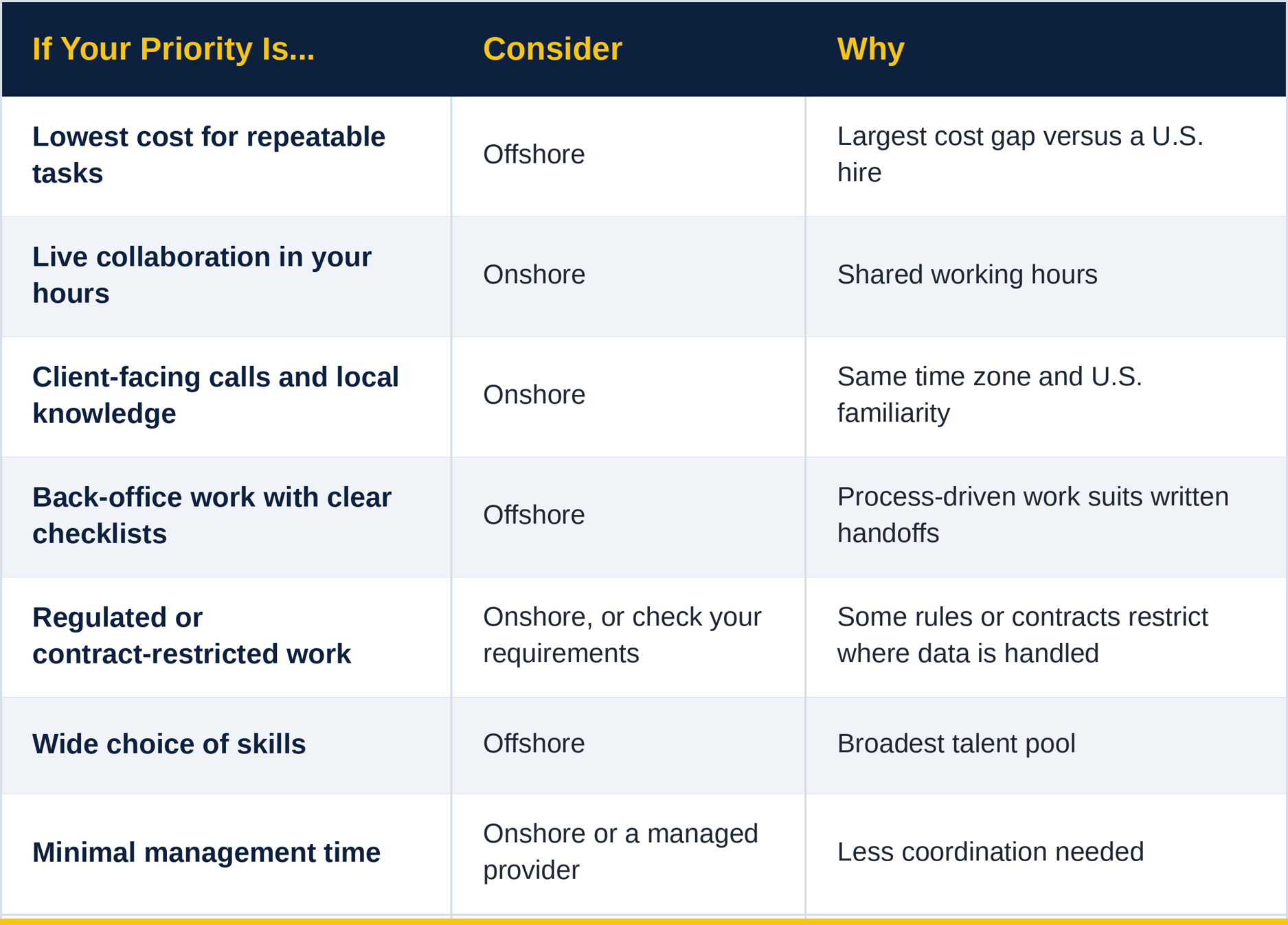
How do you choose? A simple decision framework
Start with your priority, then match it to the model.
Can you use both an onshore and an offshore virtual assistant?
Yes, and many businesses do. A hybrid approach assigns work by type, so you spend your higher-cost hours only where they add the most value.
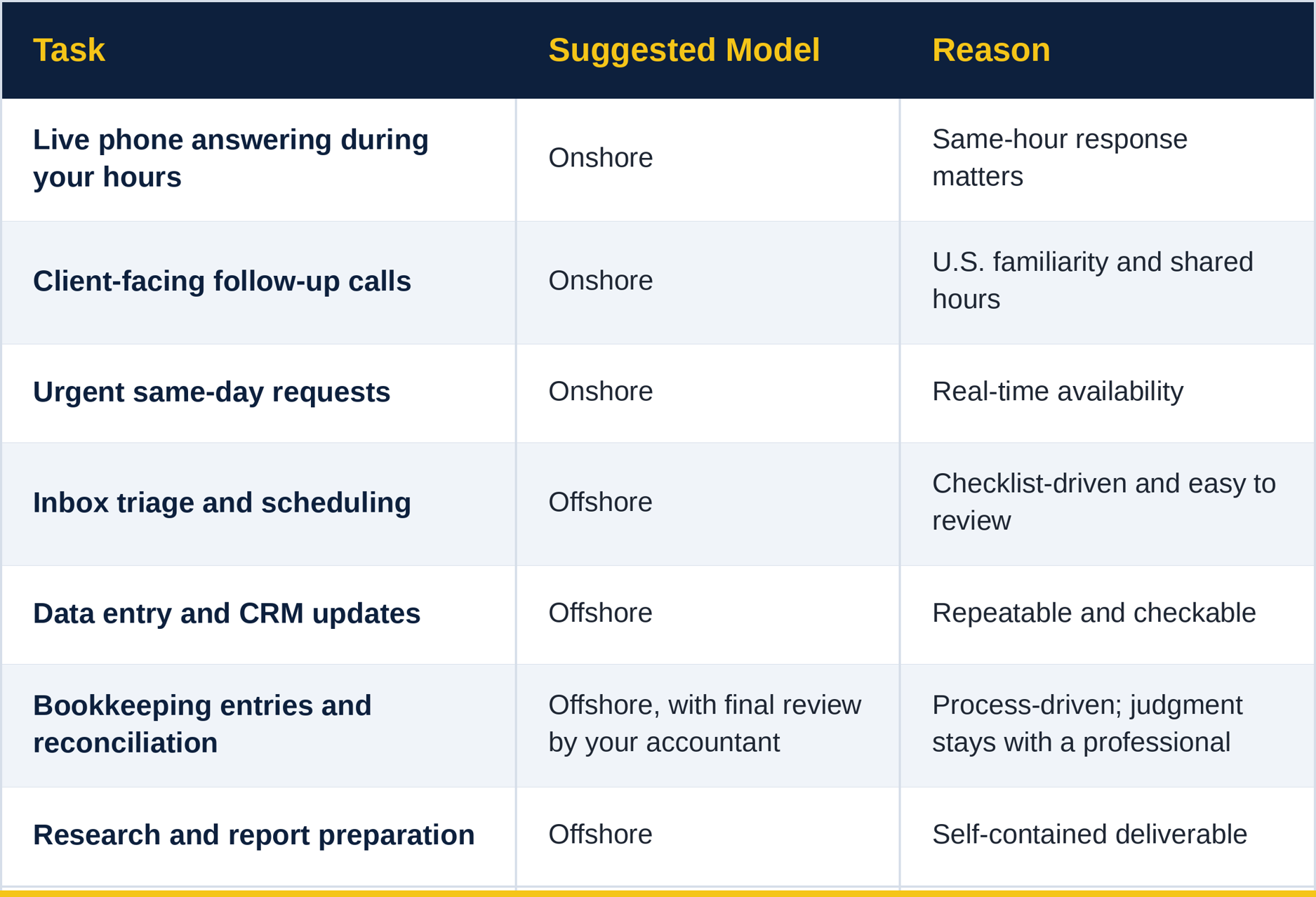
Tips for running a hybrid setup:
• Write one set of procedures that every assistant follows, so work is consistent.
• Name an owner for each workflow, so it's clear who does what.
• Use shared tools (one task board, one shared inbox) so handoffs are visible.
• Review the split every quarter. Tasks that start live often become routine and can move to a lower-cost model.
Ready to compare in practice?
Explore Savvital's Offshore Virtual Assistant Services: flat monthly pricing, month-to-month terms and free replacements.
Published on 15 Oct 2026
Author: Noor Ul Ain Liaqat