HIPAA Compliant Virtual Assistants for Insurance Agencies
Health and benefits insurance agencies handle protected health information every day: enrollment forms, claims details, medical underwriting notes, plan selections tied to specific conditions. Delegating that work to a virtual assistant without confirming real HIPAA compliance is not a minor oversight, it is a direct liability exposure for the agency. This guide covers what HIPAA compliance actually requires from a virtual assistant, how to verify a provider meets it, and what a compliant setup looks like in practice.
What Does HIPAA Compliance Actually Mean for an Insurance Agency?
HIPAA, the Health Insurance Portability and Accountability Act, sets national standards for how protected health information, often shortened to PHI, must be handled. For insurance agencies, PHI shows up constantly: enrollment applications, claims documentation, medical underwriting details, and plan selections that reveal a client's health status. The law applies through two categories of parties. A covered entity is an organization such as a health plan or provider that originates the PHI. A business associate is any third party that performs work involving that PHI on the covered entity's behalf. An insurance agency handling client health data, and any vendor that agency brings in to help with that data, falls into this framework.
Is a Virtual Assistant Considered a HIPAA Business Associate Agreement?
Yes, in almost every case relevant to insurance work. If a virtual assistant accesses client enrollment details, claims information, or any other PHI while supporting your agency, they are functioning as a business associate under HIPAA, regardless of whether they are a contractor, a remote employee, or work through a staffing company. That status is not optional and does not depend on how the working relationship is labeled. It depends entirely on whether the person touches PHI while doing the work.
This means a HIPAA Business Associate Agreement, commonly called a BAA, is required before a virtual assistant should ever access client health data. A BAA is a legal document that obligates the business associate to protect PHI to the same standard the agency itself must meet, and it defines what happens if something goes wrong.
What a HIPAA Compliant Virtual Assistant Provider Should Have in Place
HIPAA's Security Rule requires safeguards across three categories, and a legitimate provider should be able to speak to all three specifically, not just generally
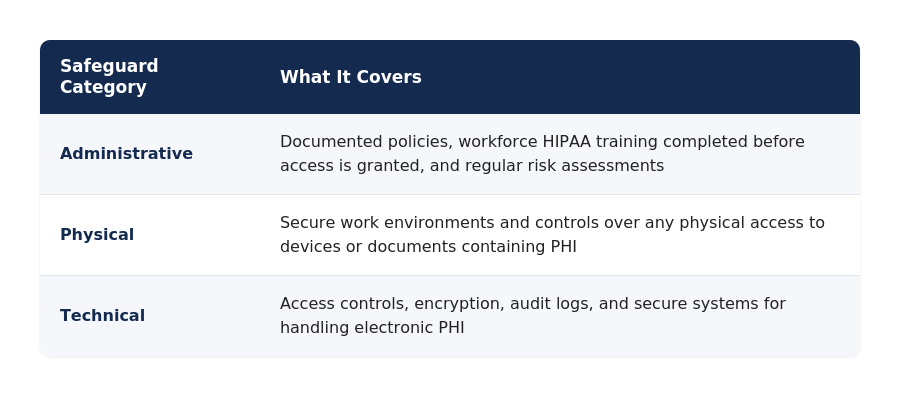
A provider that cannot describe specifics in each of these three categories, beyond a general statement that they are HIPAA compliant, has not actually demonstrated compliance. Compliance is a documented, ongoing practice, not a claim on a website.
The Risk of Skipping a Business Associate Agreement (BAA)
Without a signed BAA, an agency carries the full weight of a data incident alone. If a virtual assistant without a BAA in place mishandles client health information, whether by sending it to the wrong recipient, storing it insecurely, or accessing more data than their task required, the agency has no contractual protection and the business associate has no documented obligation to have followed proper safeguards in the first place. This is true regardless of the provider's intentions. The absence of a BAA is itself the exposure, separate from whether anything ever actually goes wrong.
How Savvital Protects Insurance Agency Data
Savvital's insurance virtual assistants operate inside HIPAA compliant infrastructure, backed by a partnership with Cyberfin for monitoring and data protection. This means access controls, documented safeguards, and a signed BAA are part of the standard working relationship, not an add on negotiated after the fact. Agencies bringing on a Savvital insurance virtual assistant are not starting from zero on compliance, since the infrastructure and documentation already exist before the VA begins work.
Read our guide on hiring an insurance claims processing VA → /blog/insurance-claims-processing-va
Questions to Ask Before Hiring a HIPAA Compliant Virtual Assistant
1. Can you provide a signed Business Associate Agreement before work begins, not after?
2. What administrative safeguards are in place, including workforce HIPAA training and how often risk assessments are conducted?
3. What physical safeguards protect the environment the VA works from?
4. What technical safeguards protect electronic PHI, including access controls and encryption?
5. What happens, contractually and operationally, if a data incident occurs?
6. Can the VA's access be limited to only the specific systems and data their role requires?
Read our guide on HIPAA Violations in Remote Teams
Compliance Should Not Be a Reason to Avoid Delegating
Some agencies avoid delegating client facing work altogether because HIPAA feels like too much risk to hand to an outside provider. That reaction is understandable, but it treats compliance as a reason to keep everything in house rather than as a standard to verify before you delegate. The agencies handling this well are not the ones doing everything themselves. They are the ones who ask the right questions upfront, confirm a BAA and real safeguards are in place, and then delegate with a documented relationship behind them instead of an informal one.
Handled this way, HIPAA compliance becomes a filter for choosing the right provider, not a reason to avoid outsourcing at all. An agency that skips delegation entirely out of compliance concern is not actually safer. It is just carrying the same administrative burden alone, without gaining any protection it would not have had otherwise.
Frequently Asked Questions
Is a virtual assistant required to sign a HIPAA BAA (Business Associate Agreement)?
Yes, if the virtual assistant will access protected health information while supporting an insurance agency. This makes them a business associate under HIPAA, and a signed Business Associate Agreement should be in place before they begin accessing any client health data, not after.
What counts as protected health information at an insurance agency?
PHI at an insurance agency typically includes enrollment applications, claims documentation, medical underwriting details, and any plan selection information that reveals a client's health status or conditions. If a document or record ties an individual to health related information, it is generally treated as PHI.
What happens if an agency skips the BAA requirement?
Without a signed BAA, the agency carries full liability for any data incident involving that virtual assistant, with no contractual protection in place. The absence of a BAA is itself a compliance gap, independent of whether an actual data incident ever occurs.
How does Savvital keep insurance agency data secure?
Savvital's insurance virtual assistants operate inside HIPAA compliant infrastructure, backed by a partnership with Cyberfin for monitoring and data protection, with a signed BAA and documented safeguards in place as a standard part of the working relationship.
Does a small independent insurance agency need to worry about HIPAA?
Yes. HIPAA compliance obligations apply regardless of agency size. A solo broker handling client health data carries the same fundamental BAA and safeguard requirements as a larger agency, even though the scale of the compliance program will look different.
Can a virtual assistant's access to PHI be limited to specific tasks?
Yes, and it should be. A properly configured setup limits a virtual assistant's access to only the systems and data their specific role requires, rather than broad access to everything in an agency management system. This limits exposure if any single account is ever compromised.
Published on 11 Aug 2026
Author: Noor Ul Ain Liaqat