Roofing Virtual Assistant Cost: Pricing and Hiring Guide
A roofing virtual assistant costs different amounts depending on the model. Marketplace freelancers, agencies and managed providers all price differently, and the cheapest hourly rate is rarely the cheapest outcome. At Savvital, a dedicated assistant costs starting at $2,300 a month for 40 hours a week, month to month, which works out to roughly $13 an hour. This guide explains what drives the price, how a virtual assistant compares with hiring an office manager, and what to check before you hire one for your roofing company. It is part of our series on the roofing virtual assistant.
How much does a roofing virtual assistant cost?
It depends on the model, the hours and who manages the person. These are the common structures:
• Hourly: you pay for hours worked or booked. Easy to start, but the total moves with usage, and management time is yours.
• Flat monthly: a set price for a set number of hours, such as full time. This is Savvital's model.
• Per task or per call: common for answering services. Cost rises in busy storm months.
Savvital's pricing, from our pricing page as checked Oct 29, 2026: $2,300 a month for 40 hours a week, flat, month to month with no contract, a 30-day money-back guarantee and free replacements. Annualized, that is $27,600. The hourly figure of about $13 is our own calculation (the monthly price divided by an average month of 40-hour weeks).
Prices from other providers change, so get a current written quote and ask what is included. We have not listed competitor prices here because they vary by plan and date. See our roofing virtual assistant guide for how some providers describe their services.
What affects the price of a roofing virtual assistant?
Five things move the number:
1. Hours. Part time costs less than full time. Storm season may need more.
2. Skill. Phones and scheduling differ from bookkeeping or claims paperwork.
3. Who manages them. A marketplace freelancer is yours to recruit, train and replace. A managed provider handles that.
4. Coverage. Backup when the assistant is out is worth asking about.
5. Security and tools. Access to your CRM, accounting and customer data should come with clear controls.
For a deeper look at marketplace versus managed pricing, see our post on virtual assistant cost for an insurance agency. The same trade-off applies to roofing.
Virtual assistant vs office manager: which does a roofing company need?
They do different jobs, and many growing roofing companies end up with both. A virtual assistant takes a defined set of tasks off your team. An office manager owns the office, the people and the decisions around them.
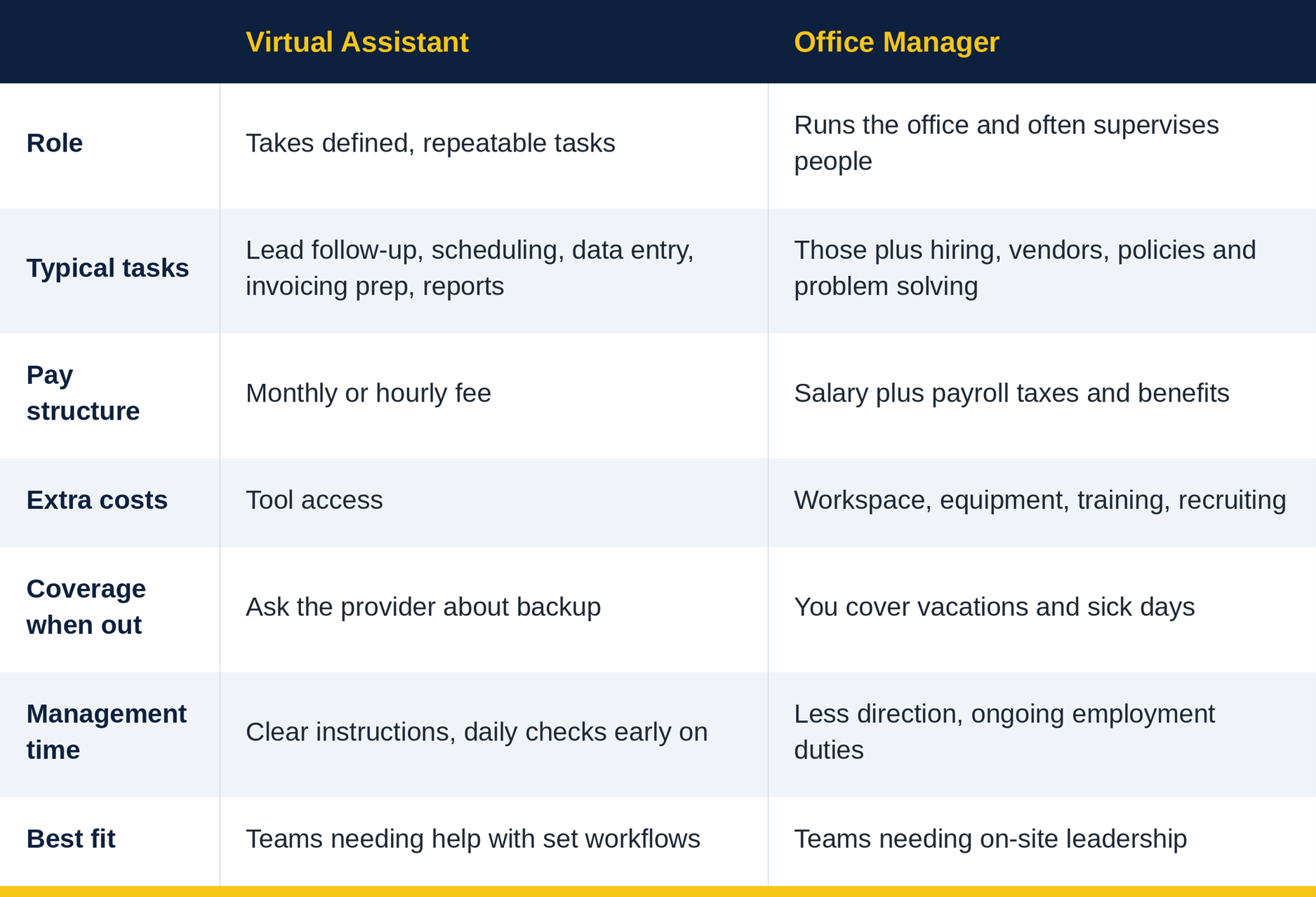
How do you work out what a full-time hire really costs
Add every line, using your own numbers, because they differ by state and company:
• Salary or hourly pay
• Payroll taxes and any required insurance
• Benefits, if you offer them
• Equipment, software and workspace
• Recruiting and onboarding time
• Cover for time off
• Your own time spent managing
Then divide the total by the hours you actually need covered. Put the same lines against a virtual assistant's price, adding the time you will spend training and checking work in the first month. We have not given an in-house salary figure here. Check current pay for your area with a primary source, such as the U.S. Bureau of Labor Statistics, and your accountant.
What should you check before you hire a roofing virtual assistant?
Use this checklist when you compare providers:
• Hours and time zone. Do they cover your business hours, and what happens after hours? Missed calls are costly in storm season.
• Dedicated or shared. Will one person learn your jobs and your crews?
• Replacement and backup. What if the person leaves or is out?
• Tools. Can they work in your CRM, calendar and accounting software?
• Security. How is customer and payment data protected, and who can see it?
• Scope. Which tasks are included, and which are not? Ask specifically about insurance paperwork.
• Contract. Is it month to month, and is there a refund or trial?
• Management. Who handles training and performance?
Can a roofing virtual assistant handle insurance paperwork?
Ask this explicitly, because many providers don't list it. A good assistant can log claim numbers, keep photos and documents organized, track approvals and supplements and schedule around them. Coverage opinions and claim negotiation stay with your team, and some states restrict what contractors and their staff may do, so check your state's rules.
See our guide to insurance claims support for roofing companies and our recap on how roofers work with insurance companies.
How do you hire a roofing virtual assistant and get value fast?
Start narrow and measure:
1. Pick one workflow, such as missed calls, estimate follow-up or scheduling.
2. Write the process down: scripts, statuses, who decides what.
3. Give access to the tools they need, nothing more.
4. Review their work daily for the first couple of weeks.
5. Track results: response time, estimates followed up, jobs scheduled on time.
6. Add a second workflow once the first runs smoothly.
Good starting points are lead follow-up, call coverage, bookkeeping and invoicing and scheduling and project coordination.
How does Savvital price and support roofing contractors?
Savvital gives roofing contractors one dedicated assistant who works in your tools and sends an end-of-day report.
See our roofing virtual assistant services or pricing
Frequently Asked Questions
How much does a roofing virtual assistant cost?
It depends on the model and hours. Savvital rates start from $2,300 a month for 40 hours a week. Other providers differ, so get a current quote and compare hours included.
Can a virtual assistant replace an office manager?
For defined tasks, yes. They cannot lead people or make on-site decisions. Many companies use a virtual assistant to free the office manager for higher-value work.
Should I hire a freelancer or a managed virtual assistant?
A freelancer can cost less per hour, but you recruit, train, manage and replace them. A managed provider handles those, usually at a higher rate.
Published on 4 Nov 2026
Author: Noor Ul Ain Liaqat