Roofing Answering Service for Contractors: Covering Calls in Storm Season
A roofing answering service picks up your calls when you can't, captures the caller's details and the roof problem, and passes the lead to you so it doesn't go to the next roofer. For roofing contractors, the pressure peaks in storm season, when one hail or wind event can flood your phone. A dedicated virtual assistant from Savvital can cover this during business hours and overflow, and then do what an answering service usually doesn't: log the lead, book the inspection and follow up. This guide covers what to capture, how to sort urgent calls from routine ones, your coverage options and how a virtual assistant fits. It is part of our series on the roofing virtual assistant.
Why do roofers miss calls?
Roofers miss calls because the people who answer the phone are also on roofs, on estimates or in meetings. Typical causes:
• Owners and estimators are on a roof or in an attic and can't pick up.
• The office is closed after hours, at weekends or during a storm.
• A hail or wind event sends many callers at once, and a single line can't cope.
• Voicemails pile up and nobody checks them quickly.
These are capacity problems, not effort problems, which is why a process or a dedicated person fixes them.
What does an answering service for roofing contractors do?
A roofing answering service answers calls in your company's name, follows your script and passes the caller's details to your team. Done well, every caller gets a consistent, friendly response and you get a usable lead.
What a good script captures:
• Name and best callback number
• Property address
• The issue (leak, storm damage, missing shingles, inspection, estimate)
• Whether water is coming in right now
• Roof age and type, if known
• Whether the call relates to a storm
• Whether insurance is involved, the claim stage, the carrier and any adjuster visit dates
• Best time to call back
Record the problem in the caller's own words, so whoever calls back doesn't have to ask again.
How do you sort urgent calls from routine ones?
Sort every call into three buckets, so the right person responds at the right speed. Write the rules down so anyone answering follows the same ones.
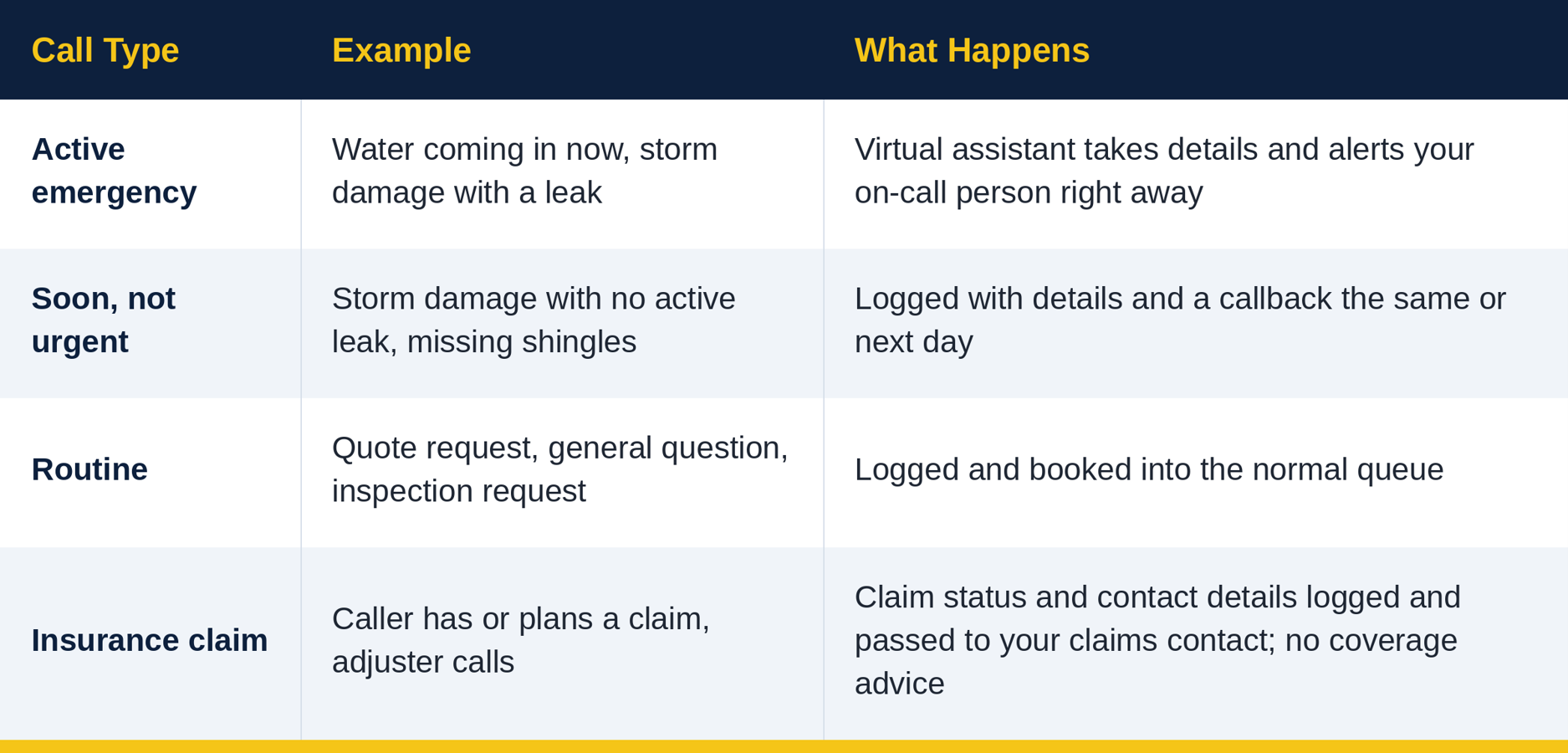
How do you handle storm-season call overflow?
Plan for the surge before it arrives. One storm can multiply calls in a day or two, and the first roofers to respond often get the work.
• Write the scripts now. Storm, active-leak and tarp requests need different questions.
• Set honest expectations. Tell callers when they can expect an inspection.
• Add overflow coverage. Route calls to a second person or service when the main line is busy.
• Define on-call. Decide who handles true emergencies, at what hours and how they're contacted.
• Don't over-promise. Never give an inspection date the estimator hasn't scheduled. Say when someone will call back.
• Screen out spam. Solicitor and spam calls often rise after storms, so have the answerer filter them.
• Send a text. A short message right after the call confirms what happens next.
• Review daily. Check the day's calls, callbacks and bookings so nothing slips.
What are your options for answering calls?
Each option trades cost, coverage and the quality of the conversation. Compare them on the hours they cover, how well they handle surges and what happens after the call.
• Voicemail. Cheapest, but many callers hang up and move on.
• Live answering service. People answer 24/7 in your company's name. Check costs in busy months, because some bill per call.
• AI receptionist. Answers instantly at any hour and can take simple details, but it can't answer the way a person does (see below).
• Virtual assistant. A dedicated person who answers during their scheduled hours, handles overflow and follows up on every call.
• A mix. For example, AI or an answering service for after-hours emergencies, and a virtual assistant for business-hours calls and everything after the call.
Whichever you choose, test it with real scenarios before sending live calls: a routine quote, a late-night leak, a tarp request and an insurance adjuster calling.
Can AI answer your roofing calls?
AI can be one option, but it can't answer humanely. It can pick up instantly, at any hour, and capture basic details such as address, issue and callback number, which makes it a reasonable first answer for after-hours calls or a busy line.
Where it falls short is the human side of the call. A homeowner with water coming through the ceiling or storm damage to their home is often stressed, and they want someone who listens, reassures and understands what they're dealing with. AI struggles with that tone, with callers who are upset or confused, and with calls that don't follow the script, such as an adjuster, a property manager or a claim question. It can also sound impersonal, and some callers hang up when they realise they aren't talking to a person.
A practical approach: let AI, if you use it, handle the first pickup and simple intake, and make sure a person follows up quickly. Anything urgent, emotional or insurance-related should go to a human. That is where a dedicated assistant earns its place.
How does a virtual assistant cover roofing calls?
A virtual assistant answers, captures and follows up, so each call becomes a logged lead with a next step. They can:
• Answer calls and web forms in your company's name using your script
• Handle overflow when the main line is busy
• Triage calls into urgent, soon and routine and alert the right person
• Log every call in your CRM with the details above
• Text the caller to confirm next steps
• Call back missed calls and check voicemails
• Book inspections, grouping them by area where they can so crews travel less, and send reminders
• Send you an end-of-day summary of calls, bookings and open items
That last part is the difference from a plain answering service. After the call, the assistant keeps going: logging, booking and following up. See roofing lead follow-up for how that works.
Confirm hours. A virtual assistant works scheduled hours. If you need live coverage at 3 a.m. for active leaks, pair the assistant with an after-hours service, AI or an on-call rule, and ask your provider exactly which hours they cover.
What about insurance and storm calls?
Treat them as their own category. Callers after a storm often have an insurance claim open or planned, so the assistant asks early whether one is involved, records the claim status and notes any adjuster details. They should not give coverage advice or discuss what a policy pays. That stays with your team, and some states restrict what contractors and their staff may do, so check your state's rules.
Troy Thompson, who runs an independent insurance agency, said on the Roofing Insights podcast that agents refer roofers who give honest damage opinions and report back on leads. See our recap on how roofers work with insurance companies and our guide to insurance claims support for roofing companies.
How does Savvital cover calls for roofing contractors?
Savvital gives you a dedicated assistant who learns your scripts and your process, and who works from a background in insurance. Savvital's CEO, Troy Thompson, runs an independent insurance agency, and in Savvital's recap of the Bricks and Risk podcast he says 8 of that agency's 22 staff are virtual assistants. Claim-related calls are everyday work for that team, so asking about claim stage, carrier and adjuster dates is familiar territory.
• One dedicated person. They learn your company, your scripts and your crews, instead of a rotating pool of agents.
• Insurance-aware intake. Claim details are recorded for your team, without coverage advice.
• Flat price. $2,300 a month for 40 hours a week, month to month. Some answering services bill per call or per minute, so storm weeks can cost more.
• After the call. Logging, booking and follow-up are part of the job, with an end-of-day report.
• Low risk. Free replacements and a 30-day money-back guarantee.
Set it up in a week: write the script and triage rules, decide who is on call, forward calls and overflow, test with realistic scenarios, then go live with a daily review. See our roofing virtual assistant services or pricing.
Frequently Asked Questions
What is a roofing answering service?
A service that answers your calls in your company's name, captures the caller's details and passes the lead to your team, so you don't lose jobs while you're on a roof.
Can a virtual assistant act as a virtual receptionist for a roofing company?
Yes, during their scheduled hours. They can answer calls, handle overflow, triage and log calls, book inspections and follow up. For overnight emergencies, add an after-hours option.
Do roofing contractors need an answering service?
If calls go unanswered while crews and estimators are on roofs, some form of coverage helps. That can be a live service, a virtual assistant, AI or a mix, depending on the hours you need.
What should a roofing answering service ask callers?
Name, callback number, address, the issue, whether water is coming in, roof details, storm connection, and whether insurance is involved, including claim stage, carrier and adjuster dates.
Is an AI answering service enough?
It can handle simple intake at any hour, but it can't answer humanely: it struggles with stressed or upset callers and calls that go off script. Urgent, emotional or insurance-related calls should reach a person, so many companies combine the two.
Published on 4 Nov 2026
Author: Noor Ul Ain Liaqat