How Much Does a Virtual Assistant Cost ?
Troy Thompson Explains on Bricks and Risk
Agency owners ask Troy Thompson this question constantly. What does a virtual assistant actually cost? Savvital delivers fully managed Virtual Assistants for insurance agencies, combining full-time, pre-trained talent with enterprise cybersecurity, and Troy laid out the real numbers behind that model in a recent episode of the Bricks and Risk Podcast, hosted by Tim Gity and Sean Mooney.
Troy is President & CEO of Savvital and also owns Pinnacle Insurance Agency of Minnesota in Coon Rapids, where he runs both businesses side by side. On the episode, he walked through how Savvital started, what a virtual assistant really costs, and why the cheapest option on the market usually isn't the right one for an agency handling client data and policy work.
How Much Does a Virtual Assistant Cost for an Insurance Agency in USA?
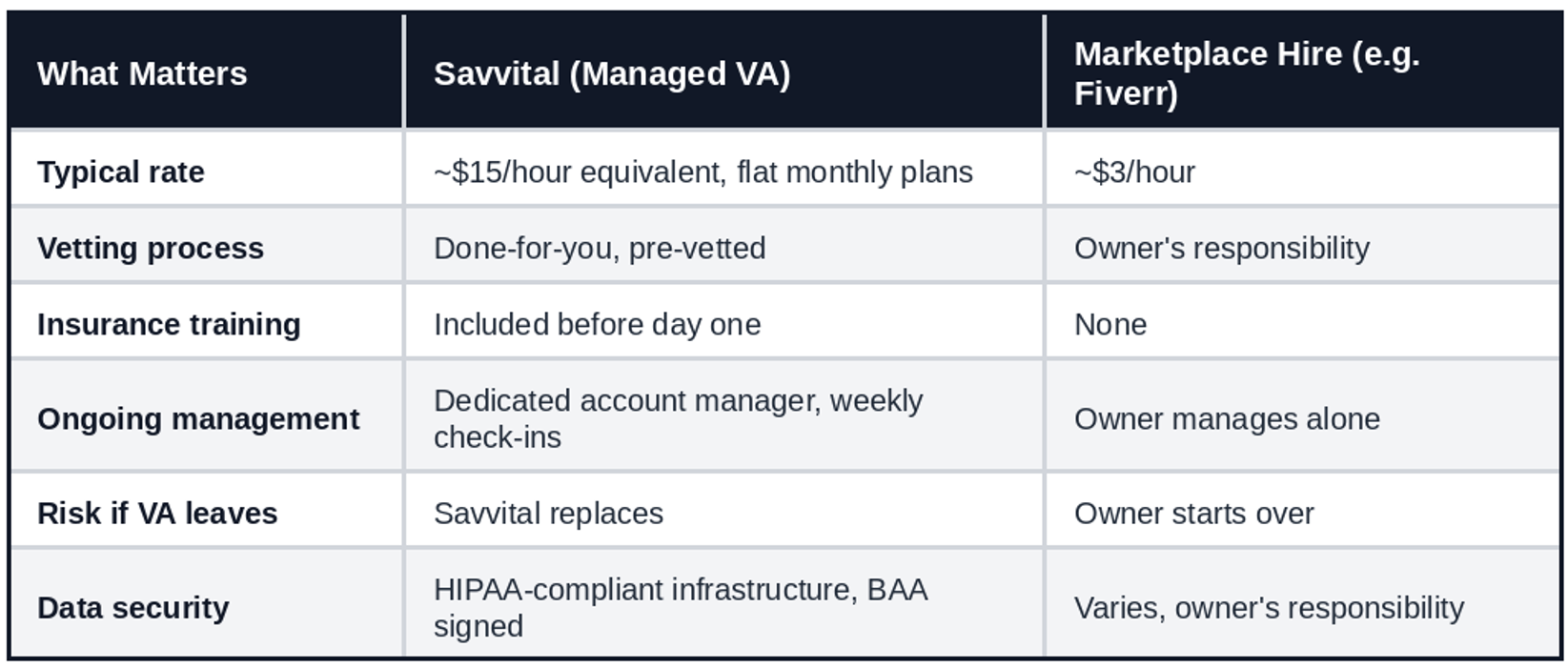
Pricing for insurance virtual assistants covers a wide range, wider than most agency owners expect. Troy gave a straight answer on the show. A virtual assistant can be found for about $3 an hour on a marketplace like Fiverr. Savvital's run closer to $15 an hour. That gap is real, and it's wider than most agency owners expect until they start comparing options.
That five-times gap isn't random. A $3-an-hour hire usually comes with no vetting, no insurance training, and no one checking their work. A $15-an-hour managed VA is trained on insurance basics before day one, backed by a manager who checks in weekly, and works for a company with a reputation on the line. As Troy said on the show, you get what you pay for.
Troy also pointed out that comparing virtual assistant cost per hour across companies only tells part of the story. What matters more is what's actually included at that price. Savvital doesn't bill hourly at all. For a full monthly breakdown instead of an hourly guess, Savvital's virtual assistant pricing runs on flat monthly plans, so there's no tracking hours against an invoice each week.
What Does an Insurance Virtual Assistant Actually Do?
An insurance virtual assistant handles the work that keeps a policy moving but doesn't involve selling: quoting, requoting, service requests, and client calls.
Troy used his own agency as the example. At Pinnacle, 8 of the 22 total staff are virtual assistants, handling quoting, requoting, service requests, and client calls. That frees up the other 14 to focus on sales and face-to-face client work.
This matches the scope outlined on Savvital's virtual assistant for insurance agency: Policy servicing, Quoting support, ACORD forms, and Claims follow-up stay with the virtual assistant, while binding coverage and final carrier decisions stay with a licensed agent.
Why Do So Few Insurance Agencies Use Virtual Assistants?
Adoption is still low, and that's exactly why the agencies who move first get an edge. On the episode, Troy and Sean guessed that somewhere between 5 and 10 percent of insurance agencies currently use virtual assistants. That's a rough, on-air estimate, not a formal industry number, but it lines up with how often agency owners say they're short-staffed without knowing a solution already exists for their industry.
Troy doesn't think the low adoption is about complexity. Most owners simply haven't seen what a properly managed VA relationship looks like, so they either try a marketplace hire that doesn't work out or never try at all.

How Does Hiring a Virtual Assistant Create More Local Jobs?
Hiring a virtual assistant doesn't shrink a local team. It funds growth of one. Troy calls this a flywheel: hiring VAs frees up time for the local team to sell more. That brings in more revenue, which funds higher local pay and more local salespeople. That, in turn, supports hiring more VAs, and the cycle keeps building on itself.
Troy has described this same pattern about Minnesota's labor shortage: money saved on back-office work goes toward raising local pay and hiring more people who sit across the table from clients, not fewer local jobs.
What Should an Agency Expect When Managing a Virtual Assistant?
Troy was direct about this on the show. A virtual assistant isn't a set-it-and-forget-it hire, and treating one that way is the most common reason a placement fails. Owners need daily check-ins, and they need to correct a mistake clearly the first time it happens, rather than getting quietly frustrated every time it repeats.
Savvital builds this into its managed service by default. Every VA gets a dedicated manager who runs weekly check-ins and helps with onboarding, so the agency owner isn't handling that relationship alone from day one.
Savvital vs. Marketplace Virtual Assistant
About Troy Thompson
Troy Thompson is President & CEO of Savvital, which delivers fully managed Virtual Assistants for insurance agencies, combining full-time, pre-trained talent with enterprise cybersecurity. He also owns Pinnacle Insurance Agency of Minnesota in Coon Rapids. Connect with Troy on [LinkedIn] or learn more at Savvital.
Ready to See What a Managed Virtual Assistant Costs for Your Agency?
Every agency's workload looks a little different, so the fastest way to get a real number is to talk it through. On a free strategy call, the Savvital team will look at where your time is going and map out exactly what a virtual assistant could take off your plate, along with a clear monthly cost, no hourly guesswork required.
Prefer to look at the numbers first? See current Savvital pricing
Want the full breakdown of what a virtual assistant can handle at an insurance agency?
Explore the Insurance Virtual Assistant service
Published on 17 Sept 2026
Author: Noor Ul Ain Liaqat