A virtual assistant stops roofing leads going cold by owning the follow-up your team doesn't have time for: replying to new leads, calling back missed calls, qualifying, booking and confirming inspections, chasing estimates and re-contacting leads that said "not now." Roofing lead follow-up usually fails for one reason. Everyone is on a roof or on the phone, and nobody is responsible for the next step. A dedicated assistant, working in your CRM, makes sure there is always a next step and that it happens.
This guide shows where roofing leads go cold and how a virtual assistant fixes each point. It is part of our series on the roofing virtual assistant.
Why do roofing leads go cold?
Roofing leads go cold mainly because the people who would follow up are busy on roofs, in estimates or on the phone with existing customers. Common patterns:
• Slow first response (speed to lead). Many roofing inquiries are urgent, such as leaks, storm damage or an insurance deadline, and homeowners often contact more than one company. The company that replies first often has the advantage, although how much will vary by market.
• Missed calls with no callback. A caller who gets voicemail may simply call the next number.
• Leads scattered across places. Texts, voicemails, web forms, ad leads and notes live in different spots, so some are never worked.
• No owner. Everyone assumes someone else sent the follow-up.
• Estimates left to age. A pipeline that shows "Estimate Sent" for weeks tells you nothing about what happens next.
• No record of why. If you don't record why a lead didn't buy, you can't reactivate it intelligently.
None of these are marketing problems. They are process problems, and a process can be written down and handed to someone.
How does a virtual assistant stop leads going cold?
A virtual assistant takes each stage of the follow-up and makes it someone's daily job. Here is where leads go cold and what the assistant does about it.
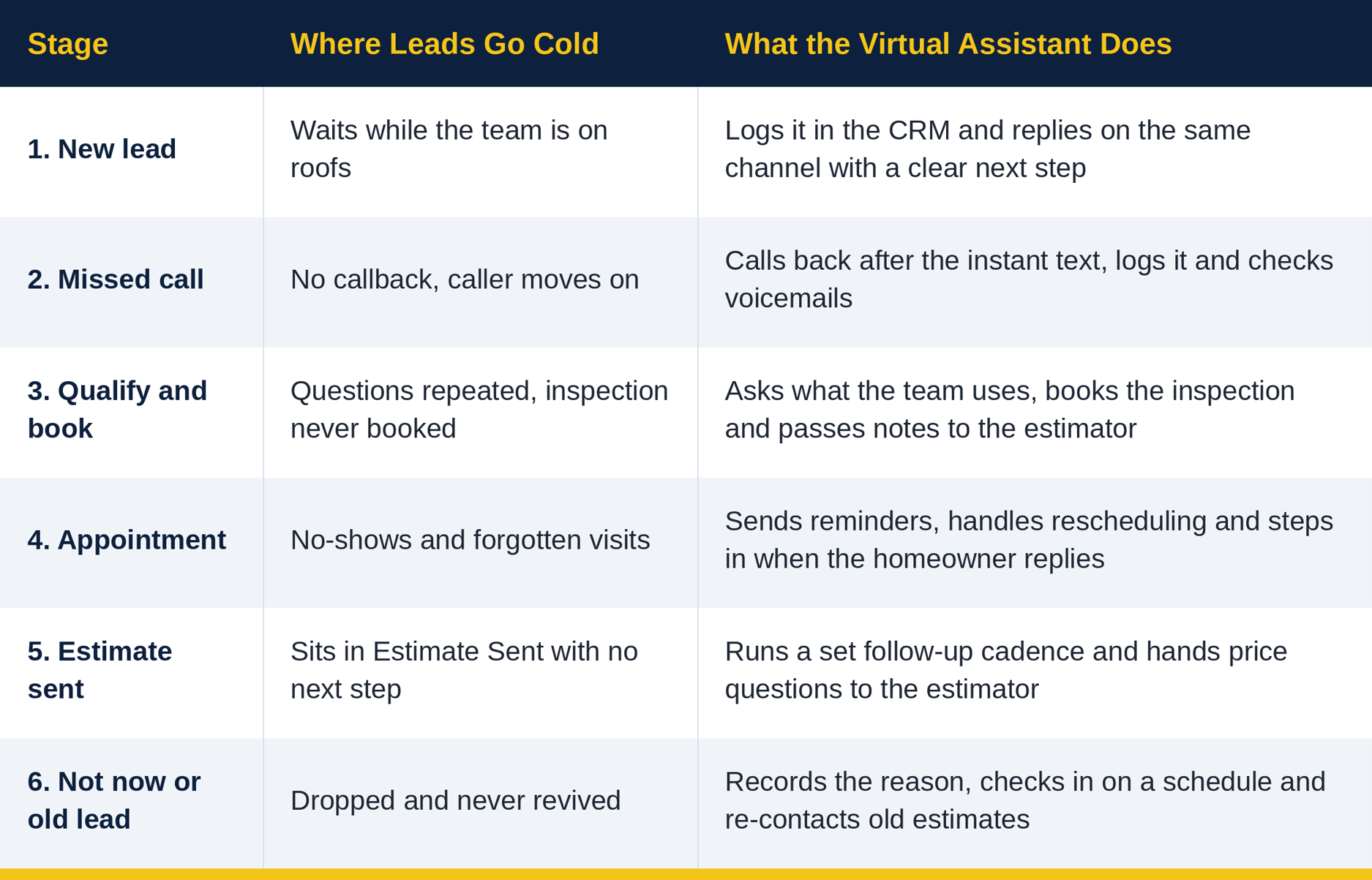
In text, the six stages are below.
1. They reply to every new lead
The assistant logs each lead in your CRM with its source, then replies on the channel the homeowner used, with a clear next step. Because following up is their main job, replies don't wait for a gap in the crew's day.
"Hi [Name], this is [Company]. Thanks for reaching out about your roof. Can I ask a couple of quick questions so we can set up your inspection?"
2. They call back every missed call
Software can send an instant text when a call is missed. The assistant then calls back, logs the call and checks voicemails on a schedule, so no caller is left hanging.
"Hi, this is [Company]. Sorry we missed your call. Are you looking for a repair, a replacement or an inspection? We'll call you back shortly."
For overflow and after-hours coverage, see our guide to the roofing answering service.
3. They qualify and book the inspection
The assistant asks only what your team uses: address, repair or replacement, roof age, what happened, urgency and whether insurance is involved. They book the inspection, send a confirmation and pass the notes to your estimator, so nobody asks the same questions twice.
4. They protect the appointment
No-shows waste estimator time. The assistant sends reminders, handles rescheduling and steps in when a homeowner replies, so the conversation stays personal.
5. They follow up on every estimate
This is where the most money is often left on the table. Each estimate gets a next action and a set cadence until the homeowner decides. An example cadence, to adjust for your sales cycle:
• Same day: confirm they received the estimate and offer to answer questions.
• Day 2 to 3: a short check-in about scope, materials or financing.
• Day 7: ask about timing and any other decision-makers.
• Day 14: ask directly whether they want to proceed, wait or go another way.
6. They revive "not now" leads and old estimates
Many homeowners who don't buy right away are delayed by budget, timing or a household decision. The assistant records the reason, sets a low-frequency check-in and contacts old estimates in groups (past enquiries, unclosed estimates, past customers), with a message that fits each. This steady, easy-to-postpone work is what an assistant is good at.
At the end of each day, a good assistant sends a short report: leads handled, inspections booked, estimates followed up and anything that needs your decision. Savvital's assistants send end-of-day reports.
How do you follow up on insurance and storm leads?
Tag them, because they move differently from retail leads. Storm and insurance leads can arrive in surges, often have deadlines and involve documentation and conversations with homeowners about what happens next.
• Ask early whether a claim is involved, and record the claim status in the CRM.
• Separate the pipeline. Storm and insurance leads get their own stage and follow-up rules.
• Collect documents. Photos, claim numbers and adjuster contact details go in one place.
• Be honest about damage. Troy Thompson, who runs an independent insurance agency, said on the Roofing Insights podcast that agents refer roofers who give honest damage or no-damage opinions and report back on each lead. Our recap covers how roofers work with insurance companies.
• Know the line. Your assistant can log, track, schedule and remind. Coverage opinions and claim negotiation should stay with your team, and some states restrict what contractors and their staff may do. Check your state's rules.
For the claims paperwork side, see our guide to insurance claims support for roofing companies.
What can be automated, and what needs a person?
Automate the instant, repeatable parts and keep people on the conversations. Automation handles speed and consistency. People handle judgment, trust and anything unusual.
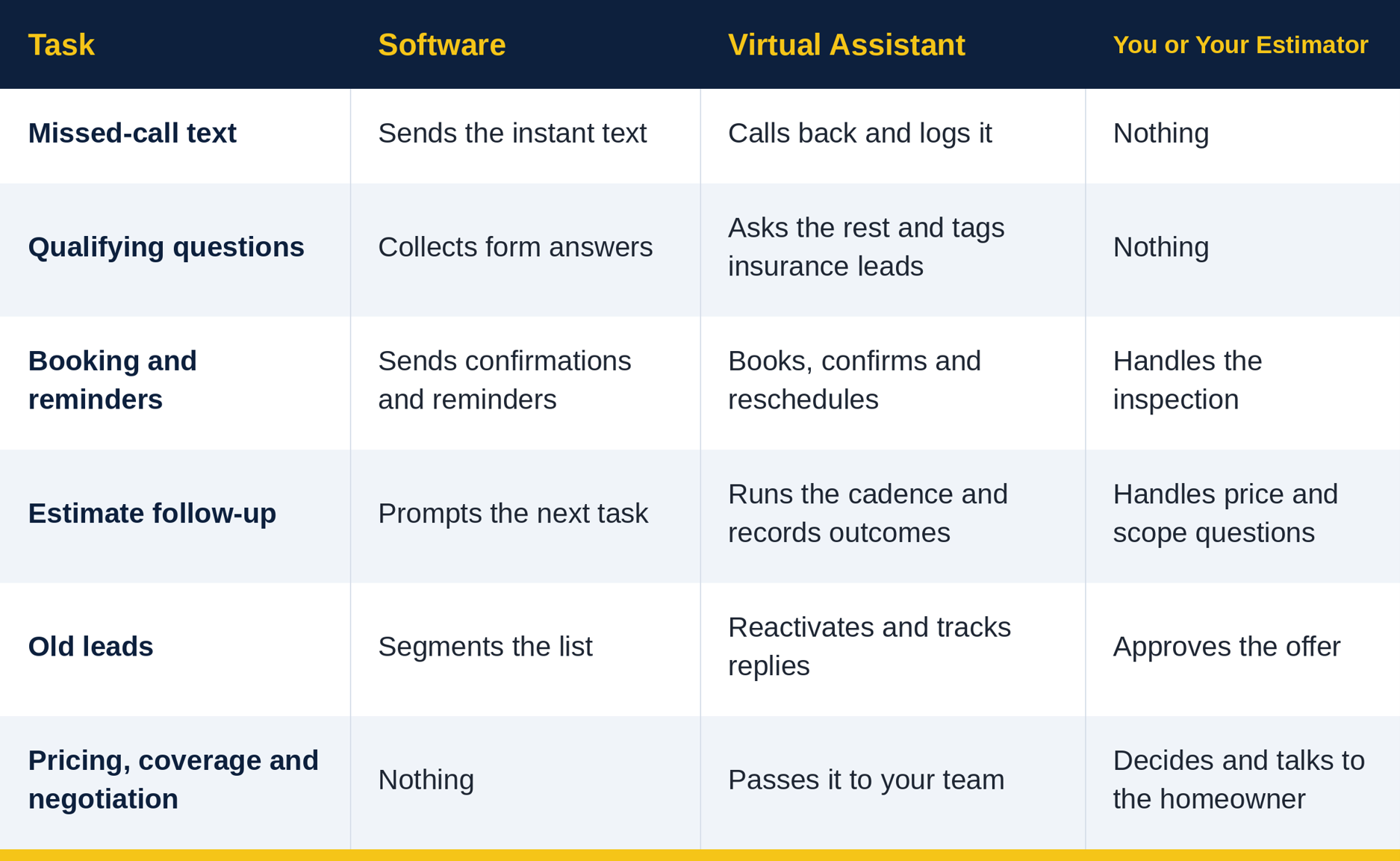
What does a virtual assistant do in a lead follow-up system?
A virtual assistant owns the follow-up so it happens every time. In practice, they can:
• Log every lead in the CRM with source and status
• Reply to new leads and follow up on missed calls
• Ask the qualifying questions and tag insurance and storm leads
• Book inspections and send confirmations and reminders
• Run the estimate follow-up cadence and record outcomes
• Reactivate old estimates and "not now" leads
• Keep the CRM clean and send you a daily or weekly summary
• Hand any pricing, scope or coverage conversation to your team
Savvital's assistants work in your tools, send end-of-day reports and are backed by free replacements and a 30-day money-back guarantee. Se our Pricing so you can start with lead follow-up and expand. See our roofing virtual assistant services page for more, or the full roofing virtual assistant guide.
Confirm coverage hours. A virtual assistant works scheduled hours, so for after-hours leads you may still want a missed-call text-back tool in place. Ask your provider exactly which hours are covered.
How do you get started?
Start narrow. Put all leads in one CRM and define your statuses. Write your first reply, missed-call and estimate messages. Have the assistant start with replies and missed calls, review their work daily for the first couple of weeks, then add estimate follow-up and old leads.
Explore Savvital Pricing
See our roofing virtual assistant services.
Ready to stop losing leads?
See how a dedicated assistant could own your follow-up. Explore our roofing executive assistant services, read the roofing virtual assistant guide, or book a call.
Keep reading
• Roofing virtual assistant: what to delegate and how to hire one
• Roofing answering service and storm-season call overflow
• How roofers can work with insurance companies (podcast recap)
• Insurance claims support for roofing companies
Savvital delivers fully managed Virtual Assistants for insurance agencies—combining full-time, pre-trained talent with enterprise cybersecurity.
Frequently Asked Questions
What is roofing lead follow-up?
Everything you do after a homeowner contacts you until they hire you or decide not to: replying, qualifying, booking, following up on the estimate and checking in with leads that aren't ready.
Can a virtual assistant do roofing lead follow-up?
Yes. They can reply to leads, call back missed calls, qualify, book inspections, run the estimate cadence and revive old leads, working in your CRM and phone system.
How fast should roofers respond to leads?
As fast as you reasonably can, on the same channel the lead used. Set a target, such as a reply within minutes during business hours, and measure it.
How do I follow up on a roofing estimate?
Set a cadence, such as a same-day check and follow-ups over the next couple of weeks, and record the outcome. Hand price or scope discussions to your estimator.
How can roofers follow up with old leads?
Group them (old enquiries, unclosed estimates, past customers) and send each group a relevant message, using the reason they didn't buy.
Is an AI appointment setter better than a virtual assistant?
They do different jobs. Automation is fast for simple steps. A virtual assistant handles conversations and follow-through. Many companies use both.
Published on 4 Nov 2026
Author: Noor Ul Ain Liaqat