A roofing virtual assistant is a remote professional who handles the office side of a roofing business: answering and logging leads, managing email and calendars, preparing estimates and invoices, coordinating schedules and keeping insurance and claim paperwork organized. Your crews and estimators stay on roofs and make the judgment calls. The assistant handles the follow-up, records and admin that otherwise pile up in the office, especially after a storm.
This guide explains what a virtual assistant for roofing companies can do, which tasks to delegate and which to keep, how insurance and claims work fits in, what it costs, how to hire well and how the main provider types compare. It is written for roofing owners, office managers and operations leads.
What is a roofing virtual assistant?
A roofing virtual professional is a remote worker who takes on administrative, customer-facing and back-office tasks for a roofing company, usually through your own email, phone system, CRM and accounting tools. You may also see the role called a roofing contractor virtual assistant, a roofer virtual assistant or a roofing office assistant. They all describe the same idea: a person who runs the office tasks so you don't have to.
What separates a roofing assistant from a generic one:
- They understand the job flow. Lead, inspection, estimate, contract, production, invoice and, on insurance jobs, claim and supplement.
- They work in your systems. Your CRM, calendar, accounting software, photo and measurement tools and shared drives.
- They follow your process. You define the steps, scripts and templates. They repeat them consistently.
Roofing company virtual assistants are not a replacement for your estimators, project managers or crew leads. They sit behind them and keep things moving.
Why do roofing companies hire virtual assistants?
Roofing companies hire virtual assistants because the work that makes money happens on roofs, while the work that keeps the business running happens at a desk, and the desk work gets dropped when the field gets busy.
Common triggers:
- Missed calls and slow follow-up. When everyone is on a roof, new leads wait. A lead that waits may call the next company.
- Storm surges. One hail or wind event can multiply calls, inspections and claim files overnight.
- Owner doing office work. Owners and estimators end up answering email, chasing invoices and updating spreadsheets.
- Paperwork gaps. Missing photos, unsigned forms and unlogged conversations cause delays and disputes later.
- Hiring friction. Finding, training and keeping local office staff is slow and uneven.
A virtual assistant doesn't fix all of that, but a dedicated person owning the follow-up and records reduces dropped balls. If you want to compare the support options for insurance-heavy work, see our guide to how roofers can work with insurance companies for the agency's view of what the market looks like.
What tasks can a virtual assistant do for a roofing company?
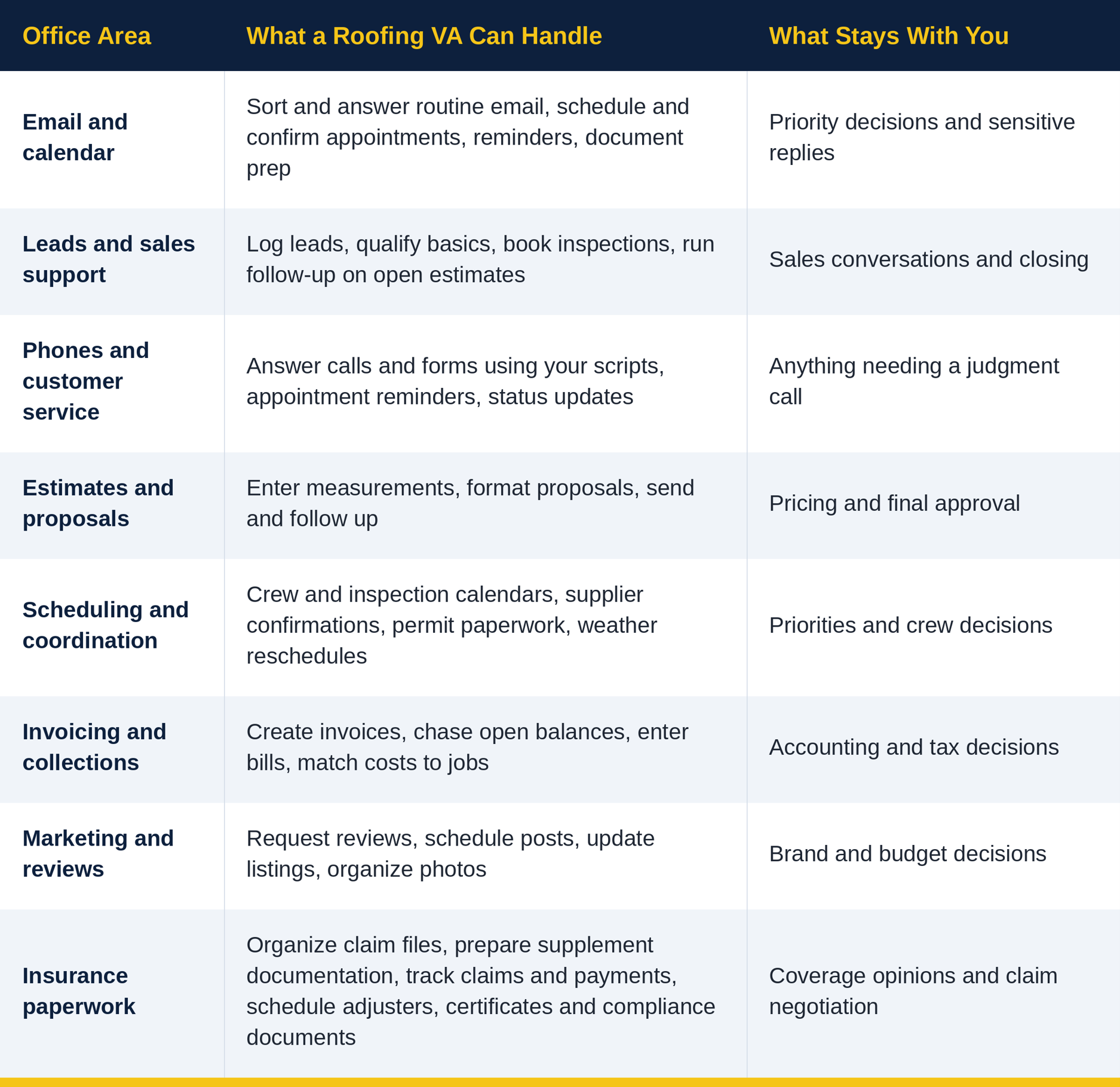
A virtual assistant for a roofing company can handle most repeatable office work: inbox and calendar management, lead intake and follow-up, estimate and proposal prep, scheduling, invoicing, records and reporting.
Here is the full picture by area.
Email, calendar and general back office
Email and calendar management is often the fastest win. An assistant can sort and answer routine email, flag what needs you, schedule and confirm appointments, manage reminders, prepare documents and keep shared files tidy. They can also handle data entry, update spreadsheets and prepare simple reports. Some providers focus mainly on phones and leads and don't describe this kind of general back-office support, so check that it is covered if you need it.
Leads, sales support and follow-up
An assistant can log every new lead, respond quickly, qualify the basics (address, roof type, damage, timeline, whether insurance is involved), book inspections and run a consistent follow-up sequence on open estimates. Consistent follow-up is one of the most useful things a roofing virtual assistant can own, because it is easy to let slide.
Phones and customer service
An assistant can answer calls and web forms, take messages, route urgent issues and answer routine questions using your scripts. They can send appointment reminders, confirm arrival windows and update homeowners on job status. Anything that needs a judgment call goes to your team.
Estimates and proposals
An assistant can enter measurements into your estimating software, format proposals, send them and follow up. The pricing decisions and final review stay with your estimator.
Scheduling and project coordination
Calendar control, crew and inspection scheduling, supplier and delivery confirmations, permit paperwork and weather-related rescheduling are all work a virtual assistant can coordinate, with you making the calls on priorities.
Bookkeeping, invoicing and collections
An assistant can produce invoices after job completion, send reminders on open balances, enter supplier and subcontractor bills, match costs to jobs and help prepare numbers for your bookkeeper or accountant. Final accounting decisions stay with your accountant.
Marketing and reputation
Assistants can request reviews after completed jobs, respond to routine reviews, schedule social posts, update listings and keep your photo library organized.
Reporting
Weekly summaries of leads, inspections booked, estimates sent, jobs scheduled and invoices outstanding give you visibility without opening five tabs. Savvital's assistants send an end-of-day report, so you can see what was done and what is waiting.
What insurance work can a roofing virtual assistant handle?
For roofing companies that do insurance work, a virtual assistant can handle the documentation, tracking and scheduling around a claim. They should not give coverage opinions or negotiate the claim for the homeowner. Insurance paperwork is a common time sink in roofing offices, which is why we call it out explicitly.
Delegable insurance-related work includes:
- Claim file organization. Collecting and filing inspection photos, measurements, signed forms and correspondence so each claim file is complete.
- Documentation for supplements. Preparing the information package your estimator or supplement specialist needs, such as photos, measurements, notes and line items.
- Adjuster scheduling and follow-up. Booking meetings, sending reminders, chasing status and logging every conversation.
- Claim status tracking. Keeping a simple tracker of open claims, what is pending and what the next step is.
- Payment tracking. Tracking insurance checks, deductible collection and recoverable depreciation reminders so money doesn't sit uncollected.
- Homeowner updates. Sending your standard explanations of next steps, appointment reminders and status updates.
- Referral report-backs. Sending referring insurance agents a short update on each lead (damage, no damage, status), a practice discussed on the Roofing Insights podcast.
- Your own insurance paperwork. Certificates of insurance requests, workers' compensation and general liability documents, license and insurance renewal tracking and compliance paperwork for general contractors and property managers.
Savvital's CEO, Troy Thompson, runs an independent insurance agency, and in Savvital's recap of the Bricks and Risk podcast he says 8 of that agency's 22 staff are virtual assistants. Claims-related paperwork, carrier correspondence and certificates are everyday work for that team, so the insurance side of roofing work is familiar territory, not something to explain from scratch. See how roofers work with insurance companies for Troy's view from the agency side, and our guide to insurance claims support for roofing companies for the delegation detail.
What should a roofer keep in-house?
Keep anything that involves judgment, accountability or a legal or licensing line. A virtual assistant handles process. You handle decisions.
• Roof inspections and the honest damage or no-damage opinion
• Pricing, final estimate approval and contract terms
• Any conversation about what an insurance policy covers
• Negotiating a claim or a scope of work with an adjuster
• Quality control on the job site and final walkthroughs
• Hiring, firing and crew management
• Final accounting and tax decisions
A useful test: if a mistake would cost a customer, a claim or your license, a person on your team makes the decision and the assistant prepares the information.
How can a virtual assistant help during storm season?
During storm season a virtual assistant keeps the office from becoming the bottleneck. One hail or wind event can multiply calls and claim files overnight, and responding quickly and keeping clean records help you make the most of those leads.
A simple storm-season setup:
1. Intake. Every call, form and message is logged in your CRM with address, roof type, damage described and whether insurance is involved.
2. Triage. Insurance claim leads and retail leads are tagged separately so the right person follows up.
3. Booking. Inspections are scheduled by area and crew availability, and homeowners get confirmations and reminders.
4. Follow-up. Open estimates and unanswered leads get a set cadence of follow-up, so nobody is forgotten.
5. Claim files. Photos, measurements and paperwork are filed in a consistent structure as jobs come in.
6. Daily report. You get a short summary of calls handled, inspections booked, claims in progress and items needing your decision.
Plan this before the storm, not during it. Write the scripts, templates and file structure now so an assistant can start fast.
What roofing virtual assistant services are available?
Roofing virtual assistant services come in several forms, and the right one depends on how much management you want to do yourself.
- Freelance marketplaces. The lowest listed rates, but you do the hiring, training, quality control and replacement yourself.
- Managed virtual assistant companies. A provider recruits, vets, trains and supports the assistant, and replaces them if it isn't working. Most charge a flat monthly fee.
- Roofing-specific outsourcing firms. Providers that focus on contractors and offer packaged services such as answering, claims support and bookkeeping, often with their own scripts and tools.
- Local in-house office staff. Full control and local presence, with the full cost of payroll, taxes, benefits, equipment and turnover.
What Savvital's service includes. Savvital provides a dedicated virtual professional matched to your industry, working 40 hours a week at one flat monthly price. According to its pricing page, plans include:
• Email and calendar management
• CRM updates and data entry
• Document formatting and preparation
• Client communication support
• Daily end-of-day reports
• Work in your own tools, such as Slack and Asana
• Priority task handling and workflow optimization support
• Free replacements and a 30-day money-back guarantee, on a month-to-month basis
On top of general admin, Savvital's insurance experience applies to the insurance side of roofing: claims-related paperwork, carrier correspondence, certificates and follow-up, skills it has built working with insurance agencies. That matters for roofers who do insurance work, because the assistant understands why a missing photo or unsigned form matters.
See the full service on the offshore virtual assistant services page, or review pricing.
How much does a roofing virtual assistant cost?
Costs vary widely by provider, skill level and what is included, and published rates can mislead because they often leave out training, management time and replacement costs. We don't quote a market average. Instead, here is how to think about it.
- Savvital's plan is $2,300 per month for 40 hours a week, flat, month-to-month. That works out to about $13 an hour ($2,300 ÷ about 173 working hours a month).
- Compare total cost, not the hourly rate. Add training time, management time, tools, replacements and the cost of mistakes.
- Compare with a local hire. Include salary, payroll taxes, benefits, equipment, training and turnover.
- Use a break-even check. Estimate how many hours a week of office work is delegable, multiply by the value of that time and by about 4.3 weeks, and compare it with the monthly fee.
An example with hypothetical numbers: if an estimator spends 12 hours a week on admin and their time is worth $40 an hour to the business, that is $2,064 a month ($40 × 12 × 4.3). Your numbers will differ.
For the broader cost picture, see our savings calculator and insurance virtual assistant cost guide.
How do you hire a roofing virtual assistant?
To hire roofing virtual assistant support, define the work first, then choose the provider type, test with a trial and review closely in the first month. Hiring well is mostly about clarity.
1. List your tasks. Write down what eats your time: email, lead follow-up, scheduling, invoices, claim files. Rank them by hours per week.
2. Pick the first workflow. Choose one that is repetitive, time-sensitive and easy to review.
3. Decide the model. Freelancer, managed company, specialist or local hire (see above).
4. Ask the right questions. Ask what is included, how the assistant is vetted and trained, what happens if they leave, how security is handled, what hours they cover and how pricing works.
5. Check tool fit. Confirm they can work in your CRM, calendar, accounting software and photo tools, or can learn them quickly.
6. Run a trial. Use a 30-day window with clear tasks and a way to measure results. A money-back guarantee lowers the risk.
7. Write the process down. Scripts, templates, folder structure and escalation rules make the assistant effective faster.
Red flags: vague task lists, no replacement policy, no explanation of vetting, rates that seem too good to be true, and unwillingness to put terms in writing.
For more on the hiring steps, see how to hire an insurance virtual assistant, which applies equally to roofing offices that do insurance work.
Should your roofing virtual assistant be offshore?
Many roofing companies use offshore assistants because they offer a lower cost for office work, and some use onshore assistants for live, local conversations. The right mix depends on your workflows. Process-driven work such as data entry, claim file organization, invoicing and follow-up suits written handoffs. Live customer conversations may suit local staff.
Savvital's assistants work from outside the United States. To think through the decision, read our guide to offshore virtual assistants, the comparison of offshore vs onshore virtual assistants and our guide to offshore administrative and executive assistants.
What does the first 30 days look like?
Start narrow and expand. A good first workflow is lead logging and follow-up, or claim file organization, because both are high-volume and easy to check.
- Week 1, setup. Give role-based access to your CRM, calendar, email and shared drive. Share scripts, templates and a short walkthrough of how your office works.
- Week 2, supervised work. The assistant handles the first workflow while you review the output daily.
- Week 3, ownership. Reduce review to spot checks and set targets, such as response time to new leads.
- Week 4, review and expand. Look at the results, fix the process and add a second workflow if the first is reliable.
Before day one, prepare: logins, a lead-handling script, an inspection booking guide, your claim file folder structure, invoice and follow-up templates, an escalation guide and short screen recordings of your tools.
How do you measure success?
Pick a few measures at the start and review monthly.
• Lead response time. How quickly new calls and forms get a first response.
• Follow-up completion. Share of open estimates that received the planned follow-up.
• Booking rate. Inspections booked from the leads logged.
• Claim file completeness. Share of claim files with photos, measurements and signed forms in place.
• Invoice turnaround. Days from job completion to invoice sent, and days to payment.
• Error rate. Corrections you had to make, which should fall over time.
• Your time recovered. Hours of admin you or your estimators no longer do.
Common mistakes
• Delegating everything at once instead of starting with one workflow.
• No written process, so the assistant has to guess.
• Choosing on price alone and ignoring training, replacement and security.
• Letting the assistant make judgment calls on damage, coverage or pricing.
• Skipping review in the first month.
• Not planning for storm season until the storm arrives.
• Sharing one login instead of role-based access.
• Assuming every provider covers the same work. Check email, back office, insurance support and hours in writing.
Ready to get your office time back?
See how a dedicated assistant could support your roofing company. Explore our roofing virtual assistant services, read about how roofers work with insurance companies, check pricing or book a call.
More from Savvital
• How roofers can work with insurance companies (podcast recap)
• Insurance claims support for roofing companies
• Offshore virtual assistants: the complete guide
• How to hire an insurance virtual assistant
• Insurance virtual assistant cost in the USA
• What does an insurance virtual assistant do?
• 10 tasks insurance agencies should outsource
• Insurance back-office tasks to outsource
Savvital delivers fully managed Virtual Assistants for insurance agencies—combining full-time, pre-trained talent with enterprise cybersecurity.
Frequently Asked Questions
What is a roofing virtual assistant?
A remote professional who handles office tasks for a roofing company, such as leads, email, scheduling, invoicing, records and insurance paperwork, under your direction
What can a virtual assistant do for a roofing company?
They can manage email and calendars, log and follow up on leads, answer routine calls, prepare estimates and invoices, coordinate schedules and organize job and claim files. Inspections, pricing and coverage decisions stay with your team.
What is the difference between a roofing contractor virtual assistant and a general virtual assistant?
A roofing contractor virtual assistant understands the job flow (lead, inspection, estimate, contract, production, invoice, claim) and works in the tools roofers use. A general assistant may need that taught from scratch.
Can a roofing virtual assistant handle insurance claims?
They can handle the documentation, tracking and scheduling around a claim, such as organizing photos, preparing supplement documentation, booking adjuster meetings and tracking payments. They should not give coverage advice or negotiate the claim for the homeowner. Rules vary by state, so check yours.
Is a virtual assistant for roofers worth it?
It can be if you have delegable office work and the time saved is worth more than the fee. Use the break-even check above with your own numbers.
How do I hire a roofing virtual assistant?
List your tasks, pick a first workflow, choose a provider model, ask about vetting, training, security and replacement, test with a trial and write down your process.
How much does a roofing virtual assistant cost?
It depends on the provider and what is included. Savvital's published plan is $2,300 per month for 40 hours a week, flat and month to month. Compare total cost, including management time and replacements.
Can a roofer virtual assistant manage my email and calendar?
Yes, if the provider includes it. Some roofing-focused services concentrate on phones, leads and claims and don't describe general email and calendar management, so confirm it in writing.
Can a virtual assistant answer my phones after a storm?
Many can handle overflow calls and web forms using your scripts. Confirm the provider's hours and how urgent calls are escalated.
Are offshore roofing virtual assistants a good idea?
They can work well for process-driven tasks such as data entry, invoicing and file organization. Live customer conversations may suit local staff. See our guide to offshore virtual assistants for the trade-offs.
What tools should a roofing company virtual assistant know?
They should be able to work in your CRM, calendar, accounting software and photo and measurement tools, such as the ones your office already uses. Ask about your specific tools during the trial.
How is Savvital different from other roofing virtual assistant providers?
Savvital offers a flat $2,300 plan for a dedicated assistant for 40 hours a week, covering email and calendar management, back-office work and insurance-side support, with free replacements and a 30-day money-back guarantee.
Published on 28 Oct 2026
Author: Noor Ul Ain Liaqat