
How Roofers Work With Insurance Companies
Troy Thompson
Roofers working with insurance companies and agents face a market that has changed fast: carriers are non-renewing older roofs, raising wind and hail deductibles, paying more roofs on actual cash value and declining new business. On the Roofing Insights podcast, Troy Thompson explained what is driving those changes from the inside of an independent insurance agency, and how roofers can work with agents without hurting homeowners, carriers or their own reputation.
Troy Thompson is President & CEO of Savvital. Savvital delivers fully managed Virtual Assistants for insurance agencies, combining full-time, pre-trained talent with enterprise cybersecurity. In this episode the host introduces him with Pinnacle Insurance in Minnesota, and Troy speaks as an insurance agency owner. The conversation is about insurance from the agency's side, not about adjusting or roofing. The show is hosted by Dimitri of Roofing Insights.
What did Troy Thompson cover on Roofing Insights?
Troy covered how the insurance market looks to an agency owner and what that means for roofers who depend on insurance work. The conversation moved from why premiums are rising, through carrier losses, deductibles and roof coverage, to how roofers and agents can work together honestly.
The main threads were:
• Why home and auto premiums are rising, and why carriers are tightening what they will write
• How hail claims affect carriers, agents and homeowners
• How roofers can partner with independent agents, and what agents need in return
• Managed repair programs, fraud, vandalism and aggressive inspection tactics
• Why starting an independent agency has become far harder
• Troy's advice that homeowners reserve claims for large losses
Why is homeowners insurance so hard right now?
Troy called it a hard market, one of the hardest in the history of the country. (A hard market is one where carriers raise rates and tighten what they will insure.) In his words, carriers are paying out more than they take in, so they are raising rates, restricting what they write and in some cases leaving states.
Here is what he said is behind it:
- Larger and more frequent losses. He pointed to inflation, higher repair costs, more litigation and more claims, especially hail and wind in Minnesota.
- Rising premiums. He said carriers in Minnesota have been raising rates roughly 30 to 40 percent a year for the last two or three years, and that homeowners' incomes have not risen to match. That is his estimate, not a published figure.
- Tighter underwriting. He described carriers that require bundling, will not write a roof older than about ten years, or decline customers with several claims in five years, even if some of those claims paid nothing.
- Fewer places to go. Customers who are non-renewed find fewer carriers willing to write them, or face higher premiums when they do.
For homeowners this means more calls to agents about large increases. Troy said his agency takes roughly ten calls a day from customers whose rates rose by a thousand dollars or more and who had not budgeted for it. For roofers it means more customers worried about roof age and claim history.
If you want to read more about how an agency copes with this workload, see how virtual assistants help insurance agencies.
Why are deductibles and roof coverage changing?
Troy said deductibles and roof payment terms are changing quickly, and in ways many homeowners do not notice until they file a claim. He described the shifts he sees across carriers, and was open that he is not an expert on every carrier's wording.
- Wind and hail deductibles. He said many carriers have moved from a flat deductible of around $1,000 or less to a percentage of the home's value, which on a higher-value home can mean several thousand dollars or more.
- Actual cash value on roofs. He explained that a roof insured on actual cash value is paid based on its remaining life. His example: a 25-year roof with 12 years left would be paid at roughly half of what a new roof costs.
- Scheduled roof payments. He described payment schedules that work the same way, paying less as the roof ages.
- New endorsements. He mentioned a large carrier offering an endorsement that requires an extra payment to cover undamaged roof parts, and said he was not sure how it works in detail.
For roofers, these changes affect what a homeowner will actually receive and what they will owe out of pocket, so they should be part of every conversation about a claim.
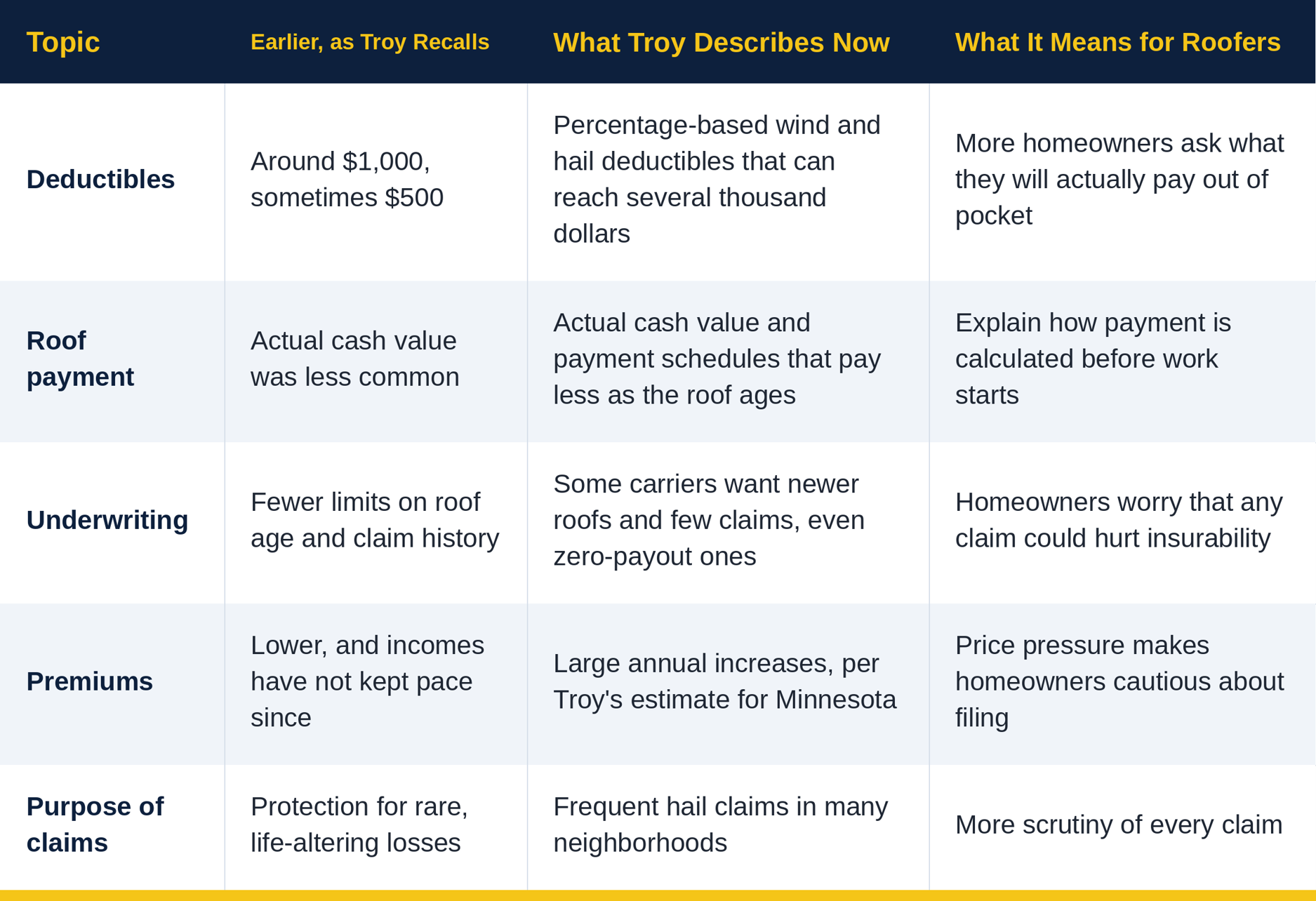
Troy recalled flat deductibles of around $1,000, sometimes $500, and now describes percentage-based wind and hail deductibles. He said actual cash value and payment schedules on roofs are spreading. Carriers increasingly want newer roofs and few claims, premiums have risen sharply in recent years, and claims that once covered rare, life-altering losses now come frequently after hail.
For roofers, each change means more homeowners asking about out-of-pocket cost, more explaining of how payment is calculated and more customers deciding whether a claim is worth filing.
Do insurance companies really lose money on claims?
Troy said carriers' losses are real, but he also said he does not fully understand how every large company reports them. He and the host compared figures the host remembered from earlier years against Troy's view that large carriers are now paying out more than they collect in premium. Those numbers were recollections, not verified data, so we do not repeat them here. If you cite figures, check each carrier's filings.
He made one point with simple arithmetic. If a homeowner pays $2,000 a year in premium and an average hail claim costs about $30,000 (his estimate: roughly $15,000 of it for the roof and about $30,000 in total), the carrier needs fifteen claim-free years to break even on a single claim ($30,000 ÷ $2,000 = 15). He described neighborhoods where many houses have had hail claims in recent years.
He also acknowledged the other side. Homeowners who pay for decades and then face a denied claim feel punished, and he said he sees the situation from the roofer's, the homeowner's and the agent's side.
One more detail matters for agents: Troy explained that agencies can earn contingency bonuses tied to their carriers' loss ratios, which he said could be worth hundreds of thousands of dollars, but that heavy hail years mean agencies rarely receive them. Agents are not paid extra for the added claims work, so a bad hail year costs them too, he said.
How can roofers work with independent insurance agents?
A roofer insurance agent referral works when roofers receive referrals from independent agents and give honest, simple answers in return. Troy said agents refer homeowners to roofers they trust after storms, and that the relationship works only if the roofer protects the agent's credibility.
His view of what works:
- An honest damage assessment. He said the worst thing a roofer can do is tell a referred homeowner they have damage when they do not, then leave the agent in the middle of a claim that has no coverage.
- A willingness to say "no damage." He described learning to refer to roofers who do not file a claim for everyone and who tell people when the roof is fine. He said that saves the carrier money, reduces fraud and avoids waste in landfills when a young roof has only a few dings.
- A simple report back. The host suggested that anyone giving away leads ask for a basic report on each one (damage, no damage, what happened), because handing out hundreds of leads with nothing coming back exposes the person who made the referrals.
- Vetting and accountability. The host said whoever gives a recommendation carries responsibility for it, and described a directory of vetted contractors he built for that reason. Troy said he is careful not to tell homeowners "you should really use this guy", because a roofer who suddenly has ten times the work can let quality slip.
Troy recalled receiving roughly 400 leads within a week after a major Twin Cities storm in June 2017 and passing them to roofers he knew. He said he did not receive anything for it.
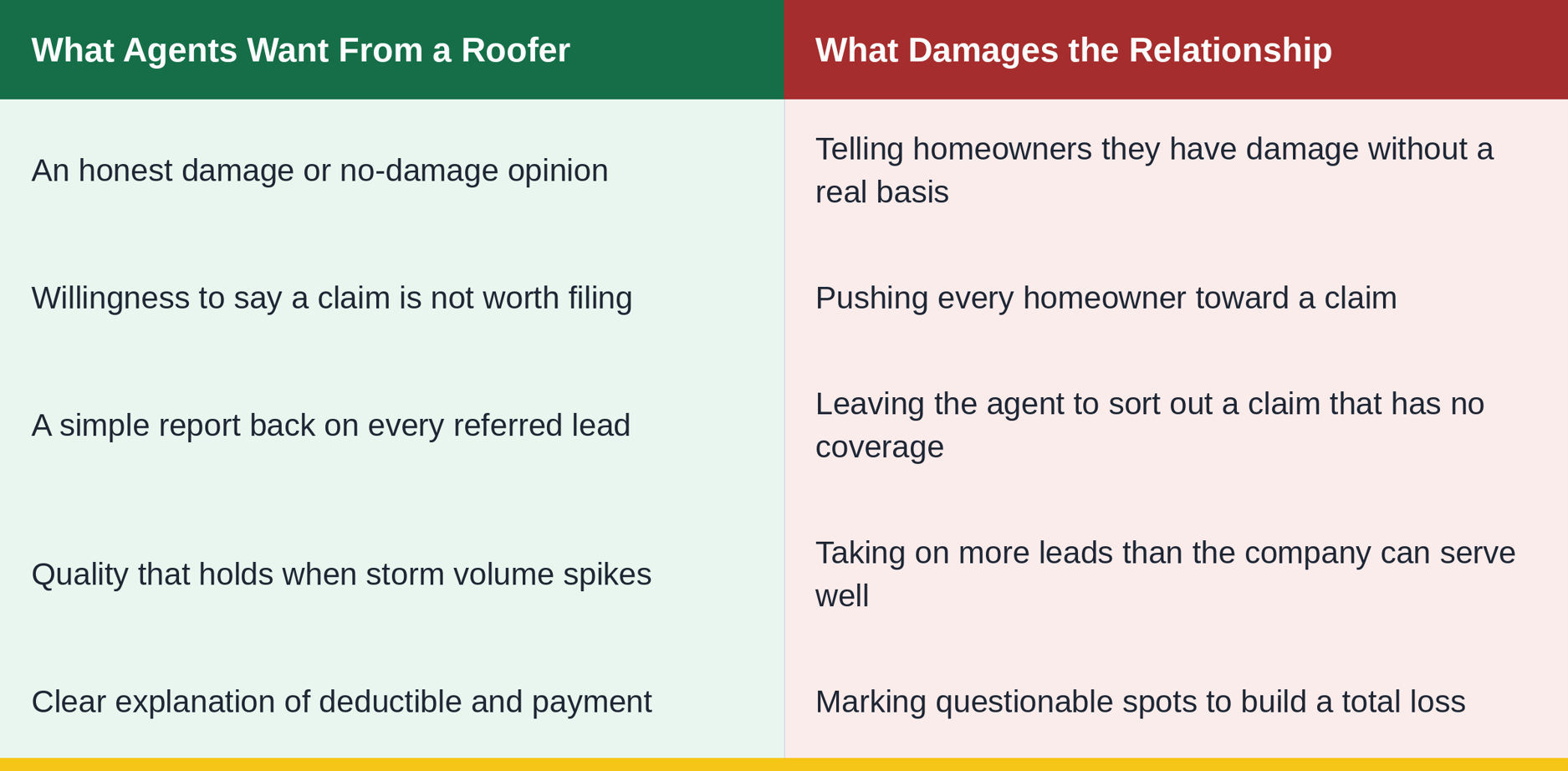
Troy quoted, an agent-friendly roofer gives an honest damage or no-damage assessment, is willing to say a claim is not worth filing, reports back on every referral and makes sure quality holds when volume spikes. The practices that damage the relationship are telling homeowners they have damage without a real basis, pushing every homeowner toward a claim, leaving the agent to resolve a denied claim, and taking more leads than the company can serve well.
If you want the agent's day-to-day view of insurance work, see what an insurance virtual assistant does for how agencies handle service workloads.
Should a roofer tell a homeowner not to file a claim?
Yes, when the damage does not justify it, and Troy said that honest answer is what makes a roofer worth referring. He said it takes skill to tell a homeowner they have a few dings and that a claim is not worth filing, and that doing so well is part of being a trustworthy partner.
He gave several reasons:
- Claims have consequences. He said frequent claims, even small ones, can make a home harder to insure and raise premiums.
- Waste. Replacing a young roof because of minor cosmetic damage sends materials to landfill, he said, when the roof may have years of life left.
- A self-insurance test. He repeated a carrier representative's thought experiment: if homeowners paid for hail damage themselves, few would spend a very large sum replacing roofing, windows and siding for a few dings. He said homeowners should ask that question before filing.
- Neighbor effects. He described how one claim can lead to claims for siding, windows and gutters and to neighbors doing the same.
Troy was careful to say there is real hail damage that should be paid, and that he has nothing against door-to-door roofers. His point was that claims should match actual damage.
What does Troy think about managed repair programs and preferred vendors?
Troy said he does not have much direct experience with managed repair programs, so his comments were limited. The host described programs in which carriers enroll contractors, set what they charge and direct work to them.
What Troy did say was that carriers are changing many things at once: deductibles, actual cash value on roofs, endorsements and underwriting. He said he had not personally dealt with preferred-vendor setups and did not want to speak beyond what he knew. If managed repair programs affect your region, ask carriers and agents how they work in your state and what they require of contractors.
How big a problem are fraud, vandalism and aggressive inspections?
Troy said he believes there is more intentional damage than most people want to admit, and that carriers are taking fraud more seriously. He mentioned carriers using drones and satellite imagery to look for vandalism. He also said that intentional damage to property is a felony and should be treated as one. He put the scale at billions of dollars a year without citing a source, so treat that as his opinion and not a verified figure.
The host played a clip of a roofer teaching an inspection approach that involved marking anything that might be hail damage and looking for more circles to support a total loss. Troy disagreed with that approach. He did not think the roof in the clip looked like a total loss, and said a roof that is likely five to ten years old can last many more years. He also named several roofers he respects, and said the minority who give the industry a bad name hurt insurance and roofing alike.
He raised one more problem: a homeowner who files three roof claims in ten years can end up with a lower premium than a neighbor who has filed none, because the newer roof is rated more favorably. He said he does not have a solution.
The host added a point about accountability. Media and video can expose bad actors faster than the legal system, and insurers making examples of a few roofers can deter others.
Why is it so hard to start an insurance agency now?
Troy said it is far harder today than when his father went independent around 2005 or 2006. Carriers are reluctant to appoint new agencies because they are afraid to write more business without being able to raise rates enough.
His points:
- Carrier contracts. Going direct to a carrier for a contract is, in his words, close to impossible right now. He gave an example of a top carrier that appointed one new agency in the entire last year, far from the Twin Cities.
- Aggregators. One route is joining an aggregator or association that holds carrier contracts, which makes it easier. He named two; verify the names before you rely on them.
- Why carriers hold back. He said carriers pay out more than they bring in, so adding business adds risk.
This matters to roofers because the agents who take referrals are often small independent offices that are themselves under pressure.
If you run an agency and want to understand how offshore support fits a busy service queue, see offshore virtual assistants for insurance agencies.
What is Troy's one piece of advice for homeowners?
Use insurance for big losses, and take a long, hard look after a hail storm before filing for minor damage. Troy said the same advice applies to the door-to-door roofers who will knock after every storm: some of them represent legitimate damage that should be paid, but homeowners should still weigh what filing will do.
He added that homeowners should work with a good local roofer who has a team behind the work and, ideally, someone who vets and stands behind contractors, the way the host's directory aims to.
How can roofing companies handle the insurance side of the work?
Roofing companies can handle the insurance side by keeping the judgment calls with an experienced roofer and delegating the documentation and follow-up that surround them. Troy’s advice creates a steady stream of paperwork, and storm season multiplies it.
Troy did not discuss virtual assistants in this episode, so what follows is our own context, not his advice. It maps the work his advice creates to who is best placed to do it.
Keep with an experienced roofer or estimator
- The inspection and the honest damage or no-damage opinion
- The decision to recommend a claim, or to say a claim is not worth filing
- Any conversation about what a policy does or does not cover
Work a support person can take on, with your review
- Claim documentation. Organizing inspection photos, measurements and notes into a clean file for each job.
- Referral report-backs. Sending the referring agent a short update on each lead (damage, no damage, status), the kind of report the host suggested.
- Homeowner follow-up. Reminding homeowners of appointments, sending your standard explanation of how deductibles and payment work, and tracking who is waiting on what.
- Adjuster scheduling and follow-up. Booking meetings, chasing status and keeping a log of who said what and when.
- Storm-season lead handling. Answering calls, logging leads and booking inspections so none go cold while crews are on roofs.
- Invoicing and records. Producing invoices, tracking payments and keeping job files complete.
On the agency side, see how to hire an insurance virtual assistant, 10 tasks insurance agencies should outsource and insurance back-office tasks to outsource. For the cost of support, see insurance virtual assistant cost in the USA. If you are weighing location, read our guide to offshore virtual assistants.
Important. Handling claim paperwork is different from negotiating a claim for a homeowner. In some states, contractors and their staff who negotiate coverage may face public-adjuster licensing rules. A virtual assistant should document, track and schedule, not advocate. Check your state's rules with your insurance department or an attorney.
More from Troy Thompson
In [Risk and Resilience Podcast episode], Troy discusses how a globally sourced team and virtual assistants can complement a business's existing staff.
In Podcast 1, Troy discusses About Virtual Assistant Cost for an Insurance Agency on Bricks and Risk
For more on Savvital's work, see the offshore virtual assistant services page.
About Troy Thompson
Troy Thompson is President & CEO of Savvital. Savvital delivers fully managed Virtual Assistants for insurance agencies, combining full-time, pre-trained talent with enterprise cybersecurity.
Visit Savvital, connect with Troy on [LinkedIn], or book a call to see how a managed virtual assistant could support your insurance agency.
Frequently Asked Questions
How can roofers work with insurance companies?
Roofers work with insurance companies mostly through homeowners' claims, adjusters and referral relationships with independent agents. Troy's advice is to give honest damage assessments, document the roof properly, and report back to agents who refer customers.
Why are roofers and insurance agents connecting after storms?
Agents get a flood of claim questions after hail or wind, and roofers can confirm whether there is damage. Troy said agents refer to roofers they trust, but need to know the roofer will not create coverage problems for the homeowner.
Why are home insurance rates going up so fast?
Troy attributed it to higher repair costs, more litigation and more claims, especially hail and wind. He said carriers in Minnesota have been raising rates about 30 to 40 percent a year recently. That is his estimate, so check with your own agent.
Why are insurers non-renewing older roofs?
Troy said some carriers will not write homes with roofs older than about ten years, or customers with several claims in five years. Policies differ by carrier and state.
What is an actual cash value roof?
Troy explained it as payment based on the roof's remaining life, so an older roof is paid at less than the cost of a new one. His example was a 25-year roof with 12 years left paid at roughly half of replacement cost. Read your policy for the exact terms.
Why are wind and hail deductibles changing?
Troy said many carriers now use a percentage of the home's value instead of a flat amount, which can raise out-of-pocket costs. Check your own policy.
Should I file a claim for a few hail dings?
Troy's advice is to use insurance for big losses and to think about whether you would pay for the repair yourself. Real damage should still be claimed. A reputable local roofer can help you decide.
What should I ask a roofer who is referred by my insurance agent?
Ask whether they will give an honest damage or no-damage opinion, whether they will explain your deductible and payment, and what their process is. Ask your agent too, since agents who refer carry some responsibility.
Published on 26 Oct 2026
Author: Noor Ul Ain Liaqat