Roofing Bookkeeping and Invoicing Help
Roofing bookkeeping is the steady work of recording what each job costs and earns, invoicing on time and collecting what you're owed. A virtual assistant can take on much of it: sending invoices, chasing balances, entering bills and receipts, matching costs to jobs and keeping insurance payments organized. Your accountant still makes the accounting and tax decisions. For roofing contractors, this matters because payment is slow when nobody owns it, and insurance jobs add extra steps, such as deductibles, held-back depreciation and checks that need the lender's endorsement. This guide is part of our series on the roofing virtual assistant.
What is roofing bookkeeping?
Roofing bookkeeping means recording income and expenses for each job and for the company, keeping accounts reconciled and producing the reports you use to price and run the business. The goal is to answer a few questions at any time: what did each job cost, who owes us, what do we owe and what is our cash position.
Good basics, which most guides for roofing contractors agree on:
• A separate business bank account. It keeps records clean.
• Job costing. Track labor, materials and overhead against each job so you know real margins.
• Monthly reconciliation. Catch errors early.
• Change orders logged. Unbilled changes quietly erode margin.
• Digital receipts and invoices. Photographed on the road and filed by job.
• A few reports reviewed monthly. Job profitability, profit and loss, estimates against actuals and cash flow.
What can a virtual assistant do for roofing bookkeeping?
A virtual assistant does the recurring entry and follow-up work and flags anything that needs a decision. Think of them as handling the process, with your accountant or bookkeeper reviewing the result.
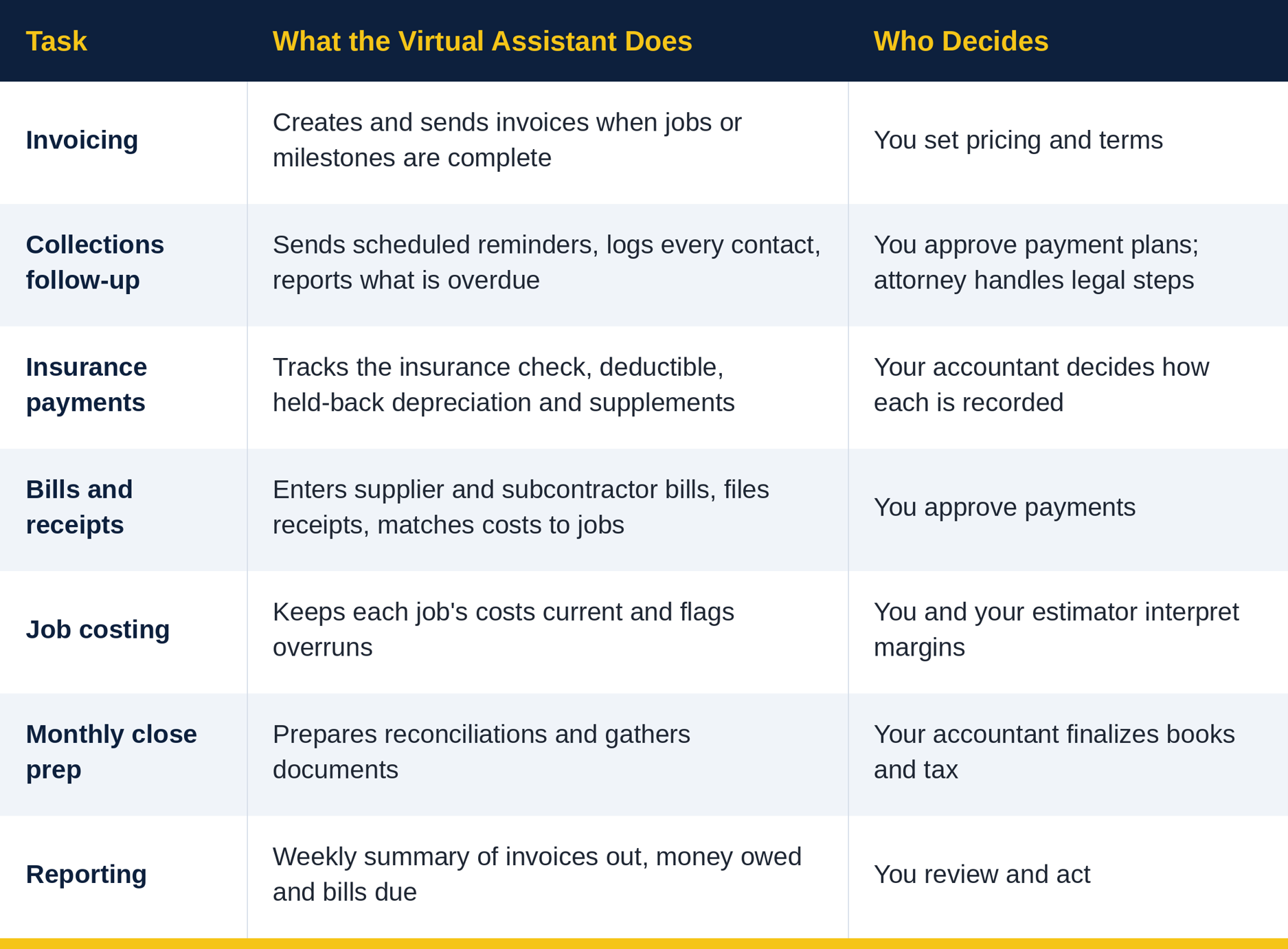
In text, the work splits like this:
• Invoicing. The assistant creates invoices when a job or milestone is complete and sends them promptly. You or your accountant set the pricing and terms.
• Collections follow-up. They send reminders on a set schedule and log every contact. You approve payment plans and concessions.
• Insurance payments. They track the insurance check, the deductible and any held-back depreciation. Your accountant decides how each is recorded.
• Bills and receipts. They enter supplier and subcontractor bills, photograph and file receipts and match costs to jobs.
• Job costing. They keep each job's costs up to date. You and your estimator interpret the margins.
• Monthly close preparation. They prepare reconciliations and gather documents. Your accountant finalizes the books and tax filings.
• Reporting. They send a weekly summary of invoices out, money owed and bills due.
For a dedicated accounting role, see Savvital's Accounting Associate.
How should you handle insurance payments in your books?
Keep insurance-funded jobs separate from retail jobs, and track each piece of the payment on its own. A single insurance job can involve several payments at different times, and mixing them makes your numbers hard to read.
A hypothetical example: a roof has a replacement cost of $30,000. The carrier holds back $10,000 in depreciation until the work is done, and the homeowner owes a $1,000 deductible. The first insurance check would be $19,000 ($30,000 − $10,000 − $1,000). The contractor then needs to track $10,000 in held-back depreciation and the $1,000 deductible as amounts still to collect.
What to track for each insurance job:
• The first insurance check and its date
• Held-back depreciation and what documents the carrier needs to release it
• The homeowner's deductible as money owed
• Supplements, tracked against the original job so they aren't counted twice
• Checks that need the mortgage lender's endorsement. These can sit with a lender for a while, so set a threshold and review them weekly.
The assistant tracks and reminds. Your accountant decides how to record revenue and receivables. Also be careful with deductibles: rules in some states restrict waiving or rebating them, so check your state's rules and do not write them off informally.
See our guide to insurance claims support for roofing companies for the paperwork side of the same jobs, and our recap on how roofers work with insurance companies.
How do you speed up roofing collections?
Use a consistent plan, check overdue accounts weekly and bring in the owner when an invoice stalls. A Roofing Contractor magazine article on accounts receivable, with attorney Trent Cotney, recommends practices like these:
• Vet customers before signing. Check for red flags before the job starts.
• Set clear expectations. Explain the process and payment terms up front.
• Review receivables weekly. Question balances that are 60 or 90 days past due.
• Follow a standard contact plan. Escalate from email reminders to calls to formal demand letters.
• Offer flexibility. Split large balances into smaller payments and resolve small disputes before they become legal problems.
• Make a personal call. A call from the owner can move a stalled invoice.
A virtual assistant is well suited to the steady middle of this: sending reminders on schedule, logging contacts and reporting what is overdue. The owner makes the personal calls and approves payment plans. Anything involving formal demand letters, liens or legal action goes to an attorney.
An example reminder schedule, to adjust to your terms: a friendly reminder when an invoice is due, a follow-up call a few days after, a firmer message at the next weekly review and an escalation to you at the point you choose.
What should you review each week and month?
A short, regular review shows problems early.
• Weekly: invoices sent, money owed by age, insurance checks and endorsements pending, bills due
• Monthly: reconciliations done, job profitability, estimates against actuals, change orders billed and cash position
Useful measures include how many days it takes to collect after invoicing and how far actual costs differ from estimates. Pick a few, record them and watch the trend.
How does Savvital help with roofing bookkeeping and invoicing?
Savvital gives you a dedicated assistant who works in your tools, enters and tracks the day-to-day, and sends an end-of-day report so you can see what was done. Savvital's background is insurance. Its CEO, Troy Thompson, runs an independent insurance agency, so claims payments, deductibles and carrier paperwork are familiar territory rather than something to explain from scratch.
• One dedicated person who learns your invoices, job files and process
• Low risk: free replacements and a 30-day money-back guarantee
• Your accountant stays in charge of accounting treatment, tax and advice
See our roofing virtual assistant services or pricing.
Ready to get invoicing and collections off your desk?
See how a dedicated assistant could keep your books and receivables current. Explore our roofing virtual assistant services, read the roofing virtual assistant guide, or book a call.
Keep reading
• Roofing virtual assistant: what to delegate and how to hire one
• Roofing lead follow-up: how a virtual assistant stops leads going cold
• Roofing answering service for contractors
• Insurance claims support for roofing companies
Savvital delivers fully managed Virtual Assistants for insurance agencies—combining full-time, pre-trained talent with enterprise cybersecurity.
Frequently Asked Questions
Can you hire a bookkeeping virtual assistant for a roofing company?
They can handle the recurring entry and follow-up: invoices, bills, receipts, job costing updates, reconciliation prep and reports. Your accountant or bookkeeper should review the books and make accounting and tax decisions.
What is roofing bookkeeping?
Recording each job's income and costs, keeping accounts reconciled and producing reports so you know margins, who owes you and your cash position.
What is job costing for roofers?
Tracking labor, materials and overhead for each job, so you can see the real cost and margin and price future jobs more accurately.
How do I track insurance payments on a roofing job?
Keep insurance jobs separate and track the first check, held-back depreciation, the homeowner's deductible and supplements individually. Ask your accountant how to record each.
How can roofing contractors collect payments faster?
Invoice promptly, set clear terms, follow a consistent reminder plan, review overdue balances weekly and step in personally on stalled accounts.
Can a virtual assistant send invoices and chase payments?
Yes. They can send invoices, send reminders and log every contact. You approve payment plans, and an attorney handles legal collection.
Published on 4 Nov 2026
Author: Noor Ul Ain Liaqat