Best Virtual Assistant Services in USA for Businesses
Searching for the best virtual assistant services usually turns up the same mix: freelance marketplaces, generalist staffing agencies, and a handful of managed providers, all claiming to be the top choice. The right answer depends heavily on the industry doing the hiring. An insurance agency handling client policy data needs a very different setup than a startup that just needs someone to manage a calendar. Savvital is a virtual assistant services company built specifically around regulated, client-facing industries, insurance, legal, marketing, dental, and healthcare, and this guide breaks down what to look for and where Savvital fits.
What Should You Look for in a Virtual Assistant Company in the USA?
Not every virtual assistant company in the USA is built the same way, and the differences matter more once the work involves client data or recurring deadlines. A few things worth checking before choosing among virtual assistant agencies USA:
- Vetting standards. Some agencies interview every applicant. Others simply list freelancers and step back.
- Industry-specific training. A VA trained on insurance workflows, legal case management, or marketing tools ramps up faster than one learning from scratch.
- Ongoing oversight. A dedicated manager checking in weekly catches problems early. A VA left entirely unsupervised often doesn't.
- Data security. Any business handling client records should confirm HIPAA compliance and a signed Business Associate Agreement, not just a general privacy policy.
- What happens if the VA leaves. A managed service replaces the person. A freelance hire means starting the search over from zero.
Professional virtual assistant services that check all five boxes tend to cost more per hour than a freelance marketplace, but they also remove most of the risk that comes with hiring blind.
For a full breakdown of that tradeoff, freelance virtual assistant vs. outsourcing to a managed service covers exactly where each option makes sense.
Virtual Assistant Service Options in the USA
Here's how the main options compare for a small business trying to decide where to start, and what actually separates them once you look past the hourly rate.
1. Savvital: Best for insurance, legal, and marketing teams
Savvital ranks among the top rated virtual assistant companies for regulated industries specifically because its virtual professionals train on industry workflows before day one and work inside a client's existing systems, not a separate tool bolted on top. An insurance VA learns AMS platforms and ACORD forms before ever touching a live file. A legal VA trains on case management software like Clio or MyCase. Every placement comes with a dedicated account manager running weekly check-ins, so the business owner isn't the one catching mistakes after the fact. Plans run $1,400 to $2,300 a month, flat, with no hourly tracking. The tradeoff is a higher starting rate than a freelance marketplace, and the model works best for businesses with recurring, client-facing, or sensitive work rather than a single short project.
2. Freelance marketplaces (Fiverr, Upwork): Best for short, low-stakes, one-time projects
These platforms offer the lowest rates on paper, often around $3 an hour, but that number doesn't include the time spent posting the job, screening applicants, writing training material from scratch, or fixing mistakes with no one else to call if the freelancer disappears mid-project. There's also no consistent security standard across freelancers, which becomes a real liability the moment the work touches client data. This route makes sense for a single bounded task with a clear end date. It gets expensive fast the moment "a few hours" turns into an ongoing role.
3. Generalist VA staffing agencies: Best for basic administrative support across any industry
These agencies typically place VAs for scheduling, inbox management, and general office tasks, usually at a mid-range rate between a freelance marketplace and a specialized managed service. What they usually lack is depth in a specific field. A generalist VA can manage a calendar competently but hasn't been trained on ACORD forms, legal intake procedures, or campaign reporting tools, which means the learning curve and management burden still land on the business owner, just at a higher price than a marketplace hire.
4. In-house local hire: Best for businesses that need someone physically on-site.
A local hire offers full control, in-person presence, and no time zone gap, which matters for roles that genuinely require someone in the building. It's also the most expensive option per hour of actual output once payroll taxes, benefits, paid time off, equipment, and recruiting costs are factored in on top of salary, and it comes with weeks of hiring time before the person is even productive. This is the right call when physical presence is a real requirement of the role, not just a preference.
Among top virtual assistant companies, the ones worth paying more for are the ones built around a specific kind of work, not general-purpose task lists. The right choice usually comes down to two questions: does the work touch sensitive client data, and does it need to stay consistent for months rather than days. The more "yes" answers, the more a managed, industry-trained service like Savvital pays for itself over a cheaper, unsupervised option.
Why Savvital Is One of the Best Virtual Assistant Companies for Small Businesses
A few things separate Savvital from a typical listing of best virtual assistants online:
- A 0.2% acceptance rate. Savvital selects a small fraction of applicants, each holding a four-year degree and fluent English, before anyone is matched to a client.
- A managed service model, not a marketplace. Every virtual professional works alongside a dedicated account manager who runs weekly check-ins and helps with onboarding, rather than leaving the business owner to manage the relationship alone.
- HIPAA-compliant infrastructure. Private VPNs, endpoint protection, and a signed Business Associate Agreement come standard, which matters most for insurance, legal, and healthcare clients handling sensitive records.
- Flat monthly pricing. Plans start at $1,400 a month for part-time support and $2,300 for full-time, with no hourly tracking or hidden fees.
- A 30-day money-back window. If the value isn't clear within the first month, Savvital refunds it.
As a best virtual assistant for small business option, Savvital's model works because the oversight and industry training are built in from the start, not something the client has to build themselves.
Savvital vs. Other Virtual Assistant Options
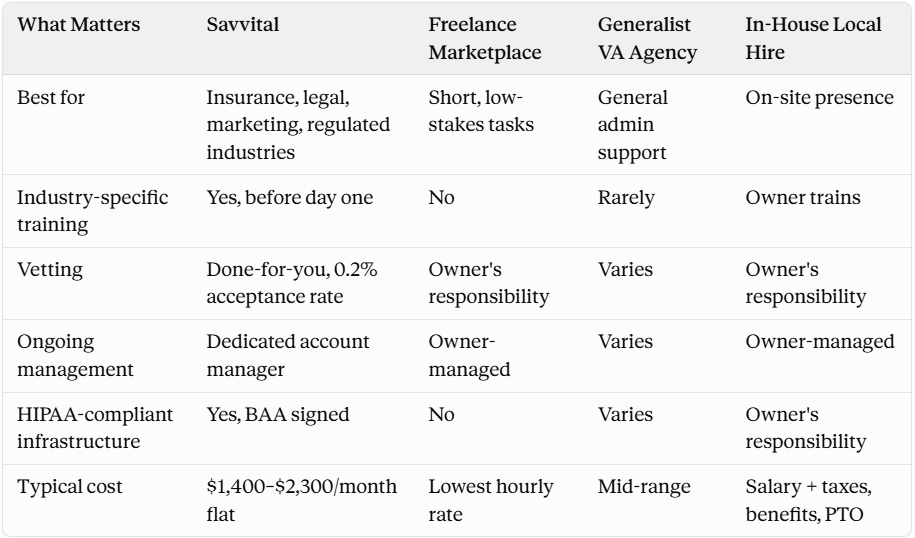
For businesses across the US comparing virtual assistant services, the deciding factor usually isn't the hourly rate on the page. It's what's actually included once the work starts.
Troy walked through the real cost gap behind this model in detail in a recent podcast conversation on virtual assistant pricing, including exactly what separates a $3-an-hour hire from a $15-an-hour managed one.
Ready to See What a Virtual Assistant Could Take Off Your Plate?
Every business's workload looks different, whether it's insurance policy servicing, legal case prep, or marketing campaign management. On a free strategy call, the Savvital team will map out exactly what a virtual professional could handle and what it would cost as one flat monthly plan.
Prefer to check the numbers first? See current Savvital pricing →
Looking for insurance-specific support? Explore the Insurance Virtual Assistant service →
Published on 23 Sept 2026
Author: Noor Ul Ain Liaqat