Feelance Virtual Assistant vs. Outsourced Virtual Assistant
A freelance virtual assistant at $3 an hour looks like an obvious win against a managed service at $15 an hour. Run the actual math on a full month, though, and the gap gets a lot more interesting.
Say a freelance VA works 20 hours a week. At $3 an hour, that's $240 a month. At $15, a managed VA on the same hours runs $1,200. On paper, the freelancer just saved four figures. But that $240 doesn't include the hours spent finding the person, training them, checking their work, and starting over when they quit, which happens often on marketplace platforms since there's no contract keeping anyone around. If fixing their mistakes and managing them eats even five hours of an owner's week at $50 an hour of the owner's own time, that's another $1,000 a month in cost that never shows up on the freelancer's invoice. The $3-an-hour VA just got expensive. It's just hidden.
Savvital delivers fully managed Virtual Assistants for insurance agencies, combining full-time, pre-trained talent with enterprise cybersecurity, built specifically to remove that hidden cost from the equation. Savvital's founder, Troy Thompson, put it plainly during a podcast appearance: you get what you pay for. This is what that actually means in practice.
What Is a Freelance Virtual Assistant, and Where Does It Actually Work?
A freelance virtual assistant is someone found, vetted, trained, and managed entirely by the business owner, usually through a marketplace like Fiverr or Upwork. There's no company standing behind the hire. If the person is good, that's a stroke of luck. If they're not, there's no one to call.
This model works well for a single, bounded task with a clear finish line: cleaning up a spreadsheet, formatting a document, transcribing a batch of files. It starts to break down the moment the work is ongoing, touches client information, or needs to stay consistent for months without constant supervision, which describes most of what actually needs doing inside an insurance agency, dental office, or medical practice.
What Does It Mean to Outsource a Virtual Assistant Through a Managed Service?
Outsourcing through a managed service means the vetting, training, and oversight happen before the VA ever touches the work. A dedicated account manager stays involved for the life of the relationship, running weekly check-ins and catching small problems before they turn into a client-facing mistake.
The practical difference shows up fastest in what happens when something goes wrong. On a freelance platform, a mistake is the owner's problem to catch, explain, and fix, usually after it's already happened. With a managed VA, a manager is already watching for exactly that, which is the entire point of paying more per hour in the first place.
.jpg)
The Real Cost Comparison: What a Cheap Virtual Assistant Actually Costs
Here's a closer look at where the $3-an-hour rate quietly loses its advantage:
- Recruiting time. Posting the job, screening applicants, and running interviews takes real hours, and there's no guarantee the first hire works out.
- Training from zero. A marketplace VA usually knows nothing about the business's tools, workflow, or industry. Every process has to be taught from scratch, often more than once.
- Correction loops. Every recurring mistake that isn't caught and fixed the first time repeats indefinitely, at an internal cost that compounds faster than the hourly rate suggests.
- Turnover. Marketplace VAs often churn within a few months, at which point recruiting and training start over completely, from zero.
- No accountability layer. If the freelancer disappears mid-project, there's no one to escalate to. The relationship ends and the search starts again.
Troy Thompson, President & CEO of Savvital, walked through this exact decision point on a recent podcast appearance, including the real cost gap between a $3-an-hour freelance hire and a $15-an-hour managed one.
Read the full breakdown of virtual assistant costs for an insurance agency
Who Should Actually Hire a Freelance Virtual Assistant?
A freelance VA is the right call for a short, low-stakes, one-time project with a clear end date, something like a single data cleanup, a batch of formatting work, or a few hours of scheduling during a busy stretch. If the task doesn't touch client data and someone has the bandwidth to manage it closely for a short window, the lower rate is a fair trade for the extra oversight.
It stops being the right call the moment "a few hours" turns into a permanent, recurring role. At that point, the hidden costs above stop being occasional and start being structural.
Who Should Outsource to a Managed Virtual Assistant Instead?
A managed VA is built for exactly the situation a freelance hire struggles with: recurring, sensitive, or client-facing work that needs to stay consistent for months, not days. A few signs a business has already crossed that line:
- The same task keeps repeating every week: Quoting, policy servicing, data entry, and follow-up calls aren't one-off projects. They're the daily operating rhythm of the business, and they need someone who's still there in month six, not just week two.
- The work touches client data: Insurance, healthcare, legal, and financial businesses can't treat data handling casually. A managed service that signs a Business Associate Agreement and runs on HIPAA-compliant infrastructure is built around that requirement. A freelance marketplace generally isn't.
- A mistake would actually cost something: A miscoded policy, a missed claims deadline, or a client detail entered wrong isn't a minor inconvenience, it can mean lost business or a compliance problem. That risk is exactly why oversight matters more than the hourly rate.
- Nobody has time to manage a hire closely: A freelance VA needs active supervision to stay useful. A managed VA comes with a supervisor already built in, which matters most for owners who took on a virtual assistant specifically to free up their own time, not add a new management task to their plate.
- The business has already tried the cheap option once: A lot of owners land on a managed service after a marketplace hire didn't pan out, quiet mistakes, slow ramp-up, or a VA who disappeared mid-project. The lesson usually isn't "virtual assistants don't work." It's "that particular setup didn't have enough structure around it."
This is exactly the scope Savvital's virtual assistant for insurance agency lays out: Policy servicing, Quoting support, and Claims follow-up handled by a trained VA, with a manager overseeing the relationship from day one rather than getting looped in after something already went wrong. For an insurance agency specifically, this isn't really optional infrastructure. It's the same kind of dependable back office that a growing agency eventually needs no matter who provides it, the only real question is whether it's built in from the start or pieced together after a few bad hires.
Freelance Virtual Assistant vs. Outsourced Managed Virtual Assistant
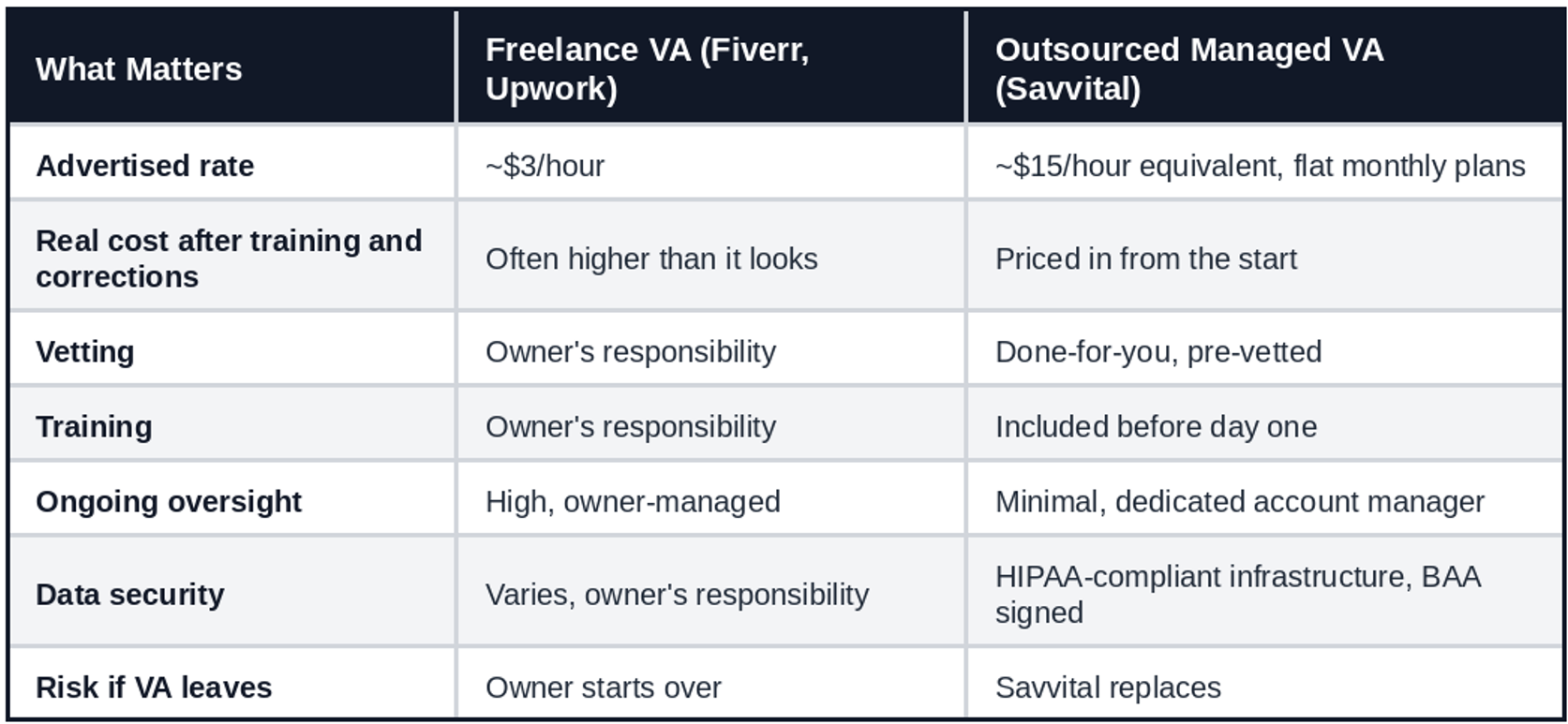
For businesses weighing this decision with real numbers instead of a headline rate, current Savvital pricing lays out the flat monthly plans behind the table above.
Ready to See the Real Cost, Not Just the Hourly Rate?
The fastest way to know which option actually costs less is to map the real workload against it, not the advertised rate. On a free strategy call, the Savvital team will walk through exactly what's eating the most time right now and what a managed virtual assistant would cost to take it off the plate, in one flat monthly number.
Prefer to check the numbers first? See current Savvital pricing
Curious what a virtual assistant can actually handle at an insurance agency? Explore the Insurance Virtual Assistant service
Frequently Asked Questions
Is it cheaper to hire a freelance virtual assistant or outsource to a managed service?
A cheap virtual assistant looks cheaper upfront, often around $3 an hour versus $15 for a managed VA. But once training time, correction time, and turnover are factored in, a low cost virtual assistant frequently ends up costing close to the same, or more, once everything is added up.
Why hire a virtual assistant through a managed service instead of doing it yourself?
The main reason to hire a virtual assistant through a managed service is oversight. A managed service vets, trains, and supervises the VA for you, while a freelance hire leaves all of that on the business owner.
What's the difference between a freelance virtual assistant and one that's outsourced through a managed provider?
A freelance virtual assistant is sourced, trained, and managed entirely by the business owner, usually through a marketplace. An outsourced virtual assistant through a managed provider comes pre-vetted and pre-trained, with a dedicated manager already in place.
Can I outsource virtual assistant services without hiring a full-time employee?
Yes, outsourcing virtual assistant services is built specifically for this. A managed provider handles the staffing and oversight, so the business gets ongoing support without adding a direct employee to payroll.
When does it make sense to outsource to a virtual assistant instead of hiring one freelance?
It makes sense to outsource to a virtual assistant once the work becomes recurring, touches client data, or would be costly to redo if it went wrong. A freelance hire vs virtual assistant freelance route works better for short, one-time, low-stakes tasks.
Published on 18 Sept 2026
Author: Noor Ul Ain Liaqat