AI In Marketing: Examples, Pros & Cons and Future
Let’s be honest.
Every marketer is talking about AI in marketing. But most people are doing it wrong.
They are either terrified that a bot will ruin their brand voice, or they are hitting "auto-generate" and wondering why their engagement is tanking.
Here is the secret: The winners in 2026 aren't letting AI drive the car. They are using AI as the high-performance engine, while a human keeps their hands on the wheel.
If you want to scale without losing your "soul," you need a strategy. In this guide, I’ll show you the exact examples of ai in marketing that work right now and how to stay in control.
Quick Summary: The AI-Human Balance
Smart businesses use AI in marketing to handle data-heavy tasks like predictive analytics and content drafts, but they keep humans in charge of strategy and final approval. By using AI marketing tools alongside elite Marketing Associate, you get the speed of automation with the safety of human oversight.
How Businesses use AI in Marketing
How are the big players doing it? Here are the most common how businesses use AI in marketing today:
1. AI-Driven SEO and Search Optimization
Search is changing. Google is now an "Answer Engine." Savvy brands are hiring ai marketing agencies specializing in ai search optimization to ensure their content shows up in AI Overviews and Perplexity results.
2. Predictive Customer Journeys
Instead of guessing what your customer wants, AI tools look at past behavior to predict what they will buy next. This is the "Amazon effect," and it’s now available for small businesses too.
3. High-Volume Content Workflows
Using AI for content creation allows you to take one "pillar" video and turn it into 20 social media posts, 3 emails, and a blog post in seconds.

Examples of AI in marketing
Here are real-world ways businesses use AI effectively.
Predictive lead scoring
AI evaluates thousands of data signals to predict which leads are most likely to convert. Sales teams can then prioritize high-value prospects.
Programmatic advertising
AI automatically buys and optimizes ad placements in real time based on performance signals.
Chatbots for customer engagement
AI chatbots provide 24/7 support, answer common questions, and collect basic lead information before human follow-up.
AI-driven email marketing
Brands use AI to personalize subject lines, content, and send times based on user behavior, improving open and click rates.
Audience segmentation
AI groups customers based on interests, behavior, and intent, enabling more relevant marketing campaigns.
AI Marketing Tools in Use Today
Businesses typically use AI across several categories.
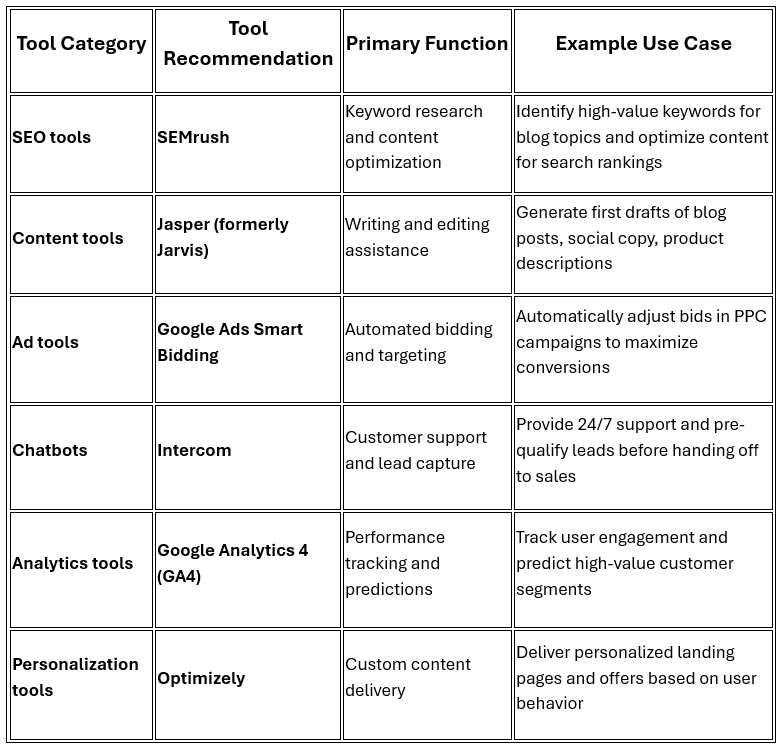
Using the right AI marketing tools helps businesses scale operations without losing quality or brand identity.
Why You Can’t Ignore AI (But Should Still Be Cautious)
There are massive pros and cons of ai in marketing. If you ignore the pros, your competitors will outpace you. If you ignore the cons, you’ll damage your brand.
The Pros of AI in Marketing:
- Hyper-Personalization: AI can analyze thousands of data points to show the right ad to the right person at 3:00 AM.
- Speed: AI for content creation can turn a 1-hour brainstorming session into a 5-minute drafting session.
- Efficiency: AI agents in marketing can now handle lead qualification and basic customer follow-ups without you touching your keyboard.
The Cons of AI in Digital Marketing:
- Hallucinations: AI can make up facts that sound very real.
- Brand Dilution: If everyone uses the same prompts, everyone sounds the same.
- Privacy Risks: Using AI without a clear data policy can lead to legal headaches.

AI Agents in Marketing
Some companies use AI agents in marketing to handle multi-step processes automatically. For example, an AI agent might analyze campaign results, adjust budgets, and generate performance reports.
While useful, AI agents still require human supervision to ensure decisions align with business goals and brand standards.
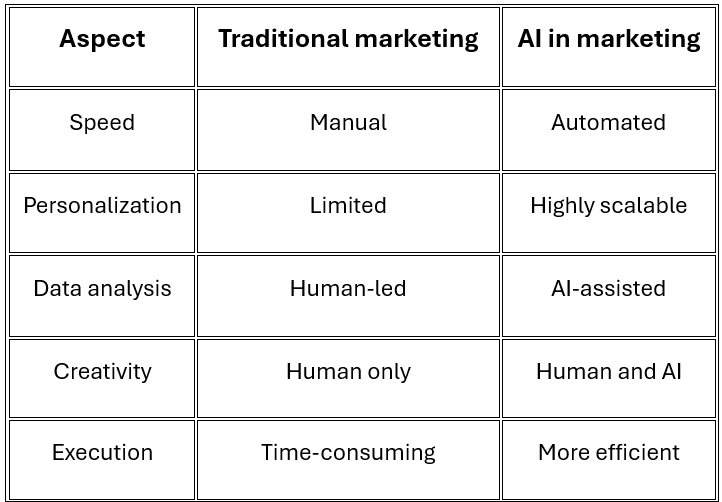
AI Marketing vs Traditional Marketing
The Future of AI in Marketing: What’s Next?
Imagine an agent that doesn't just write an email, but also checks your CRM, sees which leads haven't responded in 3 days, drafts a custom follow-up, and schedules it for the best time based on that specific lead's time zone.
That is the level of automation coming. But it only works if you have "Human-in-the-loop" oversight.
How to Stay in Control of Your Marketing AI
To succeed, you need to follow these three rules:
- Standardize Your Prompts: Don't let your team use "random" prompts. Create a brand-voice library that the AI must follow.
- Verify Every Fact: Never publish AI content without a human fact-checker. This is where most cons of ai in digital marketing happen.
- Combine Tech with Talent: AI is a tool, not a person. Use AI marketing tools to do the heavy lifting, but use human experts to do the thinking.

Conclusion: Don't Let the Machine Take Over
AI in marketing is a goldmine, but only if you have the map. If you try to automate everything, you’ll lose the trust of your audience. If you automate nothing, you’ll run out of time.
Scale Safely with Savvital
Are you worried about losing control? You don’t have to do this alone.
At Savvital, we help businesses implement AI in businesses without losing human touch. We provide elite, tech-savvy Virtual Professionals who act as your "AI Controllers." They use the best practical ways to use AI in businesses while ensuring every single post, email, and ad feels 100% human.
- Human-Verified Content: No more AI "hallucinations."
- Expert AI Agents: We set up the systems that run your marketing on autopilot.
- Predictable Growth: Focus on your vision while we handle the execution.
For businesses that want automation without losing accountability, Savvital’s human-led AI virtual support combines AI efficiency with real human judgment to keep operations accurate, compliant, and reliable.
Ready to scale your marketing without losing the human touch?
Book your free Savvital strategy session today.
Frequently Asked Questions
1. How does AI in marketing change team roles instead of replacing them?
AI in marketing usually reshapes roles rather than eliminating them. Marketers spend less time on manual tasks like reporting or basic drafting and more time on strategy, experimentation, and creative direction. Teams shift toward analysis, governance, and optimization while AI marketing tools handle repetitive execution in the background.
2. How can founders evaluate whether AI marketing tools are worth the investment?
Founders should measure impact through clear KPIs such as time saved, cost per lead, and conversion rate improvement. If AI reduces manual effort but does not improve outcomes, it may not be worth scaling. Businesses should pilot tools first, compare results, and ensure ROI before full adoption.
3. Where does AI for content creation work best inside a marketing workflow?
AI for content creation performs best in early-stage tasks like research, outlining, drafting, and SEO optimization. Human marketers add domain expertise, storytelling, and brand tone in later stages. This layered approach maintains quality while significantly speeding up production timelines.
4. How do AI marketing agencies specializing in AI search optimization operate differently?
AI marketing agencies specializing in AI search optimization focus on visibility across both traditional search engines and AI-driven discovery platforms. They optimize content for structured data, conversational queries, and AI overviews while ensuring factual accuracy and brand consistency through human review processes.
5. How should businesses balance experimentation with risk when using AI in marketing?
Businesses should test AI in controlled environments such as A/B campaigns or pilot projects before scaling. Clear guardrails, regular audits, and human oversight reduce risks like misinformation or brand misalignment. This allows teams to innovate while maintaining control and accountability.
Published on 9 Feb 2026
Author: Noor Ul Ain Liaqat