Savvital vs AI Automated Model: Why Human-Led AI Delivers Better ROI and Accuracy
AI automation platforms promise speed, scale, and efficiency. For many businesses, that sounds like the perfect solution. But once AI tools move beyond simple, repetitive tasks, cracks often begin to show.
Missed context. Inaccurate outputs. Customer frustration. Time lost reviewing and correcting AI-generated work.
This is where many businesses pause and start asking a more practical question: Is pure AI automation actually the best option, or does a human-led AI model deliver better results?
This article breaks down Savvital vs AI automation platforms, explains the real differences in outcomes, and shows why human-led AI outsourcing often delivers stronger ROI and higher accuracy.
Understanding the Difference: Automation vs Virtual Assistant
At a high level, the debate around AI automation vs virtual assistant models comes down to how work gets done.
AI automation platforms rely on predefined rules, training data, and probabilistic outputs. They work well for structured, predictable tasks but struggle when nuance, judgment, or accountability is required.
A human-led AI model, like Savvital’s, combines AI tools with experienced virtual assistants who understand context, priorities, and consequences. AI supports speed and efficiency, while humans ensure accuracy, judgment, and follow-through.
The result isn’t slower. It’s smarter. This distinction becomes clearer when you understand what an AI virtual assistant actually is and how it functions in real business workflows.
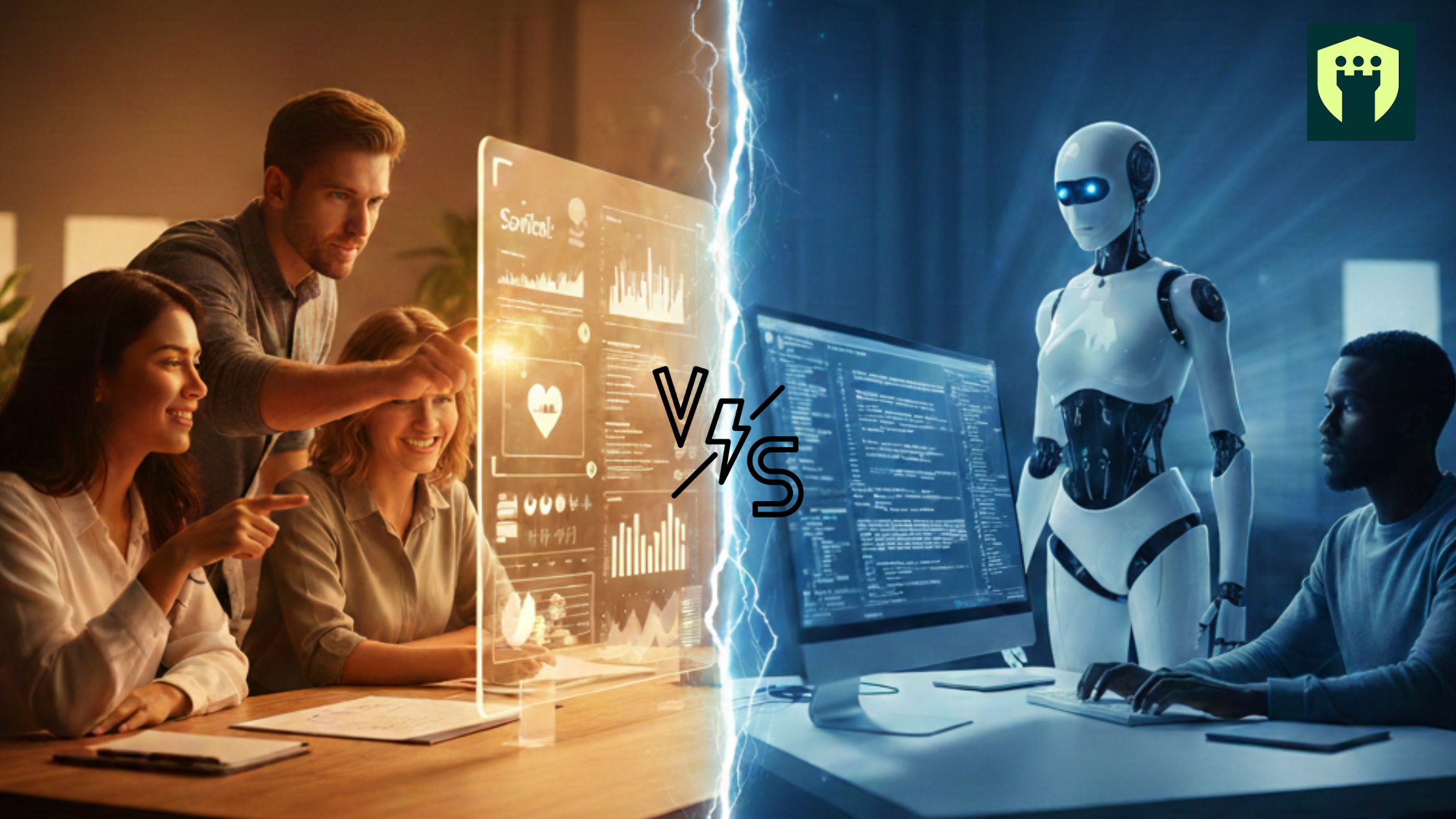
Where AI Automation Platforms Fall Short
AI automation tools are powerful, but they are not self-aware, accountable, or adaptive in the way businesses often assume.
Common limitations include:
- Lack of context awareness, especially in customer communication or operational workflows
- Confident but incorrect outputs, requiring manual review and correction
- No ownership, meaning errors don’t get resolved unless someone intervenes
- Poor handling of edge cases, exceptions, or changing priorities
Many businesses find that the time saved by automation is later spent reviewing, fixing, or re-doing work.
That hidden cost often goes unaccounted for in ROI calculations. Many of these limitations are similar to the challenges discussed when comparing AI assistants and human virtual assistants, especially around context and accountability.
Why Savvital’s Human-Led AI Model Performs Better
Savvital takes a different approach. Instead of replacing people with AI, it equips skilled virtual assistants with AI tools to work faster and more accurately.
In the Savvital vs AI tools comparison, the key difference is accountability.
With Savvital:
- A human virtual assistant owns the task
- AI supports research, drafting, organization, and execution
- Outputs are reviewed, refined, and aligned with business goals
- Exceptions are handled intelligently, not ignored
This structure dramatically reduces errors and ensures work actually moves forward. Businesses evaluating execution models often face similar trade-offs when choosing between dedicated and shared virtual assistants, particularly around ownership and consistency.
Savvital vs AI Automation Platforms: A Comparison
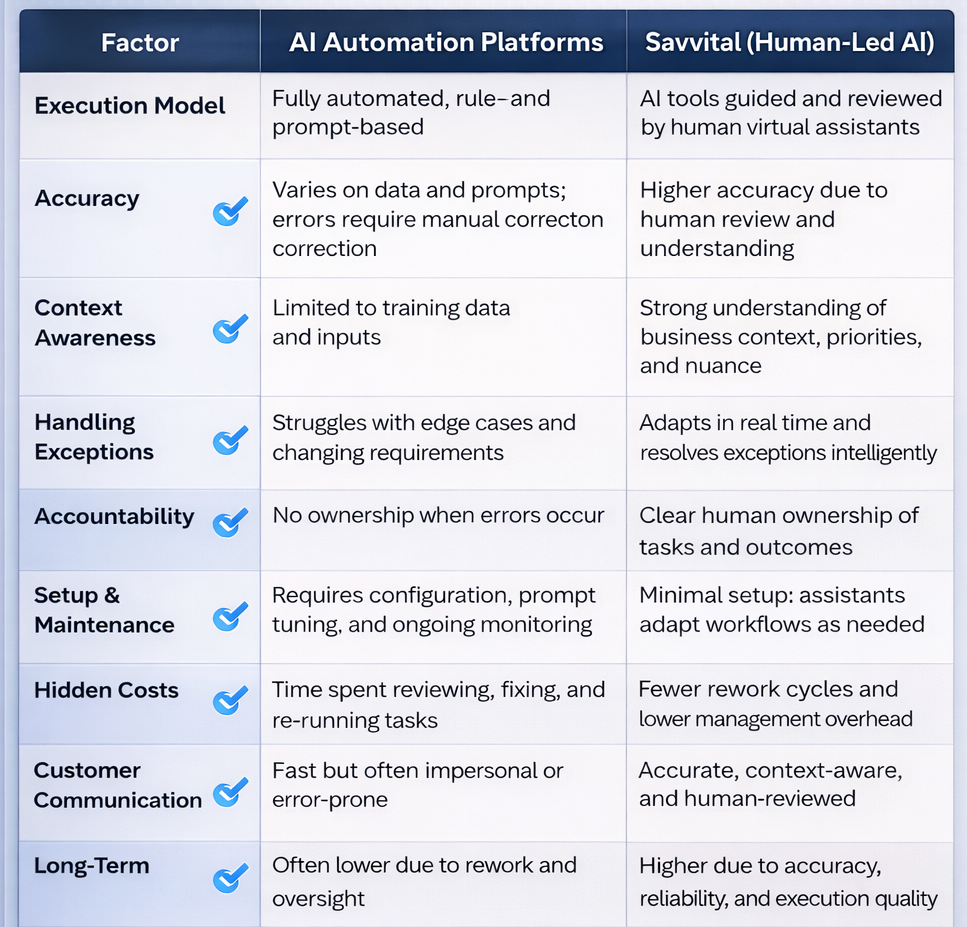
ROI: Why Human-Led AI Delivers More Value
Pure automation looks cheaper on paper, but ROI is about outcomes.
Businesses using human-led AI models typically see:
- Fewer errors and rework cycles
- Faster completion of complex, multi-step tasks
- Better customer and internal communication
- Less management overhead
In contrast, AI automation platforms often require constant monitoring, prompt engineering, and manual correction, especially as workflows become more complex.
When those hidden costs are considered, AI outsourcing comparison often favors a hybrid, human-led model.
This mirrors the broader cost and efficiency discussion many businesses have when comparing a virtual assistant vs an in-house employee.
Accuracy and Risk Management
Accuracy matters most in operations, customer experience, finance, and compliance-adjacent work. AI automation tools can’t take responsibility for mistakes, but businesses still pay the price when errors occur.
Savvital’s model adds a critical safety layer:
- Human judgment before decisions or communications go out
- Contextual understanding of business rules and priorities
- Clear accountability when something needs fixing
This significantly reduces operational risk compared to hands-off automation.
Scalability Without Losing Control
AI automation platforms scale by doing more of the same thing faster. That works until workflows change, edge cases appear, or customer expectations shift.
Savvital scales differently. As workload grows:
- AI increases speed and capacity
- Human assistants adapt workflows in real time
- Quality remains consistent even as volume increases
This makes scaling smoother and far less fragile.
When AI Automation Alone Makes Sense (And When It Doesn’t)
To be clear, AI automation isn’t useless. It’s effective for:
- Simple data processing
- Rule-based actions
- Internal tasks with minimal risk
But when work involves people, judgment, or accountability, AI automation vs virtual assistant becomes an unfair comparison. One replaces effort; the other replaces outcomes.
Most businesses don’t need “more automation.” They need better execution.
This is also why it’s important to distinguish between tools like chatbots and broader support models, as explained in our comparison of AI chatbots vs AI virtual assistants.
-1.jpg)
Savvital vs AI: The Practical Choice
Choosing between Savvital and AI automation tools isn’t a technology decision. It’s an operational one.
If your business values:
- Accuracy over volume
- Accountability over autonomy
- Real execution over theoretical efficiency
Then a human-led AI model will consistently outperform standalone automation.
Savvital doesn’t compete with AI. It uses AI responsibly, with humans in the loop, to deliver results businesses can rely on.
Which One Should You Choose?
Choose AI automation platforms if your business only needs help with simple, repetitive, low-risk tasks such as basic data processing or rule-based actions. These tools work best when workflows are predictable, require little context, and do not involve customer interaction or decision-making.
Choose Savvital’s human-led AI model if your work requires accuracy, context, accountability, or judgment. When tasks involve customer communication, operations, prioritization, or multi-step execution, combining AI efficiency with human oversight produces more reliable outcomes and stronger ROI.
In summary:
AI automation is suitable for narrow, rule-driven tasks. Human-led AI is better for real business operations where quality, adaptability, and responsibility matter.
Final Takeaway
AI automation platforms promise efficiency, but efficiency without judgment often creates more work downstream. Savvital’s human-led AI approach delivers stronger ROI because it combines speed with accountability and intelligence with context.
For businesses that care about accuracy, reliability, and real outcomes, Savvital vs AI tools isn’t a close comparison.
FAQs
Q1. What is the difference between AI automation and a human-led AI virtual assistant?
AI automation relies entirely on predefined logic and data, while a human-led AI virtual assistant combines AI tools with human judgment. This allows for better handling of context, exceptions, and decision-sensitive tasks, resulting in higher accuracy and accountability.
Q2. Is AI automation cheaper than hiring a virtual assistant?
AI automation may appear cheaper upfront, but hidden costs often emerge through errors, rework, and oversight. Human-led AI models typically deliver better ROI by reducing mistakes and management time while improving execution quality.
Q3. When should businesses choose AI automation over a virtual assistant?
AI automation works best for simple, repetitive, low-risk tasks with clear rules. When tasks involve communication, prioritization, or operational judgment, a human-led virtual assistant model is usually more effective.
Q4. How does Savvital use AI differently from automation platforms?
Savvital equips experienced virtual assistants with AI tools to enhance speed and efficiency while keeping humans responsible for outcomes. AI supports the work, but humans ensure accuracy, context, and follow-through.
Q5. Which model delivers better long-term ROI: AI tools or human-led AI outsourcing?
For most operational and customer-facing work, human-led AI outsourcing delivers better long-term ROI. It reduces errors, adapts to change, and scales without sacrificing control or quality.
Scale with Savvital: The Best of Both Worlds
At Savvital, we specialize in human-led AI integration. We provide elite Virtual Professionals (VPs) who act as the "Human-in-the-Loop" for your business. Our VPs are experts at implementing ai in everyday tasks, ensuring your operations run like a machine while your customers feel like they're talking to a friend.
Savvital’s human-led approach combines AI efficiency with experienced virtual assistants. Learn more about our AI-enabled business support services.
[Don't let your business become a bot. Partner with Savvital and scale with soul]
Published on 2 Feb 2026
Author: Noor Ul Ain Liaqat