AI Chatbot vs AI Virtual Assistant
Imagine this scenario:
An AI assistant manages your calendar, schedules meetings, and reminds you of deadlines.
At the same time, a chatbot on your website answers customer questions around the clock.
Both are powered by AI.
Both improve efficiency.
Yet, they serve very different purposes.
As US businesses increasingly adopt AI to streamline operations, one question comes up repeatedly:
Should we use an AI chatbot or AI virtual assistant?
They may sound similar, but choosing the wrong tool for the wrong job can result in poor customer experiences, operational gaps, and unnecessary costs.
This guide explains the real differences between AI chatbots and AI virtual assistants, how they are used across industries, and how businesses should decide without hype, exaggeration, or buzzwords.

The Growing Role of AI in US Businesses
AI adoption is no longer experimental.
- Around 31% of US companies use AI chatbots in customer-facing workflows
- Businesses using conversational AI report faster response times and lower support volume
- By 2027, AI assistants are expected to support a significant share of administrative and operational tasks across industries
AI is now part of everyday business operations. From customer service and scheduling to workflow coordination.
Understanding which AI tool does what is the first step to using it effectively.

What are AI Chatbots
An AI chatbot is a software application designed to provide conversational experiences through text or voice.
Chatbots process user inputs and generate responses using predefined rules, decision trees, or AI-powered natural language processing (NLP). Most chatbots are reactive. They respond when a user initiates a conversation.
What AI Chatbots Are Commonly Used For
- Answering frequently asked questions
- Providing order status or account information
- Routing customer support requests
- Collecting basic user details or leads
- Offering 24/7 first-level support
Types of AI Chatbots
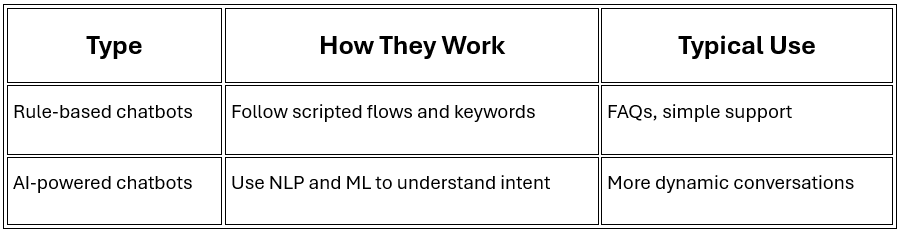
Limitations of Chatbots
- Limited contextual memory
- Difficulty handling exceptions
- Not designed for multi-step task execution
Chatbots are effective for high-volume, repetitive interactions, but they are not built to manage workflows or make decisions.
Understanding AI Virtual Assistants
An AI virtual assistant is a more advanced application designed to perform tasks and support workflows, not just converse.
AI virtual assistants use NLP, machine learning, and sometimes voice recognition to interpret commands and take action across systems.
What AI Virtual Assistants Commonly Do
- Schedule meetings and set reminders
- Manage calendars and inboxes
- Retrieve and organize information
- Trigger workflows across tools
- Support voice-based interactions (e.g., Siri, Alexa)
Unlike chatbots, AI virtual assistants can maintain context across interactions and support ongoing tasks rather than one-off conversations.
Where AI Virtual Assistants Still Need Support
- Handling sensitive or regulated workflows
- Managing exceptions and edge cases
- Making judgment-based decisions
This is why AI virtual assistants are often used alongside human oversight in real business environments.
AI Chatbot vs AI Virtual Assistant: Key Differences
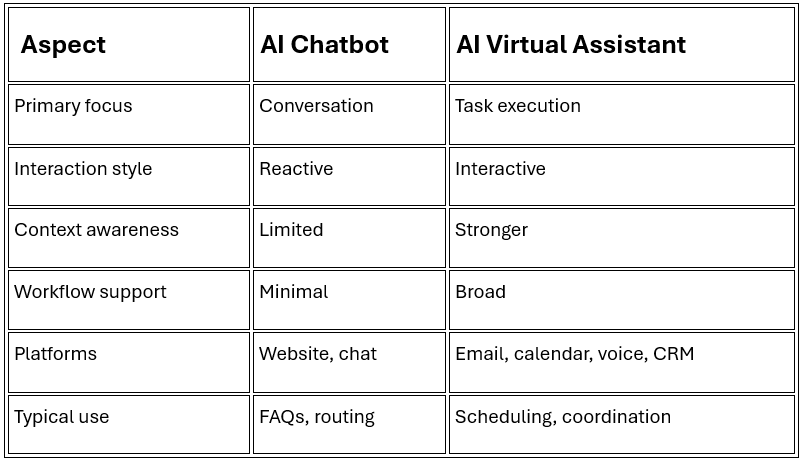
Rather than competing, these tools address different layers of work.
How Chatbots And AI Assistants Are Used Across Different Industries
AI chatbots and AI virtual assistants are widely used across US industries, but their roles differ depending on task complexity and context.
E-commerce
Chatbots handle product availability, order tracking, returns, and FAQs.
AI virtual assistants personalize recommendations, track deliveries, and manage follow-ups across channels.
Health Care
Chatbots schedule appointments and answer basic patient questions.
AI virtual assistants support medication reminders, patient follow-ups, and care coordination.
Travel and Hospitality
Chatbots assist with bookings, reservations, and itinerary creation.
AI virtual assistants manage calendars, send real-time updates, and support schedule changes.
Finance
Chatbots answer routine questions about balances and transactions.
AI virtual assistants deliver alerts, monitor activity, and assist with reporting.
Insurance
Chatbots handle policy FAQs and route claims inquiries.
AI virtual assistants support policy processing, documentation, tracking, and compliance workflows.
Legal
Chatbots manage intake questions and consultation scheduling.
AI virtual assistants organize case documents, track deadlines, and support confidential communication.
Accessibility and Productivity
AI virtual assistants enable hands-free task management, smart device control, and voice-based access to information.
Choosing the Right AI Assistant for Your Use Case
Choosing between an AI chatbot and an AI virtual assistant depends on business needs, workflow complexity, and user experience goals.
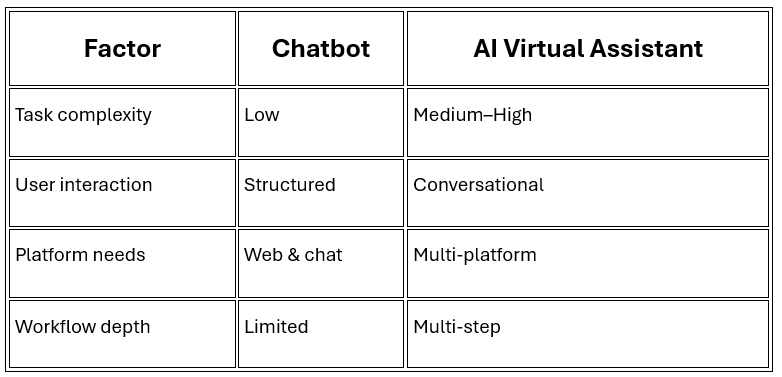
Chatbots are suitable for volume and speed.
AI virtual assistants are suited for continuity and coordination.
Why Final Judgment Should Always Remain Human
No matter how advanced AI becomes, final decision-making should remain human.
AI systems operate on patterns, probabilities, and historical data. They do not fully understand intent, risk tolerance, legal consequences, or business context. In real-world operations, especially regulated and client-facing environments, judgment matters more than speed.
Human oversight ensures:
- Context, nuance, and exceptions are considered
- Errors are caught before becoming costly
- Ethical, legal, and compliance standards are upheld
- Accountability exists for outcomes
This is especially important in insurance, legal, healthcare, and finance, where even small mistakes carry serious consequences. AI should support decisions, not make the final call.
How These Tools Fit Into a Real Business Workflow
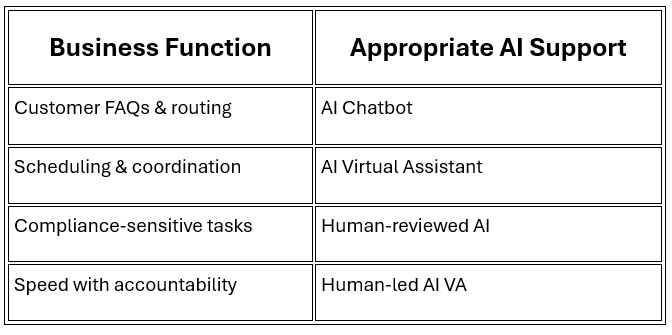
In practice, many businesses combine AI efficiency with human judgment to ensure accuracy and reliability.
Final Takeaway
AI chatbots and AI virtual assistants are not interchangeable.
- Chatbots handle high-volume, repetitive conversations
- AI virtual assistants support task execution and coordination
- Human judgment remains essential for final decisions
When AI is used as a support system and not a replacement, it becomes a powerful tool for sustainable growth.
Frequently Asked Questions
FAQ 1: When should a business upgrade from an AI chatbot to an AI virtual assistant?
Businesses should consider upgrading when customer interactions move beyond simple FAQs and require follow-ups, scheduling, or coordination across tools. If your chatbot can answer questions but cannot complete actions or maintain context across conversations, an AI virtual assistant becomes a better fit for improving efficiency and customer experience.
FAQ 2: Can AI chatbots and AI virtual assistants be used together in the same workflow?
Yes, many businesses use both. Chatbots handle high-volume, front-line interactions like FAQs or intake, while AI virtual assistants manage task execution such as scheduling, documentation, and follow-ups. Using them together allows businesses to automate conversations without losing operational continuity or accountability.
FAQ 3: How do AI virtual assistants improve outcomes in regulated industries like insurance and legal?
AI virtual assistants help by supporting structured workflows while preserving human oversight. They assist with documentation, tracking, and coordination, reducing manual effort without replacing judgment. This balance is critical in regulated industries where accuracy, compliance, and context matter more than speed alone.
FAQ 4: What are the hidden costs businesses overlook when relying only on AI chatbots?
While chatbots are cost-effective upfront, businesses often overlook ongoing costs such as tool stacking, integration complexity, monitoring, and error correction. When workflows grow more complex, the lack of context and task execution can lead to inefficiencies that outweigh the initial savings.
FAQ 5: How should small and mid-sized US businesses evaluate ROI between chatbots and AI virtual assistants?
ROI should be measured by outcomes, not just automation. Chatbots reduce response volume, while AI virtual assistants reduce workload, errors, and follow-up time. Businesses should assess whether they need conversation handling or task completion and choose the solution that delivers measurable operational impact.
FAQ 6: What is the difference between an AI chatbot and a traditional chatbot?
A traditional chatbot follows predefined rules and scripted responses, responding to specific keywords or menu selections. An AI chatbot uses natural language processing and machine learning to understand intent, adapt responses, and handle more flexible conversations. While AI chatbots are more dynamic, both types are typically designed for conversation and not complex task execution or decision-making.
Ready to Use AI That Actually Supports Your Business?
Savvital helps US businesses implement human-led AI virtual assistant solutions that combine automation speed with real accountability.
Instead of relying on rigid chatbots or disconnected tools, businesses gain structured support that balances efficiency with judgment.
[Don't let your business become a bot. Partner with Savvital and scale with soul.]
Published on 20 Jan 2026
Author: Noor Ul Ain Liaqat