AI Assistant vs Human Virtual Assistant
In 2026, the decision between using an AI assistant vs human virtual assistant is about strategy, efficiency, and outcomes.
With AI rapidly evolving and virtual assistants transforming remote work, business leaders are asking:
Where should we invest? Automation, Outsourcing, or both?
This article walks you through a step-by-step comparison, clarifies key differences, and shows why the best businesses are using a hybrid AI-led human model for real results.
This article walks you through a step-by-step comparison between AI assistant and human virtual assistant, clarifies key differences, and shows why the best businesses are using a hybrid AI-led human model.
AI Assistant vs Human Virtual Assistant: Definitions You Need to Know
What Is an AI Assistant?
An AI virtual assistant refers to software that uses machine learning, natural language processing (NLP), and automation to perform tasks like scheduling, data entry, CRM updates, and email drafting.
AI assistants are suited for structured and repeatable work.
Examples include:
- Automated scheduling and reminders
- Chatbots and customer support responses
- Data extraction and classification
- CRM updates and workflow triggers
- Email drafting and sorting
AI assistants work instantly and at scale, but they lack contextual judgment, emotional nuance, and decision autonomy.
What Is a Human Virtual Assistant?
A human virtual assistant is a trained professional who works remotely to manage tasks requiring judgment, communication, adaptation, and problem-solving.
Human VAs can:
- Executive and administrative support
- Email and calendar management
- Client and stakeholder communication
- Insurance, legal, and compliance workflows
- Quality control and exception handling
- Process coordination across tools and teams
They bring emotional intelligence and oversight that AI tools cannot replicate.
Step-by-Step Comparison: AI vs Human VA
Let’s compare both types of assistants across key business priorities:
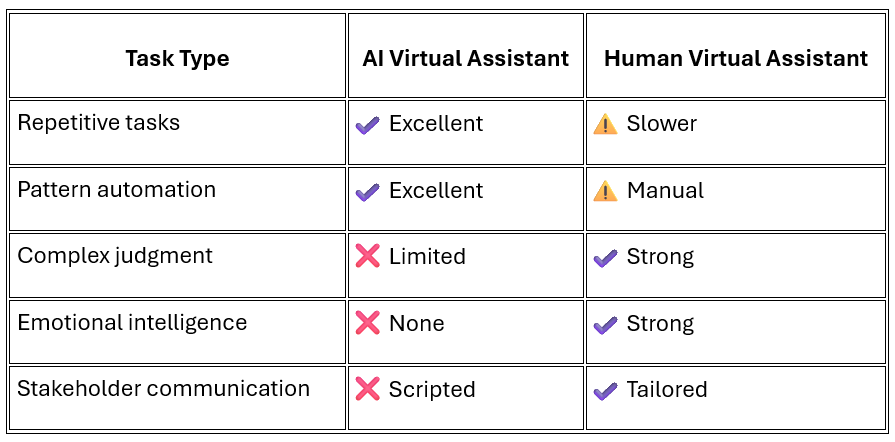
AI vs human virtual assistant – Task Complexity and Context
AI excels at structured task execution, while humans shine in nuanced and judgment-heavy work.
Automation vs Outsourcing
AI Assistant Advantages
- Works 24/7
- Handles high volume instantly
- Fast responses with consistent output
- Lower operational cost after setup
Human Virtual Assistant Advantages
- Strong communication and client handling
- Adaptable to changes and exceptions
- Better for relationship-based work
- Higher overall quality for strategic tasks
Accuracy and Decision-Making
One of the biggest limitations of AI is context understanding.
While generative AI can draft text, automate workflows, and parse data quickly, it does not always understand nuance which means mistakes can go unnoticed.
Human assistants:
- Catch errors with context
- Escalate exceptions
- Ensure compliance
- Manage outcomes end to end
This is crucial in industries like:
- Insurance
- Legal
- Healthcare
- Financial reporting
In these fields, a misunderstanding, even a subtle one, can lead to costly mistakes.
Cost Comparison: AI and Human Virtual Assistant
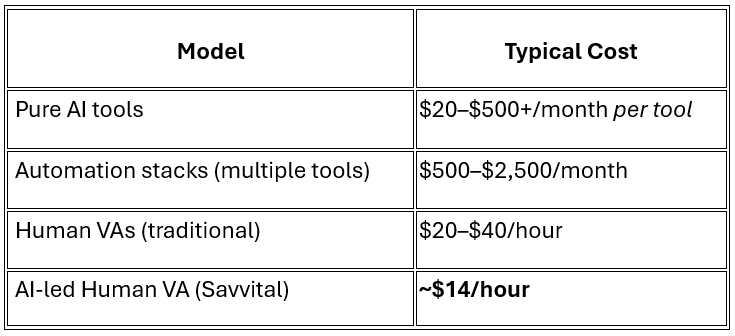
AI tool costs may be lower to start, but real business workflows often require multiple subscriptions and human monitoring which increases operational overhead.
Bottom line: Outsourcing (human VAs) with embedded automation often delivers higher quality and predictable ROI.
Hybrid model – Why to Choose AI-Led Human VAs
This is where the conversation shifts.
The best-performing teams don’t ask: “Should we choose AI or humans?”
They ask: “How do we use AI with humans?”
What this hybrid model looks like:
AI handles routine work
- Scheduling
- Data extraction and formatting
- Repetitive CRM updates
Humans handle judgment work
- Client communication
- Complex decisions
- Escalation and review
Outcome = Faster + Better
- Faster execution
- Fewer errors
- Lower costs
- Better outcomes
This is the foundation of Savvital’s service model.
This pattern reflects industry consensus: teams pairing AI with human agents boost productivity and quality while managing risk.
When Should You Choose Each Option?
Choose AI Virtual Assistants When:
- Tasks are structured and predictable
- You need instant 24/7 responses
- Volume is high and decisions are simple
- Repetitive data work dominates
Choose Human Virtual Assistants When:
- Tasks require empathy or negotiation
- You work in regulated industries
- Communication tone matters
- Exceptions and judgment rules the day
Choose a Hybrid Model When:
- You want automation without sacrificing quality
- You need cost efficiency and judgment together
- Your workflows involve both repetitive and complex tasks
Savvital’s AI-led Human VA model was designed with this balance in mind.
Use Cases of AI-Led Human Virtual Assistants
- Insurance: AI pre-processes applications; humans verify compliance
- Legal: AI organizes documents; humans manage intake and review
- Admin: AI schedules; humans prioritize and coordinate
- Finance: AI extracts data; humans reconcile and report
How this affects your business ROI
A hybrid approach typically leads to:
- Reduced task turnaround time
- More accurate outcomes
- Lower per-hour real work cost
- Better client satisfaction
- Fewer errors and exceptions
This makes it ideal for small and mid-sized businesses prioritizing efficiency + reliability + cost control.
Final Verdict: AI Virtual Assistant or Human Virtual Assistant?
This isn’t a battle between technology and people.
- AI is unbeatable at speed and scale
- Humans are irreplaceable for judgment and accountability
- The future belongs to AI-led human teams
Businesses that understand this scale faster, make fewer mistakes, and spend less fixing errors.
Frequently Asked Questions (FAQ)
What is the difference between an AI virtual assistant and a human virtual assistant?
AI virtual assistants rely on software and automation to handle predefined tasks such as scheduling, data entry, or basic responses. Human virtual assistants, on the other hand, bring reasoning, communication skills, and accountability to their work. They can understand context, make judgment calls, and adapt when situations change—things AI alone cannot reliably do.
Can AI replace human virtual assistants?
AI can effectively handle repetitive, rules-based tasks, but it cannot fully replace human virtual assistants. Tasks that require decision-making, discretion, problem-solving, or direct communication still need human involvement. In most real-world workflows, AI works best as a support tool rather than a replacement.
Which is better: automation or outsourcing?
Automation is ideal for high-volume, repetitive work that follows clear rules. Outsourcing is better for tasks that involve responsibility, coordination, and ongoing decision-making. A hybrid approach, where automation handles routine work and human assistants manage execution and oversight—often delivers the most reliable and scalable results.
Are AI virtual assistants safe for insurance and legal work?
Using AI alone in insurance and legal environments can be risky due to compliance, confidentiality, and accuracy requirements. Human oversight is essential to ensure regulations are followed, sensitive information is handled properly, and decisions are reviewed before action is taken. AI should supportinstead of replacing human professionals in these fields.
What is the best virtual assistant model for small businesses?
For small businesses, AI-led human virtual assistants offer the best balance of cost, speed, and reliability. This model combines automation for efficiency with human judgment and accountability, allowing businesses to scale operations without sacrificing quality or control.
Ready to Use AI Without Losing Human Judgment?
Savvital provides AI-led human virtual assistants who combine automation speed with real accountability — helping businesses work smarter, not riskier.
Instead of managing multiple AI tools or hiring expensive full-time staff, you get trained professionals supported by AI, starting at just $14/hour.
Book a consultation to know more about AI-led virtual assistant services with Savvital
Published on 16 Jan 2026
Author: Noor Ul Ain Liaqat