Insurance Policy Endorsements Explained
A policy rarely stays exactly the same for an entire term. Clients add vehicles, change addresses, adjust coverage limits, or need a new additional insured added mid year, and every one of those changes has to be processed correctly through an endorsement. Endorsement processing is one of the highest volume, most detail sensitive tasks in policy servicing, and it is a natural task to delegate once an agency understands exactly what is involved.
What Is an Insurance Policy Endorsement?
An insurance policy endorsement, sometimes called a rider, is a formal amendment to an existing policy that adds, removes, or changes coverage without issuing an entirely new policy. Endorsements can be requested by the policyholder, initiated by the carrier, or required at renewal, and once processed, they become a legally binding part of the policy for as long as it remains in force. Because an endorsement directly changes what is and is not covered, accuracy in how it is processed matters as much as the underlying policy itself.
Standard vs. Non-Standard Endorsements
Endorsements generally fall into two categories. Standard endorsements are industry approved forms developed by organizations such as the Insurance Services Office, commonly called ISO, which creates uniform, widely accepted policy language used across many carriers. Non-standard endorsements, also called manuscript endorsements, are custom modifications drafted for a specific policy or carrier rather than pulled from a standardized library. Standard endorsements tend to be faster to process since the language is already established. Manuscript endorsements require closer review, since the wording is unique to that policy.
Common Types of Insurance Policy Endorsements
• Adding or removing a vehicle or driver on an auto policy
• Changing an insured address or location
• Adding an additional insured, often requested alongside a certificate of insurance
• Increasing or decreasing coverage limits
• Adding a specific rider, such as coverage for a high value item or a specific exclusion removal
• Updating a named insured due to a legal name change or business structure change
The Endorsement Processing Workflow, Step by Step
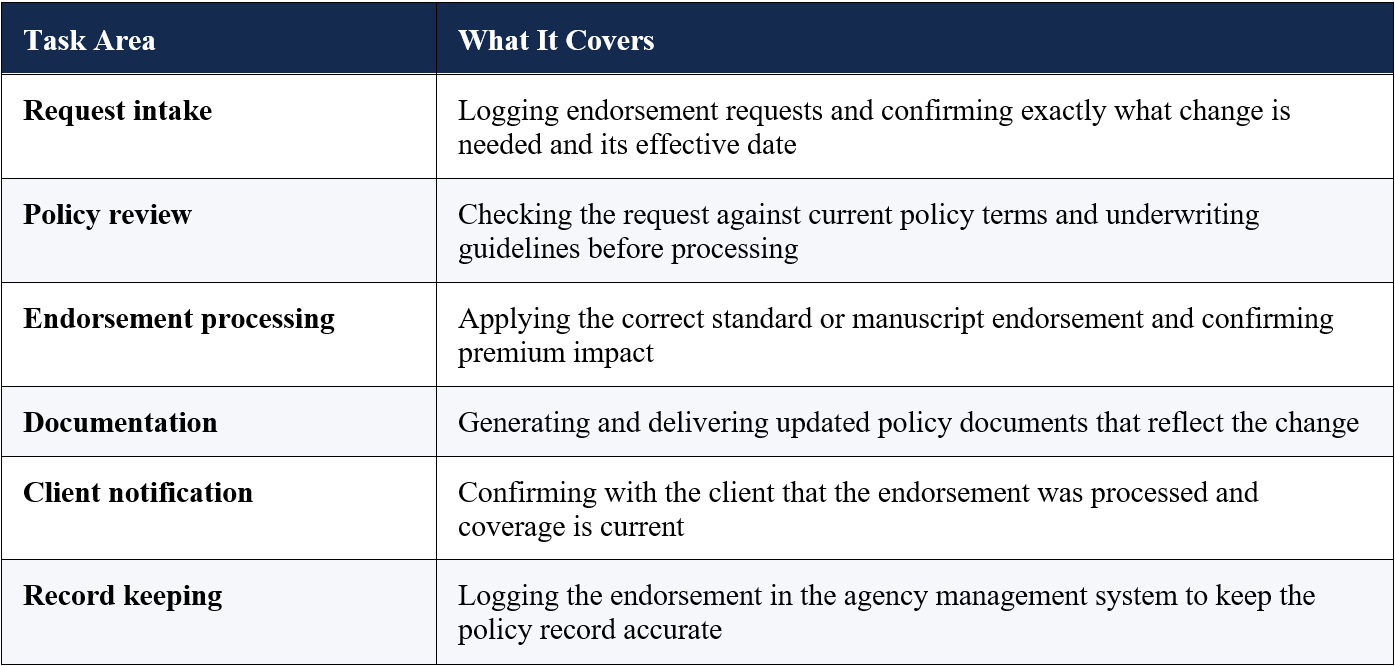
1. Receive the endorsement request. The policyholder or agency initiates the change, specifying exactly what needs to be modified and the desired effective date.
2. Review the request against current policy terms. Confirm the change is consistent with underwriting guidelines and does not conflict with existing coverage.
3. Process the endorsement. Apply the correct standard or manuscript endorsement form and confirm any resulting premium recalculation.
4. Issue updated policy documentation. The endorsement becomes part of the policy record, and the client receives updated documents reflecting the change.
5. Notify the client and update internal records. Confirm the change was applied correctly and log it in the agency management system for future reference.
Endorsement Processing Virtual Assistant Tasks
Why Endorsement Accuracy Directly Affects Premium and Compliance
An endorsement processed incorrectly does not just create an administrative headache. It can misstate coverage the client believes they have, create a premium calculation error, or leave a gap between what a client thinks is covered and what the policy actually reflects. If a claim is made against coverage affected by a mishandled endorsement, the accuracy of that endorsement becomes directly relevant to whether the claim is honored as the client expected. This is the same underlying risk covered in our guides on policy renewal and certificate of insurance processing: administrative precision in servicing work is directly tied to the agency's own liability.
Industry Insight
Endorsement requests tend to spike during specific periods, such as renewal season or after a significant client life or business event. Agencies that have dedicated, consistent endorsement processing in place handle these spikes without the backlog and errors that come from stretching existing staff thin.
Endorsement Processing VA vs. Automated Tools
Newer AI powered tools can classify incoming endorsement requests and route simple, high confidence changes for faster processing. These tools work well for high volume, low complexity requests, such as a straightforward address change. They are less reliable for manuscript endorsements or requests involving judgment about underwriting guidelines. A dedicated endorsement processing virtual assistant fits the space between full automation and manual, unstructured handling: consistent, accurate processing with the judgment to flag anything unusual, working inside the systems your agency already uses.
Read our guide on Certificate of Insurance Processing
What to Look for When Delegating Endorsement Processing
• Experience distinguishing standard endorsements from manuscript endorsements requiring closer review
• Familiarity with your agency management system for accurate documentation and record keeping
• A clear process for flagging requests that need broker or underwriter judgment rather than routine processing
• A defined turnaround time for endorsement requests, especially during renewal season spikes
• HIPAA compliant infrastructure if the book of business includes health or benefits policies
How Onboarding an Endorsement Processing VA Works
Onboarding starts with access to your agency management system and a walkthrough of the endorsement types your agency processes most frequently, along with which requests typically need broker review before completion. Most agencies begin the VA on routine, standard endorsement requests to confirm accuracy before expanding into more complex or manuscript endorsement handling.
Endorsements Are Small Changes With Real Weight
No single endorsement feels significant on its own, which is exactly why the work is easy to underinvest in. Handled inconsistently across a full book of business, though, endorsement errors compound into real client confusion and real agency risk. A dedicated, consistent process for endorsement handling protects the accuracy of every policy it touches.
Ready to Get Your Time Back?
Running an insurance agency means constant demands on your time, from renewals and endorsements to claims, certificates, and everything in between. A Savvital insurance virtual assistant takes the administrative work off your plate so you can focus on clients and growing your book of business, backed by HIPAA compliant infrastructure and a signed BAA from day one.
See a full breakdown at PRICING, OR BOOK A 15 MINUTE STRATEGY CALL
Frequently Asked Questions
What is an insurance policy endorsement?
An endorsement is a formal amendment to an existing policy that adds, removes, or changes coverage without issuing a new policy. Once processed, it becomes a legally binding part of the policy. Endorsements can be requested by the policyholder, initiated by the carrier, or applied at renewal.
What is the difference between a standard and a non-standard endorsement?
Standard endorsements use industry approved language, often developed by the Insurance Services Office, and are faster to process since the wording is already established. Non-standard, or manuscript, endorsements are custom drafted for a specific policy and require closer review before processing.
Can a virtual assistant process insurance policy endorsements?
Yes, for the administrative processing of the endorsement: intake, documentation, policy record updates, and client notification. Requests requiring underwriting judgment or coverage decisions should be flagged for broker or underwriter review rather than processed independently by the VA.
Why does endorsement accuracy matter for compliance?
An inaccurate endorsement can distract coverage or create a gap between what a client believes is covered and what the policy reflects. If a claim is made against affected coverage, that inaccuracy becomes directly relevant, which is why precise endorsement processing matters as much as the underlying policy.
Published on 31 Aug 2026
Author: Noor Ul Ain Liaqat