Certificate of Insurance (COI) Processing Guide
A single client relationship can generate dozens of certificate requests a year from vendors, landlords, and contractors, each with its own deadline. Certificate of insurance processing is repetitive, detail heavy, and easy to fall behind on, which makes it one of the clearest candidates for delegation in an agency's entire workflow.
What Is a Certificate of Insurance?
A certificate of insurance, almost always shortened to COI, is a document that verifies a policy exists and summarizes its coverage, without being the policy itself. Businesses request COIs constantly to confirm that a vendor, contractor, or partner carries adequate coverage before work begins or a lease is signed. Two standardized forms come up repeatedly in COI work: ACORD 25, the Certificate of Liability Insurance form, and ACORD 28, the Evidence of Commercial Property Insurance form. Most COI requests also involve a certificate holder, the business or individual receiving the certificate, and often an additional insured designation, which extends certain policy protections to that third party.
Why COI Requests Pile Up Faster Than Agencies Expect
A single commercial client with multiple vendor relationships, lease agreements, or subcontractor requirements can generate a steady stream of certificate requests throughout the year, not just at renewal. Each request needs someone to review current policy details, confirm the coverage actually matches what is being asked for, generate the correct ACORD form, and deliver it before the requester's deadline. Multiply that across a full book of business and COI processing quietly becomes one of the highest volume tasks in the agency, even though no single request takes very long on its own.
The Certificate of Insurance Processing Workflow, Step by Step
1. Intake the request. Confirm exactly what the certificate holder needs, including any specific additional insured language or coverage limits they are requesting.
2. Verify current policy details. Confirm the policy is active and that coverage actually meets what is being requested before generating anything.
3. Generate the correct form. Most COI requests use ACORD 25 for liability coverage or ACORD 28 for commercial property, filled out with accurate, current policy information.
4. Review for accuracy before delivery. A single incorrect limit or missing endorsement on a certificate can create real problems if a claim is ever made against it.
5. Deliver on time and track the request. Log the certificate issued and note any renewal or expiration date the certificate holder will need updated in the future.
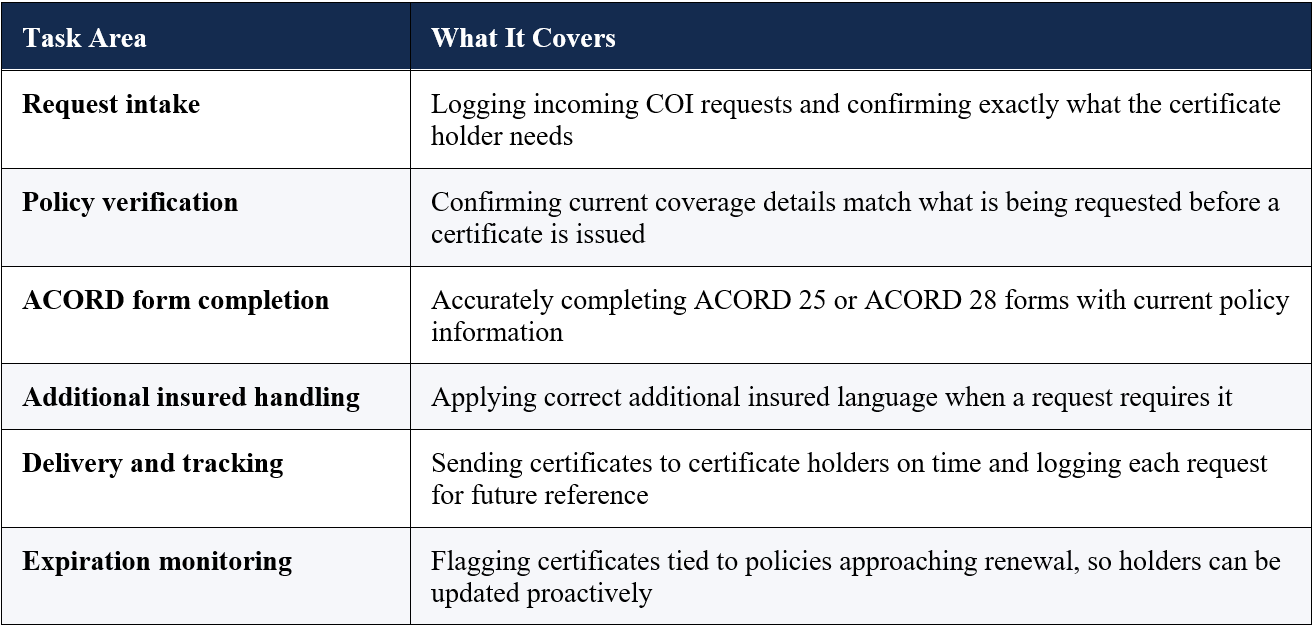
What a COI Processing Virtual Assistant Actually Does
Why COI Errors Are a Real E&O Risk
An inaccurate certificate is not just an inconvenience. If a certificate misstates coverage limits, omits a required endorsement, or is delivered late enough to hold up a contract or lease, the agency can face real errors and omissions exposure. This is the same underlying risk covered in our guide on policy renewal and servicing: administrative accuracy in insurance work is not a minor detail, it is a direct line to the agency's own liability.
%20Processing)
COI Processing VA vs. Automated COI Software or a BPO
Some larger carriers and agencies use automated COI generation tools or full scale business process outsourcing partners for certificate volume at true enterprise scale. For independent and small to mid sized agencies, a dedicated COI processing virtual assistant offers a middle path: someone who learns your specific book of business, works inside your existing agency management system, and applies consistent judgment to each request, without the cost of enterprise software licensing or the loss of a direct relationship that comes with routing requests through a large, shared BPO operation.
Read our guide on policy renewal and servicing
What to Look for When Delegating COI Processing
• Direct familiarity with ACORD 25 and ACORD 28 forms, not just general administrative experience
• Experience working inside agency management systems to pull accurate, current policy data
• A defined turnaround time commitment for certificate requests
• A clear verification step before any certificate is delivered, not just fast processing
• HIPAA compliant infrastructure if the book of business includes health or benefits policies
How Onboarding a COI Processing VA Works
Onboarding starts with access to your agency management system and a walkthrough of how your agency currently receives and tracks certificate requests. Most agencies start the VA on a smaller volume of incoming requests to confirm accuracy and turnaround time before handing over the full COI workload. Within the first couple of weeks, most agencies notice certificates going out faster and more consistently, simply because one person owns the process from intake to delivery instead of it being handled inconsistently by whoever has a free moment.
A Small Task With Outsized Consequences
Certificate of insurance processing rarely gets discussed as a priority, since no single request feels significant. Handled inconsistently across dozens or hundreds of requests a year, though, it becomes a real source of client friction and agency risk. Treating COI processing as a dedicated, owned function protects the agency the same way disciplined renewal tracking does, quietly, but with real consequences if it is neglected.
Frequently Asked Questions
What does a certificate of insurance processing virtual assistant do?
They handle certificate requests from intake through delivery: verifying current policy details, completing ACORD 25 or ACORD 28 forms accurately, applying additional insured language when needed, and tracking each request. Their goal is fast, accurate certificate delivery without errors that could create liability.
What is the difference between ACORD 25 and ACORD 28?
ACORD 25 is the standard Certificate of Liability Insurance form, used most often for general liability coverage. ACORD 28 is the Evidence of Commercial Property Insurance form, used specifically for property coverage. Most COI requests use one of these two standardized forms.
Why do COI errors create E&O risk for an agency?
An inaccurate certificate, such as one with incorrect limits or a missing endorsement, can create real liability if a claim is later made against it. Errors and omissions exposure ties directly to administrative accuracy, which is why consistent verification before delivery matters as much as speed.
What is an additional insured on a certificate of insurance?
An additional insured is a third party, often a certificate holder such as a landlord or contractor, who is granted certain protections under the policyholder's coverage. Certificate requests frequently specify additional insured language that must be applied correctly before the certificate is issued.
How long does it take to onboard a COI processing VA?
Most agencies see a working relationship established within 5 to 10 business days, covering system access and a walkthrough of current COI request handling. Many start the VA on a smaller request volume first to confirm accuracy and turnaround time before transferring the full workload.
Published on 17 Aug 2026
Author: Noor Ul Ain Liaqat