Insurance Policy Remarketing: A Complete Guide
If you run an insurance agency, you already deal with renewals every year. Some renewals should just go through as is. Others need a closer look. This guide explains what remarketing means, when it makes sense to shop a policy to other carriers, and how a virtual assistant can help with the busy work involved.
What Is Insurance Policy Remarketing?
Remarketing means shopping a client's policy to other insurance carriers when it comes up for renewal, instead of just renewing it with the same carrier. Agencies do this for two reasons: to make sure the client is not paying too much, and to have leverage if they want to negotiate a better price with the current carrier. Remarketing happens most often with business insurance, but it can happen with personal insurance too, especially when a renewal price jumps or a carrier changes what kinds of risks it wants to cover.
When Should You Remarket a Policy?
The clearest sign it is time to remarket is a price increase of 8 to 10 percent or more at renewal. When an increase is that big, it usually makes sense to get quotes from two or three other carriers that write that type of business.
Other good reasons to remarket include the current carrier no longer wanting to cover that type of risk, or a real change in the client's business, like new equipment, more employees, or a new location.
Not every renewal needs this extra work, though. If a client has a clean claims history and their price only goes up 3 to 5 percent, it is usually better to leave the policy where it is. That relationship with the current carrier is worth something, especially if the client ever needs to file a claim. Shopping every single policy every single year, just to chase a small discount, can actually hurt the agency's relationships with carriers over time.
Industry Insight
Agencies that only remarket when there is a clear reason, like a big price jump or a real change in risk, tend to keep both their clients and their carriers happier than agencies that shop every policy every year out of habit.
How the Remarketing Process Works
1. Spot the reason to remarket. Confirm the price increase, carrier change, or risk change that makes this policy worth shopping.
2. Start early. Most agencies begin reaching out to carriers 60 to 120 days before the renewal date, so there is enough time to get quotes back.
3. Gather the paperwork. This means loss history reports and a new application, basically the same amount of work as writing a brand new policy.
4. Send it to other carriers. The same client and risk information goes out to two or three carriers that are a good fit.
5. Compare the quotes. Look at price, but also compare what is actually covered and what is excluded, not just the bottom line number.
6. Decide and finalize. Show the client the options. Either stay with the current carrier at a new price, or move to a new one.
7. Handle the switch, if there is one. If the client moves carriers, someone needs to send updated certificates of insurance to their vendors or landlords, update the agency's records, and make sure there is no gap in coverage during the change.
Why Remarketing Takes So Much Time
Remarketing takes almost as much work as writing a brand new policy. The same information has to be typed into several different carrier websites. Loss runs have to be requested and organized. Then, once the quotes come back, someone has to sit down and compare them side by side. For an account manager who is already busy with renewals, this can double the time it takes to close out just one account.
What a Virtual Assistant Can Handle in the Remarketing Process
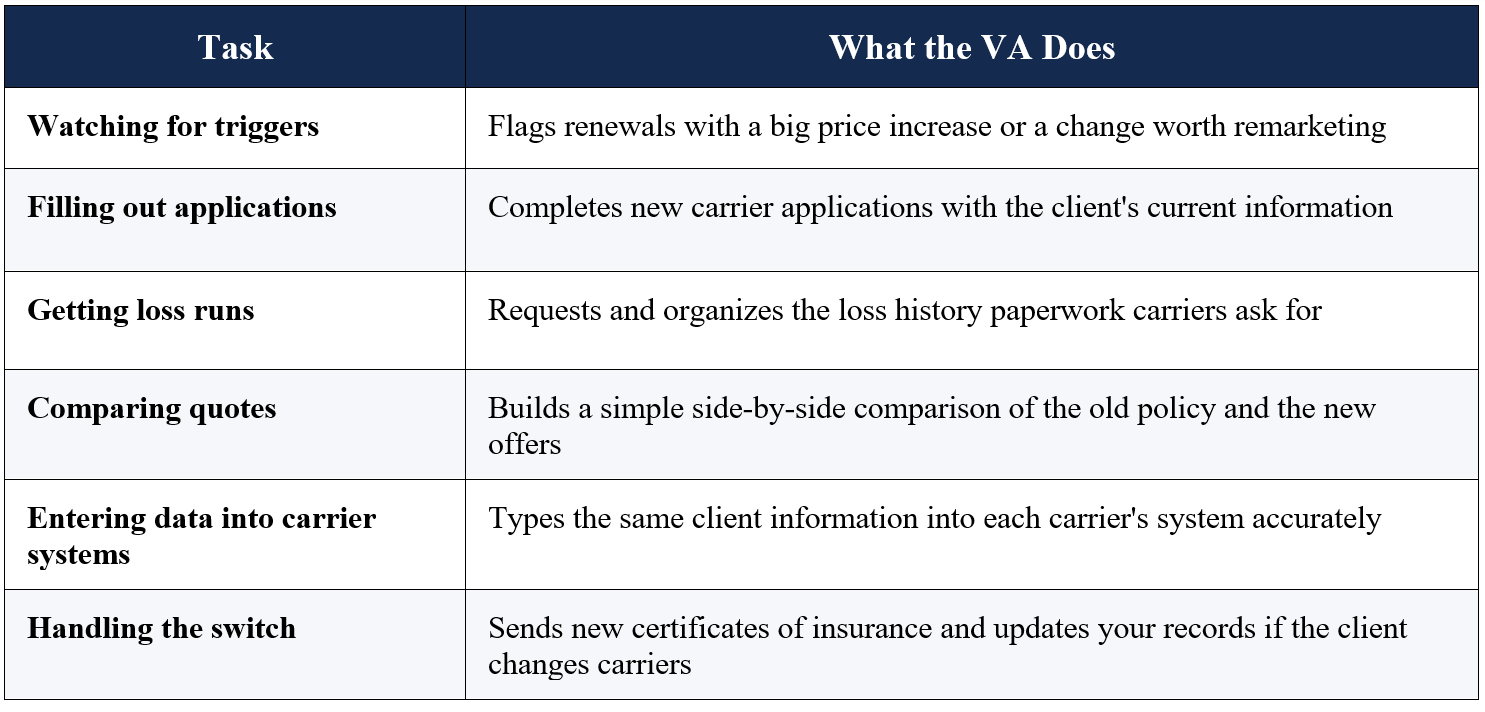
Can Software Do This Instead of a Person?
Some rating software can pull quick, early quotes from several carriers at once. That is useful for narrowing down which carriers to approach first. But software cannot decide which accounts are actually worth remarketing, gather the full paperwork a carrier needs, or explain the options to a client in a way that makes sense to them. A virtual assistant can work alongside that kind of software, handling the paperwork and data entry, while your team makes the actual decisions and has the client conversations.
Read our guide on Insurance Policy Endorsement Processing
What to Look for in Remarketing Support
• Someone who has worked with business insurance applications before, not just simple admin tasks
• Comfort using your agency's specific carrier websites and rating tools
• A clear sense of which decisions need your input and which parts they can just handle
• Enough advance notice to start the process 60 to 120 days before renewal, not at the last minute
• A clear plan for handling paperwork if a client does decide to switch carriers
READ OUR LATEST BLOG ON Insurance Policy Endorsements
Getting Started
When you bring on help for remarketing, start by walking through your agency's rules of thumb: what price increase makes you want to shop a policy, which carriers you usually use for which types of business, and how you currently request loss runs. Most agencies start small, letting the VA handle the paperwork and quote comparisons for a few accounts first, before handing over the full process.
The Bottom Line
You do not need to remarket every policy every year to do a good job for your clients. What matters more is having a clear rule for when it is worth doing, and enough support to actually do it well when it counts. That combination protects your relationships with clients and carriers, and it protects your agency's bottom line too.
Ready to Get Your Time Back?
Running an insurance agency means constant demands on your time, from renewals and endorsements to claims, certificates, and everything in between. A Savvital insurance virtual assistant takes the administrative work off your plate so you can focus on clients and growing your book of business, backed by HIPAA compliant infrastructure and a signed BAA from day one.
See a full breakdown at PRICING, OR BOOK A 15 MINUTE STRATEGY CALL
Frequently Asked Questions
What does remarketing mean in insurance?
Remarketing means shopping a client's policy to other carriers when it renews, instead of automatically keeping it with the same company. Agencies do this to check that the client is getting a fair price and to have leverage if they want a better deal from the current carrier.
When should an agency remarket a policy?
The clearest sign is a renewal price increase of 8 to 10 percent or more. Other good reasons include the carrier no longer wanting that type of business, or a real change in the client's situation. A small increase with a clean claims history usually does not need remarketing.
Why does remarketing take so long?
It takes almost the same amount of work as writing a new policy. Someone has to fill out new applications, request loss history, submit everything to multiple carriers, and then compare the quotes by hand. This can double the time needed to finish just one renewal.
Can rating software replace a person for remarketing?
Not fully. Rating software can give quick early quotes, but it cannot decide which accounts are worth shopping, gather full paperwork, or explain the options to a client. Many agencies use software and a virtual assistant together for the best result.
Published on 8 Sept 2026
Author: Noor Ul Ain Liaqat