How HIPAA Compliant VAs are Revolutionizing Medical Staffing
Healthcare staffing is changing faster than ever.
Rising costs, staff shortages, and increasing administrative workloads are forcing clinics and healthcare providers to rethink how they build and manage their teams.
At the same time, data privacy regulations, especially HIPAA, have made hiring remote staff more complex.
So how are modern healthcare organizations solving both problems?
The answer lies in HIPAA-compliant virtual assistants.
These trained remote professionals are are completely transforming how medical staffing works in the United States.
What Is a HIPAA-Compliant Virtual Assistant in Medical Staffing?
A HIPAA-compliant virtual assistant is a remote healthcare professional trained to handle sensitive patient data (PHI) while following strict privacy and security regulations.
Unlike general virtual assistants, they:
- Understand HIPAA laws and compliance requirements
- Use secure, encrypted systems
- Follow strict data access protocols
- Work within healthcare workflows (EHR, billing, scheduling)
They perform tasks like:
- Patient scheduling
- Insurance verification
- Medical billing support
- EHR documentation
- Patient communication
All while ensuring full data security and compliance.
Healthcare providers increasingly rely on these professionals because they combine efficiency + compliance, which is critical in modern medical operations.
Why Medical Staffing Is Changing in 2026
Healthcare staffing is under pressure from multiple directions.
1. Severe Staff Shortages
Many clinics struggle to find qualified administrative and support staff locally.
Remote staffing expands access to global talent pools.
2. Rising Operational Costs
In-house hiring includes:
- Salaries
- Benefits
- Office space
- Training
Remote staffing reduces these costs significantly.
3. Increased Administrative Burden
Doctors spend a large portion of time on non-clinical tasks.
Virtual assistants help offload this workload, improving efficiency and patient care.
4. Strict Data Security Requirements
Healthcare data breaches can lead to legal penalties and reputational damage.
HIPAA compliance is now a non-negotiable requirement.

How HIPAA-Compliant Virtual Assistants Are Transforming Medical Staffing
1. Making Remote Staffing Safe for Healthcare
One of the biggest concerns with remote work in healthcare is data security.
HIPAA-compliant virtual assistants solve this by:
- Using encrypted communication tools
- Following strict access controls
- Working under HIPAA security rules
- Signing Business Associate Agreements (BAA)
This ensures that patient data remains protected at all times.
2. Reducing Staffing Costs Without Compromising Care
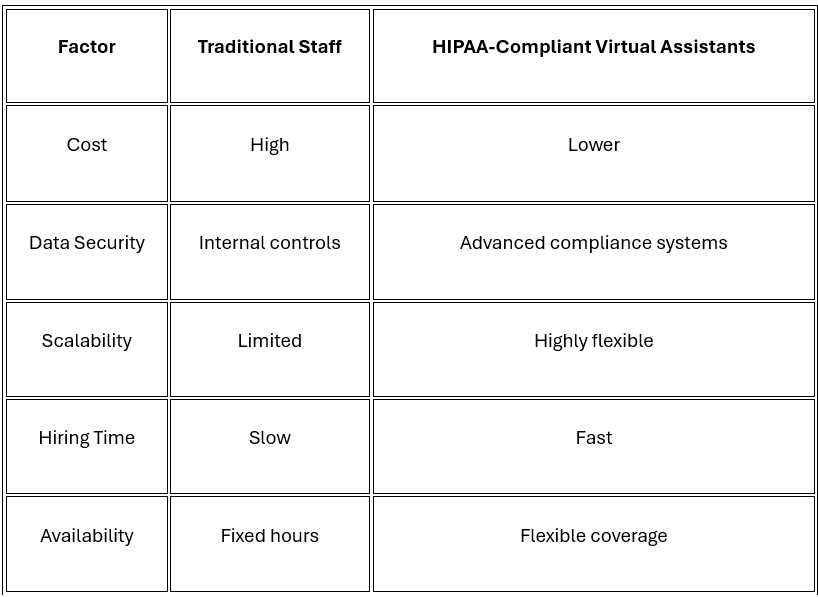
Healthcare providers can reduce overhead by 60% or more by using virtual assistants instead of in-house staff.
This allows clinics to:
- Operate more efficiently
- Allocate resources to patient care
- Scale without increasing payroll
3. Improving Efficiency and Workflow
HIPAA-trained virtual assistants handle repetitive administrative tasks such as:
- Scheduling appointments
- Managing patient communication
- Processing insurance claims
- Updating EHR records
This allows healthcare providers to focus on clinical responsibilities instead of paperwork.
4. Supporting Scalable Healthcare Operations
Virtual staffing allows clinics to:
- Scale teams quickly
- Adjust staffing based on demand
- Support multiple locations
This flexibility is not possible with traditional hiring models.
5. Enhancing Patient Experience
With dedicated remote staff:
- Calls are answered faster
- Appointments are managed efficiently
- Patient communication improves
This leads to higher patient satisfaction and better retention.
6. Reducing Burnout Among Healthcare Staff
Administrative overload is a major cause of burnout.
By delegating tasks to virtual assistants, clinics reduce stress on:
- Doctors
- Nurses
- Front desk staff
This improves workplace satisfaction and productivity.

Key Features That Make HIPAA-Compliant Virtual Assistants Essential
1. Comprehensive HIPAA Training
Virtual assistants undergo ongoing training to stay updated with compliance requirements and best practices.
2. Secure Infrastructure
They use:
- Encrypted systems
- Secure cloud platforms
- VPN access
- Role-based permissions
3. Healthcare-Specific Expertise
Unlike general VAs, they understand:
- Medical terminology
- EHR systems
- Insurance workflows
- Clinical documentation
4. Strict Data Handling Protocols
All patient data is:
- Stored securely
- Accessed only by authorized personnel
- Protected against breaches
HIPAA-Compliant Virtual Assistants vs Traditional Staff
Real Impact on Healthcare Practices
Healthcare providers using HIPAA-compliant virtual assistants report:
- Lower operational costs
- Improved billing accuracy
- Better patient communication
- Reduced missed appointments
- Higher efficiency
Who Should Use HIPAA-Compliant Virtual Assistants?
This model works best for:
- Small and mid-sized clinics
- Multi-location healthcare providers
- Telemedicine companies
- Dental and specialty practices
- Healthcare startups
If your clinic is facing administrative overload, virtual staffing is a strong solution.
The Future of Medical Staffing
Healthcare is moving toward a hybrid workforce model:
- In-house clinical staff
- Remote administrative teams
- Digital-first operations
HIPAA-compliant virtual assistants are at the center of this shift.
They enable healthcare organizations to:
- Stay compliant
- Reduce costs
- Scale efficiently
- Improve patient care
As healthcare continues to evolve, remote staffing will become a standard—not an option.
Why Savvital’s HIPAA-Trained Virtual Assistants Stand Out
Savvital provides healthcare-focused virtual assistants trained in HIPAA compliance and real-world medical workflows.
With Savvital, clinics get:
- HIPAA-trained virtual assistants
- Secure remote operations
- U.S. working hours coverage
- Experience with healthcare systems
- Scalable staffing solutions
Published on 1 Apr 2026
Author: Noor Ul Ain Liaqat