AI Training Benefits For Competitive Industries
Professionals in legal, finance, insurance, and healthcare work in high-pressure environments. They handle sensitive data, strict regulations, and complex workflows every day.
AI tools are becoming common in these industries. But using AI safely requires more than installing software. Teams must understand how to use it correctly.
That is where AI training becomes important.
This guide explains how AI training helps professionals in regulated industries, how businesses use AI responsibly, and why human oversight still matters.
Why AI Skills Matter in Regulated Industries
AI adoption is growing in every sector. But in regulated industries, mistakes can lead to legal risk, financial loss, or compliance violations.
Professionals need training so they can:
- Understand how AI systems work
- Review AI outputs carefully
- Protect sensitive data
- Follow industry regulations
- Maintain accountability
Training turns AI into a safe productivity tool instead of a risky experiment.

Why AI Adoption Is Growing in Competitive Industries
Even with strict regulations, companies are adopting AI because it improves efficiency and reduces risk.
AI helps by:
- Monitoring compliance in real time
- Detecting fraud or anomalies
- Automating repetitive administrative tasks
- Improving accuracy in large datasets
- Standardizing workflows
Compliance teams increasingly use AI tools to track regulatory changes, detect issues early, and improve risk management processes.
When used correctly, AI in industry supports compliance instead of threatening it.
AI in Legal Industry
Law firms and legal departments use AI mainly for research, document management, and workflow automation.
Common Use Cases
- Contract review and document search
- Case law research
- E-discovery automation
- Client intake automation
- Deadline tracking
These tools help lawyers save time on repetitive work while focusing on strategy and client relationships.
Compliance Considerations
Legal work requires confidentiality and accountability. AI must follow strict data protection rules and ethical standards.
AI cannot make final legal decisions. Lawyers must review all outputs before action.

AI in Finance
Financial institutions were early adopters of AI because they manage large volumes of transactions and risk data.
Common Use Cases
- Fraud detection
- Credit risk scoring
- Algorithmic trading monitoring
- Customer support automation
- Compliance monitoring
AI can analyze large datasets faster than humans and identify suspicious patterns that may signal fraud or regulatory risk.
Compliance Challenges
Finance regulators require transparency and fairness. AI models must be explainable and free from bias.
Poor data or opaque algorithms can create legal risks.
AI in Insurance
Insurance companies use AI to improve underwriting, claims processing, and customer service.
Common Use Cases
- Claims triage and routing
- Risk assessment
- Policy recommendation
- Fraud detection
- Customer service automation
AI helps insurers analyze large datasets quickly, but final approvals remain human.
Compliance Challenges
Insurance decisions affect real people’s lives. AI must avoid bias and comply with consumer protection laws.
Human review ensures fairness and accountability.
AI in Healthcare
Healthcare organizations use AI mostly for administrative and operational tasks rather than clinical decisions.
Common Use Cases
- Appointment scheduling
- Medical billing automation
- Patient record management
- Insurance verification
- Workflow coordination
AI compliance tools can track patient data and ensure records follow healthcare regulations while detecting security risks in real time.
Compliance Challenges
Healthcare is highly regulated. Organizations must follow privacy laws and maintain patient safety when deploying AI.
Bias, transparency, and data protection are critical issues.
Key Risks of AI in Regulated Industries
AI provides benefits, but it also introduces risks.
1. Data Privacy Risks
AI systems rely on large datasets that may contain sensitive personal information.
2. Algorithmic Bias
AI models trained on biased data can produce unfair decisions.
3. Lack of Transparency
Some AI systems act as “black boxes,” making it difficult to explain decisions.
4. Compliance Violations
Regulatory frameworks require clear audit trails and documentation.
5. Overautomation
Fully automated decisions can create legal and reputational risk.
In regulated sectors, even small mistakes can have serious consequences.
How Businesses Use AI Without Breaking Compliance
Successful companies follow structured processes when using AI.
Step 1: Identify Low-Risk Automation Areas
Start with scheduling, document sorting, or reporting.
Step 2: Build Governance Frameworks
Use policies for data access, model validation, and auditing.
Step 3: Monitor AI Outputs
Track accuracy, bias, and compliance continuously.
Step 4: Keep Humans in the Loop
Humans must approve final decisions.
AI reduces workload but cannot replace professional judgment.
Skills Professionals Learn in AI Training
Good training programs focus on real workflows.
Professionals learn:
- How AI tools process data
- How to detect bias or errors
- How to review automated reports
- How to protect confidential information
- How to integrate AI with existing systems
This knowledge helps teams use AI responsibly.

Why Human Oversight Matters Most
AI can process data quickly, but it cannot understand context like a trained professional.
Human oversight ensures:
- Compliance with legal standards
- Ethical decision-making
- Contextual understanding
- Accountability for outcomes
In regulated industries, AI works best as a support system, not a decision-maker.
Example Workflow With AI and Training
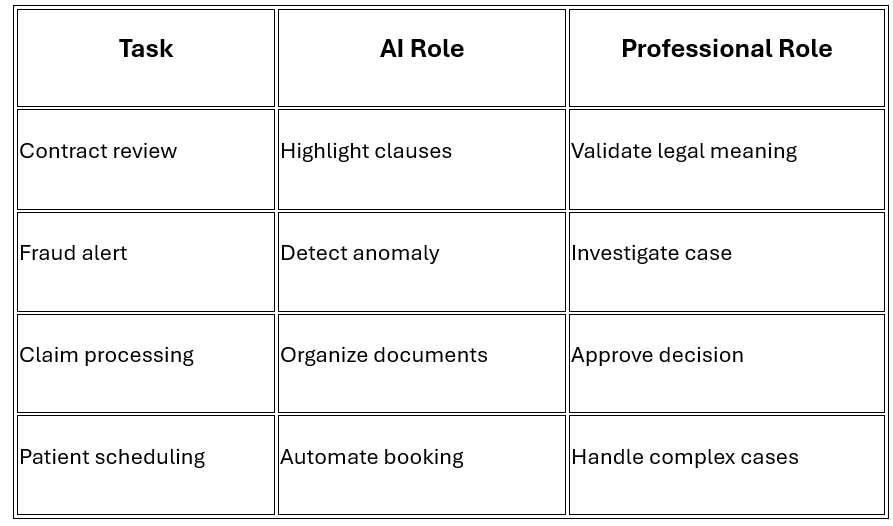
Benefits for Businesses
Companies that invest in AI training see clear results.
- Faster operations
- Fewer compliance issues
- Better data management
- More productive teams
- Higher customer trust
Employees become more confident because they understand the technology they use.
How Companies Should Start AI Training
A simple approach works best.
- Identify repetitive tasks suitable for automation
- Train staff on tools and data policies
- Monitor results and adjust workflows
- Keep human approval for important decisions
This ensures safe adoption
How Savvital Supports AI in Competitive Industries
Many businesses need AI support but cannot risk errors.
Savvital’s human-led AI virtual support combines automation speed with professional oversight. This approach helps companies manage operations efficiently while staying compliant and accountable.
Explore how Savvital supports regulated industry workflows.
Final Takeaway
AI in regulated industries is not about replacing professionals. It is about improving accuracy, efficiency, and decision support while following strict compliance standards.
Legal, finance, insurance, and healthcare organizations that combine AI with human judgment can scale operations safely and build trust with clients and regulators.
Frequently Asked Questions
1. How is AI used in different industries, especially regulated ones?
AI is used in different industries to automate repetitive tasks, improve data analysis, and support decision-making. In regulated sectors like legal, finance, insurance, and healthcare administration, AI helps with document review, fraud detection, compliance tracking, and workflow automation. Professionals still review results to ensure accuracy, fairness, and regulatory compliance. This combination improves efficiency while maintaining accountability and trust.
2. How is AI used in hospitality industry operations?
The hospitality industry uses AI for guest service chat support, booking management, pricing optimization, and customer feedback analysis. Hotels and travel companies also use AI to personalize offers and predict demand trends. While this sector is less regulated than finance or healthcare, human oversight is still important to maintain customer experience quality and data privacy standards.
3. How is AI used in automobile industry processes?
In the automobile industry, AI is used for predictive maintenance, supply chain forecasting, quality control, and customer support automation. Car manufacturers also use AI to analyze safety data and improve production efficiency. Training employees to understand AI systems helps ensure accuracy and prevents operational errors, especially in safety-critical environments.
4. Why is AI training important for professionals in regulated industries?
AI training helps professionals understand system limitations, review outputs, and manage sensitive data correctly. Legal teams can verify document analysis, finance teams can audit fraud alerts, and healthcare administrators can manage patient workflows responsibly. Training improves productivity while ensuring compliance with industry laws and ethical standards.
5. How can businesses adopt AI safely across multiple industries?
Businesses should start with low-risk automation such as scheduling, reporting, or document organization. They should create governance policies, monitor AI outputs, and keep human approval for critical decisions. This approach works across industries, from insurance and healthcare to hospitality and automotive, and helps companies gain efficiency without risking compliance or customer trust.
Published on 18 Feb 2026
Author: Noor Ul Ain Liaqat