Outsourcing Reception For Clinics
Healthcare providers today are facing a growing challenge: raising administrative workloads combined with increasing patient expectations. Clinics are expected to answer every call, schedule appointments quickly, manage patient inquiries, and keep operations organized, all while maintaining high-quality patient care.
But front desk operations are becoming harder to manage with traditional staffing models.
This is why many healthcare practices are choosing to outsource reception and adopt a virtual receptionist for medical office operations. Instead of relying solely on in-house staff, clinics are integrating remote administrative professionals who can handle front desk responsibilities efficiently and cost-effectively.
The shift toward reception outsourcing isn’t just about saving money, it’s about building a smarter, more scalable healthcare operation.
The Administrative Burden on Modern Healthcare
Administrative work has grown rapidly across healthcare systems. Scheduling, insurance verification, patient communication, and documentation consume a significant portion of staff time.
Healthcare organizations increasingly recognize that these operational tasks can overwhelm front desk teams and slow down care delivery. Delegating administrative roles to specialized remote staff is becoming a practical way to manage this workload and reduce burnout.
When front desk teams are overwhelmed:
- Calls go unanswered
- Appointment scheduling becomes inefficient
- Patient wait times increase
- Staff burnout rises
Outsourcing administrative tasks, especially reception, can relieve these pressures while keeping operations running smoothly.
What Does Reception Outsourcing Mean for Medical Practices?
Reception outsourcing means assigning front desk tasks to trained remote professionals who work as part of your team but from an external location.
A virtual receptionist for medical office environments typically manages responsibilities such as:
- Answering patient calls
- Appointment scheduling and rescheduling
- Patient intake coordination
- Insurance verification
- Reminder messages and follow-ups
- Managing appointment calendars
- Routing urgent patient inquiries
Even though they work remotely, these professionals use your clinic’s systems and follow your workflow, making them functionally similar to in-house staff.

Why Clinics Are Choosing to Outsource Reception
Healthcare organizations are increasingly moving toward outsourcing administrative roles because it improves efficiency without compromising patient care.
Many clinics are realizing that operational work does not always need to be handled in-house to maintain high service quality.
1. Rising Administrative Costs
Operating a clinic requires managing high overhead costs. Salaries, benefits, and office infrastructure can make front desk staffing expensive.
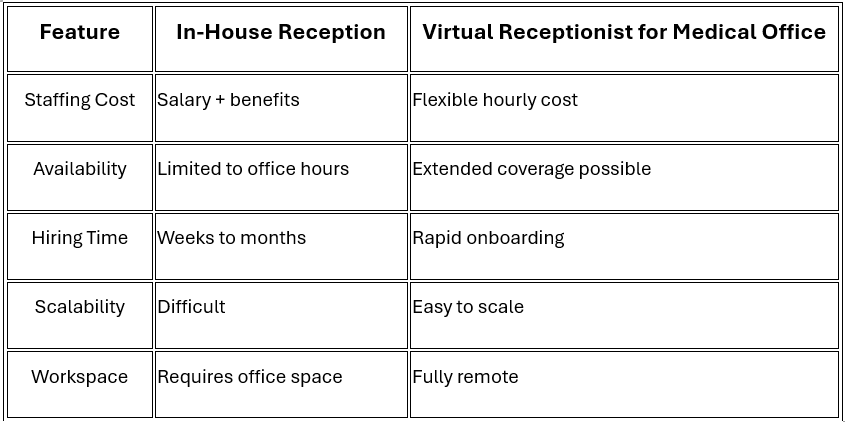
By choosing to outsource reception, clinics can convert fixed staffing costs into flexible operational expenses.
2. Staff Burnout and Workforce Shortages
Healthcare workers often deal with overwhelming administrative workloads.
Reception outsourcing helps distribute tasks across a larger remote team, allowing in-house staff to focus on patients rather than paperwork.
3. Patient Expectations Are Increasing
Modern patients expect:
- Faster response times
- Easy scheduling
- Online communication
- Quick answers to inquiries
A virtual receptionist for medical office operations helps clinics meet these expectations by providing consistent front desk support.
4. Operational Flexibility
Outsourced reception teams can scale easily as clinic demand changes.
For example:
- During busy seasons
- When expanding locations
- When call volumes increase
Reception outsourcing allows clinics to increase administrative capacity without hiring additional in-house staff.
Benefits of Using a Virtual Receptionist for Medical Office Operations
The benefits of reception outsourcing go beyond cost savings.
Reduced Administrative Costs
Outsourcing administrative functions allows healthcare providers to lower operational expenses and avoid the cost of recruiting, training, and maintaining additional staff.
Improved Efficiency
Virtual receptionists can handle multiple communication channels simultaneously—phone calls, emails, and appointment systems, helping clinics operate more efficiently.
Better Patient Experience
Prompt responses to patient calls and appointment requests improve patient satisfaction and trust in the clinic.
Patients value quick communication and streamlined scheduling processes.
24/7 Availability
Some virtual reception services provide extended hours or after-hours support, ensuring that patient inquiries are addressed even outside normal clinic hours.
Scalability for Growing Clinics
Reception outsourcing allows healthcare organizations to expand their administrative capacity without major operational changes.
As patient volume increases, remote teams can grow alongside the clinic.
Virtual Receptionist vs In-House Receptionist
Tasks That Clinics Commonly Outsource
Reception outsourcing often begins with administrative tasks that require time but not physical presence.
These include:
- Appointment scheduling
- Patient intake coordination
- Insurance eligibility verification
- Reminder calls and messages
- Email and portal communication
- Appointment confirmations
Delegating these tasks frees up internal staff to focus on direct patient care.
Is Reception Outsourcing Secure for Healthcare Practices?
Security and patient privacy are major concerns when outsourcing administrative work.
Reputable providers ensure:
- HIPAA compliance
- Secure access to practice management systems
- Encrypted communication channels
- Confidentiality agreements
Virtual reception teams are trained to handle sensitive medical information responsibly.
When Should a Clinic Outsource Reception?
Reception outsourcing works best when clinics experience:
- High call volumes
- Missed patient calls
- Overworked front desk staff
- Rapid practice growth
- Multiple clinic locations
In these situations, outsourcing reception helps restore operational balance.
The Future of Healthcare Administration
Healthcare operations are evolving. Clinics are increasingly adopting hybrid staffing models that combine in-house staff with remote administrative professionals.
This approach allows healthcare providers to:
- Reduce operational costs
- Improve administrative efficiency
- Enhance patient communication
- Support growing patient demand
Outsourcing administrative roles is no longer seen as a short-term solution—it is becoming a long-term strategy for building resilient healthcare practices.
How Savvital Helps Clinics Outsource Reception Efficiently
Savvital supports healthcare providers with trained virtual assistants who manage front desk tasks remotely while integrating seamlessly into clinic workflows.
With Savvital, clinics receive:
- HIPAA-trained virtual receptionists
- Support during US working hours
- Experience with medical scheduling systems
- Flexible and scalable administrative support
Savvital offers cost-effective reception outsourcing solutions starting at just $14 per hour, helping clinics improve efficiency without increasing overhead costs.
Final Thoughts
Healthcare clinics today must balance rising administrative demands with the need to deliver excellent patient care.
Reception outsourcing offers a practical way to achieve this balance.
By integrating a virtual receptionist for medical office operations, clinics can reduce administrative stress, improve communication, and create a more efficient front desk environment.
As healthcare continues to evolve, outsourcing reception will likely become a standard operational strategy for modern medical practices.
Frequently Asked Questions
What tasks can a virtual receptionist for medical office handle?
A virtual receptionist for medical office operations can manage appointment scheduling, patient communication, insurance verification, reminder calls, and administrative documentation. These professionals work remotely but integrate directly with the clinic’s practice management systems.
Is reception outsourcing suitable for small clinics?
Yes. Small clinics often benefit the most from outsourcing reception because it reduces payroll expenses while still maintaining professional patient communication and scheduling support.
Does outsourcing reception affect patient experience?
When implemented correctly, reception outsourcing can improve patient experience by ensuring calls are answered promptly and scheduling is handled efficiently.
Can a virtual receptionist work with medical software?
Most virtual receptionists are trained to work with EHR and practice management systems used by healthcare clinics, enabling seamless integration into daily operations.
How quickly can a clinic start reception outsourcing?
Many providers can onboard a virtual receptionist within a few days to a couple of weeks, depending on workflow complexity and training requirements.
Published on 6 Mar 2026
Author: Noor Ul Ain Liaqat